


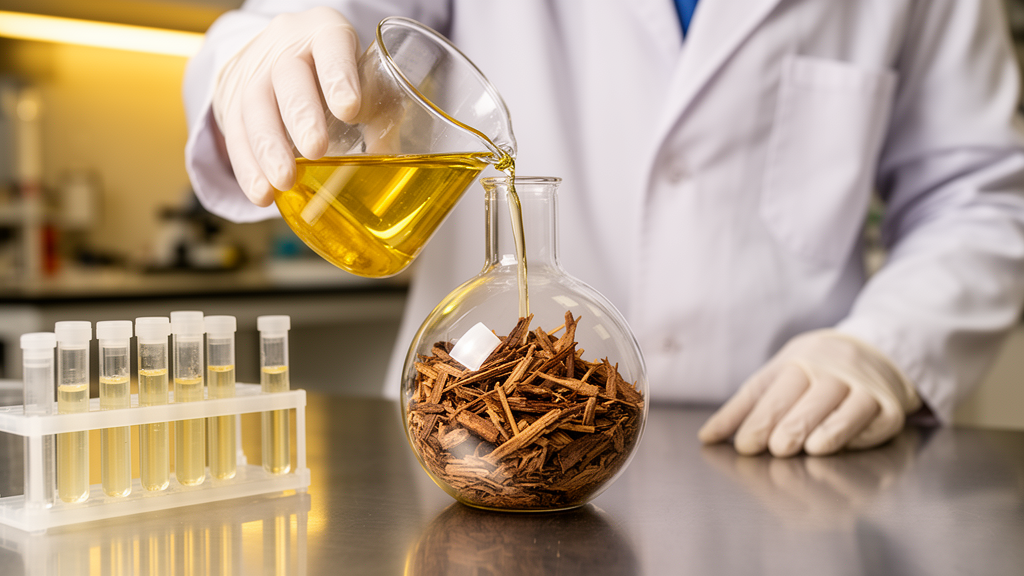
Lignocellulosic biomass—the woody, fibrous skeleton of plants composed of cellulose, hemicellulose, and lignin—is one of the most abundant carbon reservoirs on Earth, yet it remains one of the most stubborn feedstocks for the chemical industry. Its recalcitrance stems from a formidable molecular architecture: cellulose chains are locked together by dense hydrogen-bonding networks that form crystalline microfibrils, while lignin acts as a hydrophobic cement, covalently tethered to carbohydrates through lignin-carbohydrate complexes. Together, these features make plant cell walls resistant to the solvents, enzymes, and catalysts that would otherwise convert them into fuels and chemicals. A new review published in Advanced Composites and Hybrid Materials by Omnia A. A. El-Shamy of the Egyptian Petroleum Research Institute and Ki-Hyun Kim of Hanyang University examines how a class of designer solvents known as task-specific ionic liquids (TSILs) is dismantling this barrier, and what it will take to move the technology from the bench to the biorefinery.
Ionic liquids are salts that remain liquid below 100 degrees Celsius, typically pairing an organic cation such as an imidazolium, pyridinium, or ammonium ion with an anion chosen for its chemical behavior. What distinguishes TSILs from their conventional counterparts is deliberate molecular design: functional groups are grafted onto either ion to confer specific capabilities, whether that means dissolving cellulose, cleaving lignin linkages, or catalyzing dehydration reactions. This tunability is the source of their power. By swapping the anion on 1-butyl-3-methylimidazolium from chloride to acetate, for example, the solvent shifts from a cellulose-dissolving agent to one optimized for different fractionation outcomes. The review frames this structure-function relationship as the central design principle: the identity of the cation and anion, the length of alkyl chains, and the presence of acidic or coordinating groups collectively determine how a given TSIL attacks the biomass matrix.
The first arena where TSILs prove decisive is advanced fractionation. Pretreatment aims to separate the three biomass components so each can be valorized independently, and TSILs achieve this with striking selectivity. Certain ionic liquids, notably those bearing acetate or chloride anions such as 1-ethyl-3-methylimidazolium acetate or 1-butyl-3-methylimidazolium chloride, disrupt the hydrogen-bonding network of cellulose directly, swelling and dissolving the polymer without derivatization. Others, particularly Brønsted acidic ionic liquids such as alkylimidazolium hydrogen sulfates, target the lignin-carbohydrate complexes and β-O-4 ether linkages that hold lignin to the carbohydrate matrix, liberating a lignin stream that can itself be upgraded into aromatic chemicals rather than burned as low-value fuel. The review is candid about the trade-offs: high technical efficiency in cellulose dissolution and lignin isolation often comes at the cost of increased separation complexity, since recovering the solvent and isolating the dissolved fractions demand energy-intensive downstream operations.
The second arena is integrated catalytic conversion, where TSILs act simultaneously as solvent and catalyst—a dual role that eliminates the need for separate homogeneous catalysts and the corrosive mineral acids they often entail. Here the numbers are remarkable. Depending on the TSIL class and the feedstock, the review reports yields approaching 90 percent for furfural, roughly 91 percent for 5-hydroxymethylfurfural (5-HMF), and around 18 weight percent for levulinic acid. These are not obscure laboratory curiosities; furfural and 5-HMF are recognized platform chemicals from which plastics, pharmaceuticals, and fuels can be synthesized, while levulinic acid serves as a precursor to levulinic esters used in fuels and additives. Brønsted-Lewis acidic ionic liquids and dicationic ionic liquids feature prominently in this context, with their paired acid sites enabling cascade reactions: hemicellulose is hydrolyzed to sugars, sugars are dehydrated to furans, and furans are further converted to levulinic acid derivatives, all within a single reaction medium.
The third arena—system sustainability—is where the review makes its most consequential argument. For TSIL-based biorefineries to be economically viable, the solvents must be recovered and reused at high efficiency over many cycles. The review documents recycling protocols achieving efficiencies exceeding 95 percent over multiple cycles, including membrane-assisted separation and electrochemical methods that reduce operating costs relative to conventional distillation-based recovery. This is not a trivial achievement. Ionic liquids are typically more expensive than commodity solvents, and their viscosity, thermal stability, and negligible vapor pressure—properties that make them attractive in the reactor—complicate their recovery. Membrane-assisted approaches exploit size exclusion and selective permeation to separate TSILs from sugars and degradation products, while electrochemical regeneration exploits the ionic character of the solvents to drive their recovery under mild conditions. The review positions these innovations as the linchpin of techno-economic feasibility, noting that solvent recyclability directly determines the minimum selling price of the resulting products.
Beyond these three pillars, the review identifies frontiers that could accelerate rational TSIL engineering. Computer-aided ionic liquid design (CAILD) applies computational screening and molecular simulation to predict, before any synthesis, which cation-anion combinations will deliver the desired performance for a given feedstock and reaction. This approach promises to replace the trial-and-error synthesis of ionic liquids with predictive design, dramatically reducing the experimental burden. Double-salt task-specific ionic liquids (DS-TSILs) represent another emerging class, in which multiple ionic components are combined to achieve synergistic effects that no single salt can match. Integrated molecular-process design (IMPD) frameworks extend this logic further, coupling molecular-level solvent properties with process-level performance metrics so that solvent selection and process optimization proceed in tandem rather than sequentially.
The review also situates TSILs within the broader landscape of green chemistry tools for biomass valorization. Deep eutectic solvents (DESs), which share some characteristics with ionic liquids but are typically formed from hydrogen-bond donors and acceptors such as choline chloride and organic acids, appear as complementary or competing options. Amino-acid-based ionic liquids, such as those pairing cholinium with alanine, glycine, lysine, or threonine in combination with urea, illustrate the diversity of bio-derived solvent systems now under investigation. The review’s comparative framing suggests that no single solvent class will dominate; rather, the optimal choice depends on the feedstock, the target product, and the constraints of the process in question.
What emerges from this synthesis is a picture of TSILs as more than just another solvent innovation. They are presented as enabling technologies for a circular bioeconomy, capable of transforming a recalcitrant waste stream into a versatile chemical resource. The review’s conclusion is measured but forward-looking: continued advances in solvent recyclability, energy efficiency, and scale-up will be decisive in translating TSIL-based biorefineries from laboratory innovation to industrial implementation. The authors argue that linking structure-function relationships to process performance—understanding precisely how molecular design choices ripple through to yields, separations, and costs—is the key to overcoming both the technical and techno-economic barriers that have historically confined ionic liquids to academic studies.
The stakes are considerable. Lignocellulosic biomass is generated in enormous quantities as agricultural residue, forestry waste, and municipal organic refuse, and its valorization could displace fossil carbon in the production of fuels, plastics, and specialty chemicals. If TSIL-based processes can be scaled reliably, they could unlock a chemical industry built on renewable carbon, with solvents that are recycled at over 95 percent efficiency and catalysts that are built into the solvent itself. The review by El-Shamy and Kim provides a comprehensive technical foundation for that ambition, cataloguing the molecular design principles, the catalytic achievements, and the sustainability metrics that will determine whether task-specific ionic liquids fulfill their promise as the workhorses of a sustainable circular economy.
Subject of Research: The role of task-specific ionic liquids in lignocellulosic biomass pretreatment and catalytic valorization
Article Title: The role of task-specific ionic liquids in lignocellulosic biomass pretreatment and catalytic valorization
Article References: El-Shamy, O. A. A., & Kim, K.-H. (2026). The role of task-specific ionic liquids in lignocellulosic biomass pretreatment and catalytic valorization. Advanced Composites and Hybrid Materials. https://doi.org/10.1007/s42114-026-02126-6
Image Credits: AI Generated
DOI: 10.1007/s42114-026-02126-6
Keywords: role, task-specific, ionic, liquids, lignocellulosic, biomass, pretreatment, catalytic, valorization, scientific research
Cite Scienmag News
Denise Maddox. (October 17, 2026). Task-Specific Ionic Liquids Turn Stubborn Plant Waste Into Platform Chemicals. Scienmag. https://scienmag.com/task-specific-ionic-liquids-turn-stubborn-plant-waste-into-platform-chemicals/
Denise Maddox. "Task-Specific Ionic Liquids Turn Stubborn Plant Waste Into Platform Chemicals." Scienmag, 17 October 2026, https://scienmag.com/task-specific-ionic-liquids-turn-stubborn-plant-waste-into-platform-chemicals/. Accessed 17 October 2026.
Denise Maddox. "Task-Specific Ionic Liquids Turn Stubborn Plant Waste Into Platform Chemicals." Scienmag. October 17, 2026. https://scienmag.com/task-specific-ionic-liquids-turn-stubborn-plant-waste-into-platform-chemicals/


