


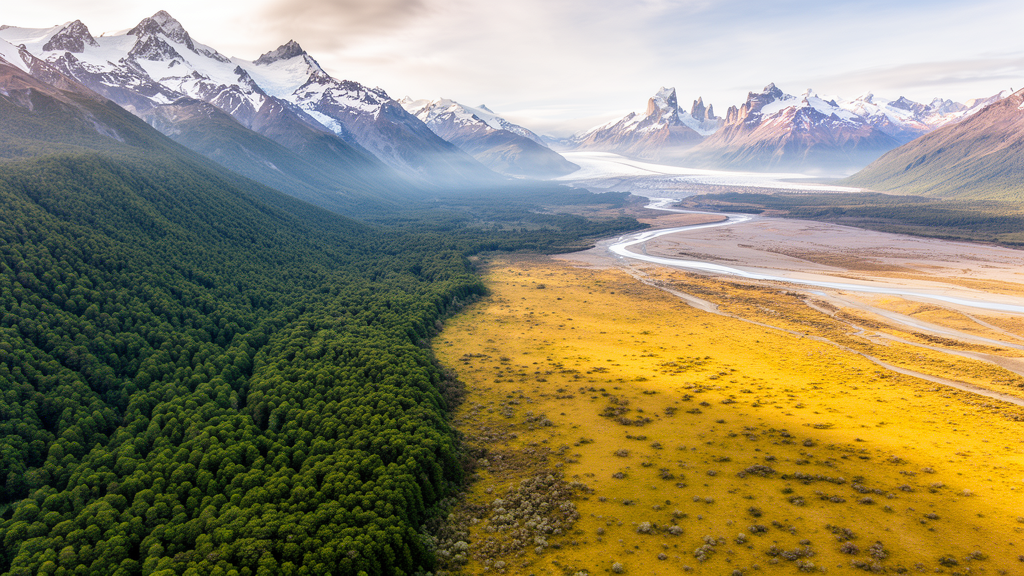
Deep in the Andes of northern Patagonia, where the rain shadow of the mountains turns lush evergreen forest into dry conifer woodland within a few dozen kilometres, an international team of ecologists has produced one of the most systematic portraits yet of how plant life is arranged across this dramatic landscape. The study, published in the journal Vegetation Classification and Survey, surveyed 141 forest plots along two steep environmental gradients in the Rio Puelo watershed of Argentina and used modern numerical methods to identify six distinct plant communities. The findings not only map the region’s vegetation with unprecedented rigor but also expose long-standing biases in the expert-based classification systems that have shaped how scientists understand Patagonian forests for more than sixty years.
The research matters because vegetation classification is far more than an academic exercise. Consistent, reproducible categories of plant communities allow conservation planners to anticipate how ecosystems will respond to climate change, disturbance, and land use. They also enable species to serve as indicators of soil properties, moisture conditions, and bioclimatic zones. Yet in northern Patagonia, the classification of forests has been contested since the pioneering work of Oberdorfer in 1960, who divided the region’s vegetation into two broad classes: evergreen montane forests and deciduous subandean forests. Later researchers, particularly Eskuche in Argentina and Pollmann in Chile, proposed conflicting reclassifications, and the resulting confusion has persisted for decades.
The new study, led by researchers from the Universities of Göttingen, Bozen-Bolzano, and the Andean Patagonian Forest Research and Extension Centre (CIEFAP), adopted a fundamentally different approach. Rather than relying on expert judgment alone, the team combined purposive and stratified systematic sampling along precipitation and elevation gradients, then applied hierarchical clustering, Indicator Species Analysis, and both constrained and unconstrained ordination analyses to identify plant community types and their environmental drivers. The sampling design captured the full range of moisture conditions from the wet Valdivian rainforest edge in the west to the dry sub-Mediterranean conifer forests near the steppe boundary in the east, along with elevation belts from 500 to 1,600 metres above sea level.
The results revealed six ecologically meaningful plant communities, each with distinct species composition and environmental preferences. In the wettest western areas, broadleaved montane forests dominated by Nothofagus dombeyi harbour rainforest indicator species such as Drimys andina, Desfontainia spinosa, and Saxegothaea conspicua. Transitional mixed montane forests, characterized by Berberis darwinii and Azara microphylla, occupy intermediate moisture conditions. Drier coniferous montane forests, dominated by Austrocedrus chilensis, display the highest species richness and evenness in the study area but also the highest proportion of non-native species. At higher elevations, two subandean forest types dominated by Nothofagus pumilio are separated by moisture: a humid woody type near the treeline with cold-tolerant species such as Escallonia alpina and Ribes densiflorum, and a drier herbaceous type with species such as Leucheria glacialis and Acaena ovalifolia. Finally, shrublands dominated by resprouting Nothofagus antarctica occupy disturbed or exposed sites.
The constrained ordination analysis, a distance-based redundancy analysis, revealed that elevation had the strongest effect on species composition, followed by annual precipitation, stand age, basal area, browsing intensity, soil pH, and the Heat Load Index. Together, these variables explained 26.3 percent of the variation in community composition. The finding that elevation outweighs precipitation reflects the crucial role of temperature in structuring vegetation, a well-established principle in ecology. However, the study also found that precipitation alone does not fully capture moisture availability, which is influenced by atmospheric saturation deficit, soil water retention, and topography.
Perhaps the most striking results concern the influence of human land use. Browsing intensity, predominantly from cattle grazing, was significantly associated with species composition and correlated strongly with logging activity. Communities experiencing high browsing, particularly the coniferous montane forests, harboured large numbers of non-native pasture species such as Holcus lanatus, Rumex acetosella, and Dactylis glomerata. The study found that grazing reduces woody vegetation, encourages herbaceous plants, and promotes vegetation homogenization. This presents a concerning future scenario, as previous research in Patagonia has shown that plant traits allowing persistence under herbivore pressure also increase flammability, creating a synergistic relationship between grazing and fire disturbance.
Soil chemistry emerged as another key driver that has been overlooked in past classifications. The study found significant differences in soil pH and carbon-to-nitrogen ratios across the six communities. pH values increased from wetter to drier conditions, reflecting enhanced leaching of basic cations in humid environments and more frequent fires in dry areas. Carbon-to-nitrogen ratios were higher in moister and colder areas, corresponding to slower nitrogen turnover in cold environments and the production of more recalcitrant litter by humid-habitat species. The positive relationship between soil pH and species richness observed in the study aligns with the species pool hypothesis, which proposes that regional diversity is shaped by the soil conditions in which species originally evolved.
When the researchers compared their numerically derived communities with the traditional expert-based classifications, they found a better match in humid western areas than in drier eastern ones. This discrepancy, the authors argue, reflects a geographic bias in the historical literature: most early surveys were conducted in Chilean forests west of the Andes, where climate is the predominant structuring force, while Argentinian forests are shaped by both climate and fire disturbance. The truncated moisture gradient created by administrative borders has led to classification systems that work reasonably well for wet forests but poorly for the sub-Mediterranean areas of Argentina. The study’s findings call for more comprehensive sampling across the full precipitation gradient and a broader classification framework that incorporates this data.
The identification of diagnostic and indicator species for each community offers practical tools for future monitoring and conservation. These species, highly adapted to specific environmental conditions, can be used to track ecological change and inform restoration efforts. As temperatures rise and drought risks increase, the study’s evidence-based groundwork for management and monitoring becomes increasingly urgent. The strong link between climate factors and vegetation patterns, combined with the demonstrated influence of land use, suggests that preserving optimal forest density ranges and controlling grazing pressure will be critical for maintaining the phytodiversity of these unique Andean forests in the decades ahead.
Subject of Research: Ecology, vegetation science, Patagonian forests, biogeography
Article Title: Floristic patterns in the Andes of northern Patagonia’s forests, Argentina: towards integrating ecological responses with expert-based and unsupervised classification methods
Article References: Joelson, N. Z., Simon, A., von Lampe, F., Loguercio, G. Á., Zerbe, S., Leuschner, C., & Walentowski, H. (2025). Floristic patterns in the Andes of northern Patagonia’s forests, Argentina: towards integrating ecological responses with expert-based and unsupervised classification methods. Vegetation Classification and Survey, 6, 37-56. https://doi.org/10.3897/vcs.134621
Image Credits: AI Generated
DOI: 10.3897/VCS.134621
Keywords: Patagonia, Andes, vegetation classification, plant communities, Nothofagus, elevation gradient, rain shadow, grazing, soil chemistry, indicator species, Argentina, forest ecology
Cite Scienmag News
Bethany Barker. (October 17, 2026). Counting Patagonia’s Forests: New Map of Six Plant Communities Reveals Climate and Grazing Divide the Andes. Scienmag. https://scienmag.com/counting-patagonias-forests-new-map-of-six-plant-communities-reveals-climate-and-grazing-divide-the-andes/
Bethany Barker. "Counting Patagonia’s Forests: New Map of Six Plant Communities Reveals Climate and Grazing Divide the Andes." Scienmag, 17 October 2026, https://scienmag.com/counting-patagonias-forests-new-map-of-six-plant-communities-reveals-climate-and-grazing-divide-the-andes/. Accessed 17 October 2026.
Bethany Barker. "Counting Patagonia’s Forests: New Map of Six Plant Communities Reveals Climate and Grazing Divide the Andes." Scienmag. October 17, 2026. https://scienmag.com/counting-patagonias-forests-new-map-of-six-plant-communities-reveals-climate-and-grazing-divide-the-andes/


