


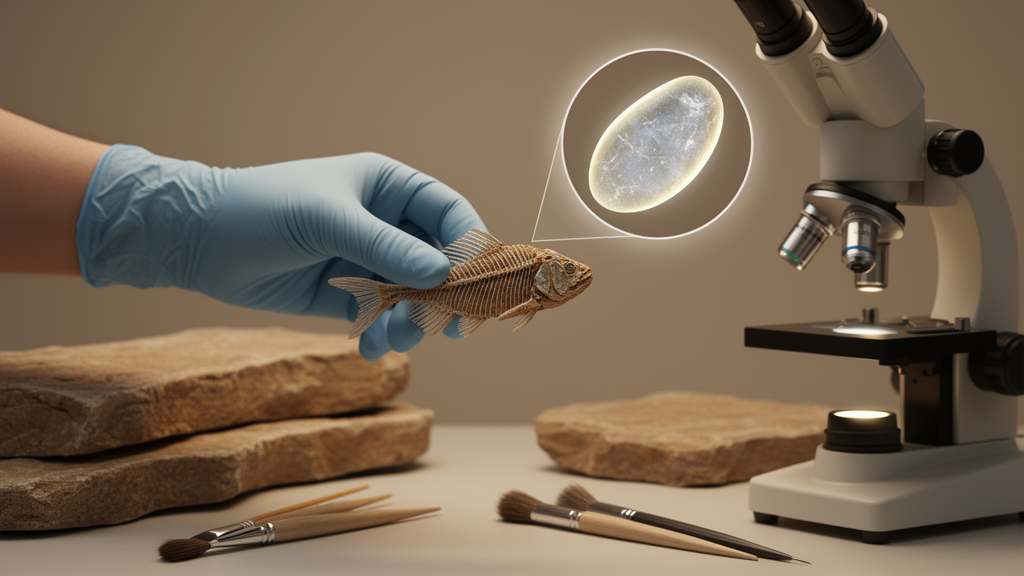
Deep in a clay pit near the Franconian village of Buttenheim, southeast of Bamberg in northern Bavaria, paleontologists have pulled hundreds of tiny fossilized ear stones from 183-million-year-old marine clay. These otoliths, the calcium carbonate structures that bony fishes use for balance and hearing, represent one of the earliest teleost otolith assemblages ever recovered. The new study, published in Zitteliana, describes 351 otoliths from the late Pliensbachian stage of the Early Jurassic, many so well preserved that their sizes indicate they came from adult, morphologically mature fishes. The assemblage contains seven species: four stem teleosts of the genus Leptolepis and three belonging to the enigmatic otolith-based genus Archaeotolithus, whose systematic position remains unresolved. Three of these species are entirely new to science.
The new species are Leptolepis buttenheimensis, Leptolepis steberae and Archaeotolithus doppelsteini. Leptolepis buttenheimensis is recognized by its slender, thin otolith reaching 3.25 millimeters in length, with an extremely long rostrum that spans nearly half the otolith length and a shallow, fading ventral margin of the ostium. Leptolepis steberae, named after collector Birgit Steber of Leibersdorf, is nearly round and compressed, with an otolith length to height ratio of only 1.1 to 1.25 and a short, blunt rostrum measuring just 12 to 25 percent of otolith length. Archaeotolithus doppelsteini, named for Berlin collector Bernd Doppelstein, is a very high-bodied, triangular otolith with a deeply curved ventral rim and a complex pattern of opposing subvertical furrows on its flat outer face. The species names honor the amateur collectors whose patient work in the Buttenheim clay pit made the discoveries possible.
The Buttenheim material comes from the Amaltheenton Formation, a roughly 35-meter-thick sequence of homogeneous grey claystone exposed in the Liapor Company clay pit at Altendorf. The section is punctuated by four thin reworking horizons that mark brief phases of high water energy during low-stand sea levels, when currents winnowed fine grains and enriched reworked calcareous concretions. The most productive of these, the echinid-pectinid-bed, yielded 333 of the 351 studied otoliths and lies about two meters below the Bollernbank, a horizon crowded with belemnite rostra. The stratigraphy is calibrated by ammonites, including large Amaltheus margaritatus specimens up to 60 centimeters across, and the boundary between the Margaritatus and Spinatum ammonite zones is marked by a distinctive pyrite bed. Some of the reworked nodules, known as hiatus concretions, continued to aggregate during the onset of the bituminous shales of the Toarcian Oceanic Anoxic Event following a sedimentation gap of about 150,000 years.
A remarkable diagenetic twist helped preserve these delicate fossils. The otoliths are neomorphed in calcite from their presumed original aragonite composition. Aragonite, the more soluble polymorph of calcium carbonate, normally dissolves over long stretches of geological time, which is one reason Jurassic otoliths are so rarely found. The conversion to calcite made the Buttenheim otoliths more stable and resistant to mechanical recovery, even those with thin and delicate features such as the rostrum of Leptolepis buttenheimensis. Healed fractures can sometimes be observed. The downside is that calcite neoformation occasionally produced surface incrustations and rugosity that partly obliterate diagnostic morphological features, a problem particularly evident in Archaeotolithus trigonalis, whose inner face almost always shows some kind of incrustation.
The study also revisits a forgotten trove of type material. Werner Schröder described 18 nominal otolith species from Franconian Jurassic outcrops in 1956, but his work was rarely cited because his documentation and descriptions were so difficult to interpret. Nolf, a leading otolith authority, considered Weiler’s Mesozoic otolith works the most problematic part of the whole otolith literature, and Schröder’s remained unreviewed because the type material had not been recovered. Now 86 otoliths from Schröder’s collection have been located at the Geological Institute of the University of Erlangen, including 49 teleost otoliths with 14 holotypes among 16 of his nominal species. Schröder had marked the labels of his holotypes in red, and comparison of the specimens with his drawings allowed reliable correlation despite mismatched registration numbers. The review accepts only a few of his species as valid, collapsing many into synonymies of Leptolepis normandica and related forms.
Leptolepis normandica emerges as the most common otolith-based species of the Early and early Middle Jurassic, known from Pliensbachian to Aalenian strata in Belgium, Luxemburg, England and Germany. It is also the only early Jurassic otolith-based taxon that can be related to a skeletal record, thanks to otoliths found in situ in skeletons described by Delsate in 1997. The species exhibits considerable variability in the shape of the postdorsal rim, the width of the cauda and rim ornamentation, variability that likely led Weiler and Schröder to establish many species that can no longer be maintained. The largest Buttenheim specimen measures 2.85 millimeters, and the review suppresses the name Leptolepis ornatus, previously used for similar material, in favor of Leptolepis curvisulcatus, whose holotype is better preserved than Weiler’s lost type material.
Three distinct otolith morphological patterns characterize the entire early Jurassic: the Leptolepis-pattern, the Xenoleptolepis-pattern and the Archaeotolithus-pattern. Two of these occur in Franconia. The Leptolepis-pattern features a straight sulcus with a widened ostium poorly defined against the cauda, a massive long rostrum and a minute antirostrum. The Archaeotolithus-pattern is strikingly different, with a triangular otolith shape and an eccentrically positioned, dorsally shifted sulcus with vague margins, open anteriorly and reaching close to the posterior tip. The relationships of Archaeotolithus are completely obscure. It is not entirely certain whether these otoliths are sagittae or lapilli, and their peculiar morphology does not relate to any known teleost. The morphotype best resembles the otoliths of extant gars, suggesting the most likely candidates for its affinities lie in the Ginglymodi or in very basal teleosts below the Leptolepidiformes level. Vaguely similar otoliths from Late Jurassic freshwater sediments of eastern Australia may belong to pholidophoriforms rather than chondrosteans.
The big evolutionary story emerges when the Franconian assemblages are combined with previously published material. Early Jurassic teleost otoliths are represented by only a few common, long-ranging species, with a maximum of five Leptolepis species occurring simultaneously. Then comes a dramatic change. Otolith finds in the Aalenian and Bajocian are sparse, but in the Bathonian the number of species with Leptolepis-type otolith morphology surges to 11 species occurring more or less simultaneously, bringing variations that have been attributed to different extinct otolith-based genera including stem elopiforms and stem osteoglossiforms. The question was whether this burst represents a real evolutionary signal or a Lagerstätten effect, an artifact of exceptional preservation. The suspicion was fueled by Stinton’s Bathonian assemblage of 368 exceptionally well-preserved otoliths from two English localities. But the comparison with Buttenheim settles it: about as many otoliths, 351, were recovered from the late Pliensbachian there, also of good preservation quality, yet they represent only three Leptolepis and three Archaeotolithus species. The Bathonian increase in species must therefore reflect a genuine phylogenetic signal.
The timing of the event can now be bracketed. The largest assemblage from the intervening interval, Schröder’s latest Toarcian to early Aalenian material of 55 specimens, seems to represent only three teleost species. The burst of diversity therefore happened between the early Aalenian and the late Bathonian, over roughly seven million years, a window into early teleost evolution from an otolith perspective. Intriguingly, the disparity in morphological diversity of early teleost otoliths trails their taxonomic diversity throughout the Early and Middle Jurassic, spreading slower than the species count and remaining far below the disparity seen in Late Jurassic fish skeletons. The key to unlocking more of this story lies in finding otoliths in situ, the only reliable way to tie otolith morphologies to the skeleton-based record. So far only otoliths of Leptolepis and the Australian Cavenderichthys have been found in situ in any Jurassic fishes. The researchers hope colleagues examining Jurassic fish skeletons will stay alert to the prospect of encountering otoliths in place, so that more of these enigmatic ear stones can finally be connected to the fishes that carried them through ancient seas.
Subject of Research: Early teleost otolith morphogenesis observed in the Jurassic of Franconia, Bavaria, southern Germany
Article Title: Early teleost otolith morphogenesis observed in the Jurassic of Franconia, Bavaria, southern Germany
Article References: Schwarzhans, W., & Keupp, H. (2022). Early teleost otolith morphogenesis observed in the Jurassic of Franconia, Bavaria, southern Germany. Zitteliana, 96, 51-67. https://doi.org/10.3897/zitteliana.96.81737
Image Credits: AI Generated
DOI: 10.3897/zitteliana.96.81737
Keywords: Early, teleost, otolith, morphogenesis, observed, Jurassic, Franconia, Bavaria, southern, Germany, scientific research
Cite Scienmag News
Gavin Prescott. (October 17, 2026). Jurassic Fish Ear Stones Reveal Sudden Burst in Teleost Evolution. Scienmag. https://scienmag.com/jurassic-fish-ear-stones-reveal-sudden-burst-in-teleost-evolution/
Gavin Prescott. "Jurassic Fish Ear Stones Reveal Sudden Burst in Teleost Evolution." Scienmag, 17 October 2026, https://scienmag.com/jurassic-fish-ear-stones-reveal-sudden-burst-in-teleost-evolution/. Accessed 17 October 2026.
Gavin Prescott. "Jurassic Fish Ear Stones Reveal Sudden Burst in Teleost Evolution." Scienmag. October 17, 2026. https://scienmag.com/jurassic-fish-ear-stones-reveal-sudden-burst-in-teleost-evolution/


