


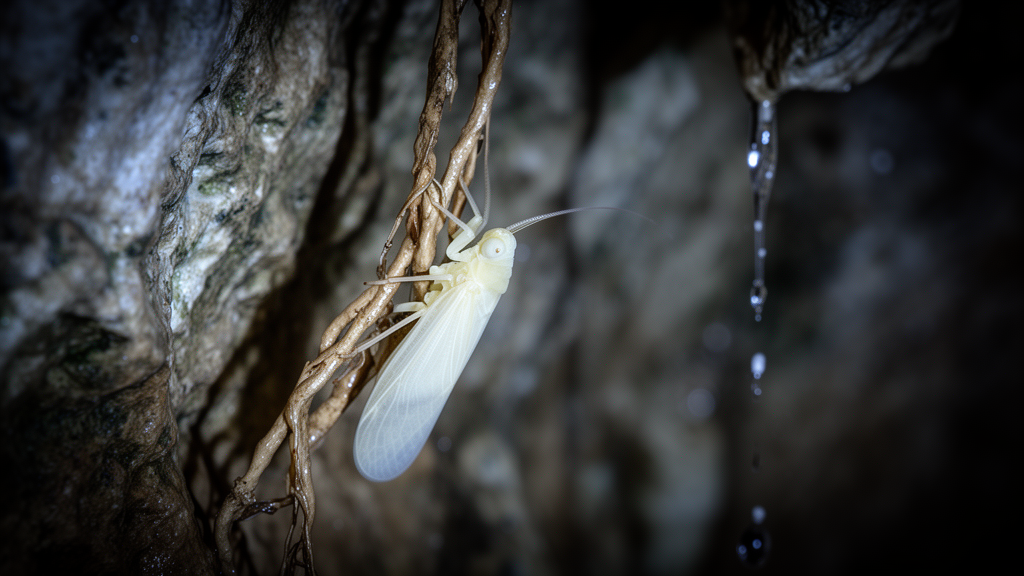
Deep inside a limestone cave in southwestern Bahia, Brazil, researchers have found an insect so specialized for life underground that it has no eyes, no wings worth the name, and a body barely two millimetres long. The tiny creature, formally described as Spelaeodelphax nexus gen. et sp. nov., is a planthopper — a relative of the sap-sucking insects that swarm across rice paddies and grasslands worldwide. Yet nothing about it resembles its sun-loving cousins. Writing in the journal Subterranean Biology, the team reports that this is only the fourth subterranean delphacid ever recorded on Earth, the second confirmed cave-adapted species in the family, and the first such discovery anywhere in the Americas.
The specimens were collected during expeditions by the Centro de Estudos de Biologia Subterrânea (CEBS) in Lapa dos Peixes I, a 9,320-metre limestone cave in the municipality of Carinhanha. Using moistened brushes and the direct intuitive search method, researchers gathered adults and nymphs from the cave floor and preserved them in ethanol. Back in the laboratory, the series was examined under a Zeiss Axio Zoom V16 stereomicroscope, and selected individuals were prepared for scanning electron microscopy at Humboldt-Universität zu Berlin using a hexamethyldisilazane drying protocol and gold coating. Male genitalia were carefully dissected and photographed in gel to resolve the fine structures that separate planthopper genera.
What emerged from that analysis is an animal so modified that it required an entirely new genus. Adults measure just 1.6 to 2.0 millimetres in body length, with females slightly larger than males. Compound eyes and ocelli are totally absent. The forewings, or tegmina, are reduced to short coriaceous pads reaching only the second abdominal segment, with venation almost entirely erased; the hind wings survive as narrow elongate rudiments. The colouration is a deep, uniform yellow across head, thorax and abdomen — the classic pallor of a troglobiont that has abandoned the surface world. There is no sexual dimorphism in the degree of these cave adaptations, and the insect is certainly flightless.
The head architecture alone sets Spelaeodelphax apart from every other delphacid genus. The vertex is roughly four times wider than it is long, with carinae so faint they are nearly invisible. The frons is wider than high, smooth and shallowly convex, without a recognizable median carina. The antennae carry a small but distinct Bourgoin’s organ, a crown of finger-shaped processes whose function remains enigmatic. Perhaps most curious is a short, densely scale-sculptured nail-like structure between the trochanters and femora — a feature the authors liken to the skin of a pangolin, present in adult planthoppers but rarely described. Scanning electron micrographs reveal it in extraordinary detail, alongside the intricate mouthparts: mandibular stylets split at the tips, maxillary stylets armed with a row of four well-spaced teeth, and a rostrum long enough to reach well past the hind trochanters.
The male genitalia provide the decisive taxonomic evidence. The pygofer is rounded in caudal view with a weakly sclerotized diaphragm; the gonostyli are very short and pincer-shaped in their distal third; and the aedeagus is a tubular, asymmetrical structure bearing four distinct spines — one long and rigid near the base, two compressed triangular processes at midlength, and a slender, apparently mobile spine arising ventrally near the apex. A tubular flagellum curves over the dorsal side. This configuration matches nothing described from the Neotropical fauna, which comprises roughly 67 genera and 304 species. The authors place the genus tentatively in the tribe Asiracini, while acknowledging that its tribal position remains problematic — the genus is, in their words, isolated.
Worldwide, subterranean planthoppers are extraordinarily rare. More than 70 cavernicolous Fulgoromorpha species are known across five families, but the vast majority belong to the Cixiidae, with over 40 species, and the Meenoplidae, with 15. Delphacidae — the second largest planthopper family — had yielded only three subterranean representatives, all in the genus Notuchus from New Caledonia in the Pacific. Spelaeodelphax nexus thus represents a second independent origin of cave life within the family, on the opposite side of the planet. In Brazil, it is the seventh troglobiont planthopper species; previous Brazilian cave-dwelling species belong to the Cixiidae and Kinnaridae, and the only other South American troglobiont is a cixiid from Argentina.
The species epithet carries an unexpected cultural echo. The authors derived “nexus” from the 1994 film Star Trek: Generations, in which the Nexus is a place of bliss connecting different points in space-time — a fitting metaphor, they suggest, for a lineage that links distinct evolutionary realities. The genus name combines the Greek word for cave, spelaion, with Delphax. It is a small gesture, but one that captures the sense of wonder surrounding a creature that has likely been evolving in darkness for millennia, unseen by human eyes until a team of speleobiologists knelt on a cave floor and brushed it from a tangle of roots.
That habitat is as remarkable as the insect itself. Spelaeodelphax nexus is known only from a single permanently humid conduit within the Água Clara Cave System, a vast linear complex of four caves totalling over 25 kilometres of passage in the Serra do Ramalho karst. The system is recognized as the richest tropical subterranean environment on Earth in terms of obligate cave fauna, harbouring at least 52 troglobitic and stygobitic species. The planthopper was found exclusively in association with root mats that penetrate the cave through fissures in the rock, descending from a small upper conduit connected to the main passage where a permanent water body sustains the humidity. Every individual — adult or nymph — was observed on floor-level roots or in their immediate vicinity, occasionally sheltered beneath rocks. Root tufts hanging from walls and ceilings yielded none. The host plant remains unidentified, but the dependence on these roots as a food resource is clear, and the presence of both adults and nymphs across successive surveys suggests continuous reproduction throughout the year.
The nymphs, described here for the first time in such detail for a cave delphacid, reveal further layers of adaptation. Third, fourth and fifth instars were examined by scanning electron microscopy, showing whitish, dorsoventrally flattened bodies equipped with precisely arranged sensory pits — 30 on the head alone in the fifth instar — each bearing a knob-tipped seta exposed horizontally over a cup-like socket. The post-trochanters carry a narrow row of ten parallel ribs forming a cog-wheel structure, and the arolia of the pretarsi are enlarged into ribbed pillows that likely aid adhesion on damp substrates. These immature stages, collected alongside adults, confirm that the entire life cycle unfolds underground, consistent with the authors’ classification of the species as an obligate cavernicole under the criteria of Sket and of Howarth and Moldovan.
Whether Spelaeodelphax nexus is an ancient relict or a relatively recent colonizer of the underground remains an open question. The genus is isolated and the species has an extremely limited distribution — observations that fit the climatic relict hypothesis, in which cave species are survivors of lineages once widespread on the surface. Yet the authors caution against premature conclusions. When the troglobiont genera Ferricixius and Iuiuia were described from Brazilian caves, they too were assumed to be relicts; epigean relatives were subsequently discovered, lending weight to the alternative adaptive shift hypothesis, in which surface populations gradually move into caves to exploit novel food resources. Given how poorly the Neotropical planthopper fauna has been sampled, close surface relatives of Spelaeodelphax may still be extant, awaiting discovery.
What is not speculative is the threat. The landscape surrounding the Água Clara Cave System is under pressure from widespread deforestation driven by agriculture and charcoal production, with ovens burning plant material removed from the cave’s surroundings. These activities reduce organic inputs, increase erosion and accelerate sediment deposition within caves, homogenizing substrates and degrading the microhabitats on which highly specialized subterranean fauna depend. The authors estimate the cave conduit lies at least 50 metres below the surface, but the exact hydrological connections remain unmapped. They strongly recommend the creation of a legally protected conservation unit encompassing not only the subterranean network but also the surrounding karst landscape and its contributing catchments. With the discovery of Spelaeodelphax nexus, Brazil’s tally of troglobiont planthoppers rises from six to seven — a figure that has grown from zero in just over a decade, and one that underscores both the extraordinary biological wealth hidden beneath Brazilian karst and the urgency of protecting it before it is lost.
Subject of Research: Discovery and description of a new troglobitic planthopper genus and species from a Brazilian cave
Article Title: First record of a troglobitic Delphacidae in the Neotropics: Spelaeodelphax nexus Santos & Asche gen. nov. et sp. nov. from Brazil ( Hemiptera , Fulgoromorpha )
Article References: Santos, J. C. C. V., Asche, M., Hoch, H., & Ferreira, R. L. (2026). First record of a troglobitic Delphacidae in the Neotropics: Spelaeodelphax nexus Santos & Asche gen. nov. et sp. nov. from Brazil (Hemiptera, Fulgoromorpha). Subterranean Biology, 55, 1-25. https://doi.org/10.3897/subtbiol.55.175661
Image Credits: AI Generated
DOI: 10.3897/subtbiol.55.175661
Keywords: Spelaeodelphax nexus, Delphacidae, troglobiont, cave biology, Brazil, Bahia, Subterranean Biology, planthopper, karst conservation, entomology, Água Clara Cave System, cave adaptation
Cite Scienmag News
Gavin Prescott. (October 17, 2026). Blind, Wingless and Living on Cave Roots: Brazil’s New Planthopper Is the First of Its Kind in the Americas. Scienmag. https://scienmag.com/blind-wingless-and-living-on-cave-roots-brazils-new-planthopper-is-the-first-of-its-kind-in-the-americas/
Gavin Prescott. "Blind, Wingless and Living on Cave Roots: Brazil’s New Planthopper Is the First of Its Kind in the Americas." Scienmag, 17 October 2026, https://scienmag.com/blind-wingless-and-living-on-cave-roots-brazils-new-planthopper-is-the-first-of-its-kind-in-the-americas/. Accessed 17 October 2026.
Gavin Prescott. "Blind, Wingless and Living on Cave Roots: Brazil’s New Planthopper Is the First of Its Kind in the Americas." Scienmag. October 17, 2026. https://scienmag.com/blind-wingless-and-living-on-cave-roots-brazils-new-planthopper-is-the-first-of-its-kind-in-the-americas/


