


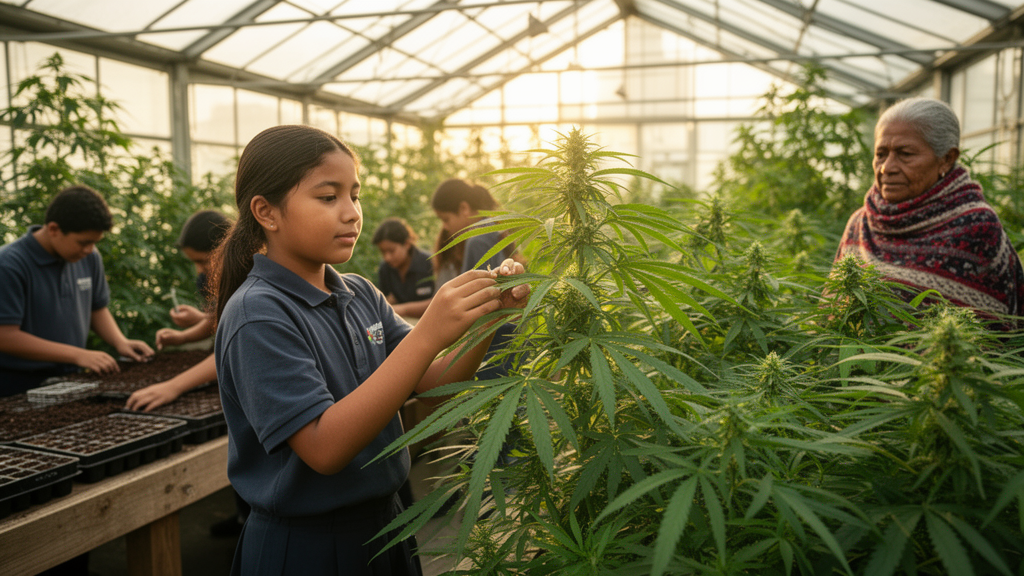
A new conceptual framework published in Frontiers in Education argues that science, technology, engineering, and mathematics education for Indigenous communities should be rooted in land, culture, voice, and economics rather than in culturally neutral curricula that treat knowledge as detached from place. The framework, developed by researchers at Oregon State University, uses hemp education as an applied learning context and represents its structure through a flower metaphor in which every element, from roots to petals, carries pedagogical meaning. The work arrives at a moment when Tribal Nations across North America are exploring bio-based economies, and when educators increasingly recognize that conventional STEM models often fail the very communities they claim to serve.
The lead author, Quintana M. Clark of Oregon State University’s Department of Educational Practice and Research and Department of Agricultural Education, Communication, and Sciences, worked with Olivia Perez and Jennifer L. Freeman to synthesize scholarship spanning Indigenous epistemologies, land-based pedagogy, culturally grounded STEM education, and community-centered economic development. Their article, published in the journal Frontiers in Education on 16 October 2026, does not report a classroom trial or measure learning outcomes. Instead, it articulates a design artifact: a coherent pedagogical structure intended to guide future curriculum development, implementation, and empirical research in Tribal Colleges and Universities and community-based educational settings.
The intellectual foundation of the framework is the principle that knowledge in Indigenous epistemologies is relational, place-based, and sustained through relationships among people, land, and community knowledge systems. Learning, in this view, is not the acquisition of discrete information but participation in relational networks connecting learners to ancestors, language, community, and territory. Storytelling, dialogue, observation, and intergenerational knowledge exchange function as central pedagogical practices. Language carries particular weight because Indigenous languages encode ecological knowledge and cultural teachings that shape how relationships among humans, land, and non-human life are understood. The authors draw on the words of Blackfoot scholar Leroy Little Bear, who describes existence as a web of relationships in which what is done to the land, to the animals, and to the water is done to oneself.
From this foundation, the framework extends into land-based pedagogy, a tradition in which land is not merely a setting for instruction but a living system that sustains ecological knowledge, cultural values, and spiritual relationships. Learning occurs through observation, participation, and reciprocal relationships with local environments and community knowledge holders. This orientation challenges educational models that separate knowledge from place or treat environmental systems as objects of extraction. The authors also invoke Two-Eyed Seeing, an integrative perspective articulated by Mi’kmaw Elder Albert Marshall, which brings Indigenous knowledge systems and Western scientific traditions into relationship without privileging one over the other. Within the framework, students can engage soil science, engineering design, and data analysis while remaining grounded in Indigenous worldviews.
Hemp serves as the applied and relational learning context that ties these threads together. The crop has re-emerged as culturally, environmentally, and economically significant for many Indigenous communities, intersecting with regenerative agriculture, sustainable construction materials, community health, and economic sovereignty. Hemp education sits at the intersection of agricultural sciences, sustainability, and STEM learning, making it a powerful vehicle for interdisciplinary curriculum. The authors illustrate the framework with a hempcrete material science module: students examine locally sourced hemp as a sustainable building material, explore Indigenous perspectives on shelter and natural building materials, consult community members and Elders about local housing needs, mix and test hempcrete samples, evaluate material properties, and investigate hemp-based housing as a pathway for workforce development and community economic resilience.
The framework’s structure is represented through a flower metaphor developed by the research team. At the center lie four foundational dimensions of curriculum design: Land, Culture, Voice, and Economics. Surrounding petals represent pedagogical approaches, including holistic, experiential, place-based, community-based, and intergenerational learning. The leaves represent guiding Indigenous values of reciprocity, respect, relationality, and responsibility. The stem symbolizes student-centered pathways that connect learners’ identities, motivations, and interests to culturally grounded educational experiences. Together, these elements support community wellbeing and sustainable futures through culturally grounded STEM education, with each component reinforcing the others rather than operating in isolation.
Each dimension carries specific pedagogical weight. Land-based learning positions land as teacher and fosters understanding of interdependence among people, environment, and community wellbeing. Culture reflects the role of Tribal knowledge systems, ancestors, protocols, language, and Traditional Ecological Knowledge in shaping how learning is framed, supporting identity development and community belonging. Voice positions student and community participation as expressions of sovereignty and self-determination, encouraging learners to engage in dialogue, decision-making, and culturally grounded knowledge production. Economics, a dimension the authors emphasize as a distinctive contribution, connects STEM and agricultural education to intertribal economic futures, workforce pathways, and sovereignty-centered development, extending economic learning beyond labor preparation toward self-determination, land stewardship, and community resurgence.
The methodological approach reflects the framework’s values. The study employed a qualitative, design-oriented conceptual inquiry guided by Two-Eyed Seeing, with Indigenous methodologies providing the epistemological and ethical grounding and Western qualitative traditions supplying analytic structure and transparency. The research team, comprising a lead researcher and two Native American student research assistants, developed the framework through weekly collaborative discussions over more than ten weeks, working with iterative curriculum framework diagrams, thematic cluster maps, reflective design notes, and evolving visual representations. Reflexivity was sustained through ongoing dialogue, documentation of design decisions, and continual alignment with Indigenous values. The authors acknowledge positionality as central to relational knowledge creation, and they frame the resulting model as a living conceptual artifact open to refinement through community dialogue and future empirical research.
The authors are explicit about limitations. The framework is a conceptual model developed through iterative synthesis rather than empirical implementation, so future research must examine its effectiveness across diverse educational contexts. While it draws on intertribal perspectives and Indigenous scholarship, it does not claim to represent all Indigenous communities or knowledge systems, and it is intended to be adapted in collaboration with local communities, educators, and learners. The authors also note that hemp-based educational initiatives may require attention to local regulatory environments, Tribal sovereignty, and seed sovereignty considerations that vary across communities and jurisdictions, and that educators should work collaboratively with Tribal governments and community leaders to ensure curriculum development aligns with local priorities, cultural protocols, and applicable legal requirements.
What makes the framework notable beyond its specific application is its insistence that scientific competencies and relational land stewardship can be developed as complementary rather than competing educational outcomes. By integrating Indigenous epistemologies with Western agronomic science, engineering applications, and sustainability-oriented economic practices, the model moves beyond superficial inclusion of cultural content, engaging students in authentic application of agronomic, engineering, and ecological knowledge within community-centered contexts. Learners collect and interpret data, evaluate design alternatives, investigate environmental impacts, and apply scientific reasoning to real-world challenges while remaining grounded in values of stewardship and relational responsibility. Planned future work includes developing full curricular modules, instructor guides, digital learning resources, and pilot implementations within Tribal Colleges and Universities and community-based educational settings, with subsequent studies examining learner experiences, pedagogical adaptations, and culturally grounded approaches to assessment. The work was supported by the U.S. Department of Agriculture’s National Institute of Food and Agriculture through the Agriculture and Food Research Initiative, and it positions hemp education not merely as a technical subject but as a relational learning space through which students engage land stewardship, community knowledge systems, and applied scientific inquiry in pursuit of sustainable, sovereignty-centered futures.
Subject of Research: An Indigenous land-based curriculum framework integrating land, culture, voice, and economics into STEM and agricultural education through hemp education
Article Title: Land, culture, voice, and economics: an Indigenous land based framework for STEM and agricultural education
Article References: Clark, Q. M., Perez, O., & Freeman, J. L. (2026). Land, culture, voice, and economics: an Indigenous land based framework for STEM and agricultural education. Frontiers in Education, 11, Article 1877168. https://doi.org/10.3389/feduc.2026.1877168
Image Credits: AI Generated
DOI: 10.3389/feduc.2026.1877168
Keywords: Indigenous education, STEM education, hemp education, land-based pedagogy, Two-Eyed Seeing, agricultural education, curriculum framework, economic sovereignty, bio-based economy, Tribal Colleges and Universities, culturally grounded pedagogy, sustainability education
Cite Scienmag News
Courtney Benton. (October 17, 2026). Hemp, sovereignty, and a flower-shaped framework for Indigenous STEM education. Scienmag. https://scienmag.com/hemp-sovereignty-and-a-flower-shaped-framework-for-indigenous-stem-education/
Courtney Benton. "Hemp, sovereignty, and a flower-shaped framework for Indigenous STEM education." Scienmag, 17 October 2026, https://scienmag.com/hemp-sovereignty-and-a-flower-shaped-framework-for-indigenous-stem-education/. Accessed 17 October 2026.
Courtney Benton. "Hemp, sovereignty, and a flower-shaped framework for Indigenous STEM education." Scienmag. October 17, 2026. https://scienmag.com/hemp-sovereignty-and-a-flower-shaped-framework-for-indigenous-stem-education/


