


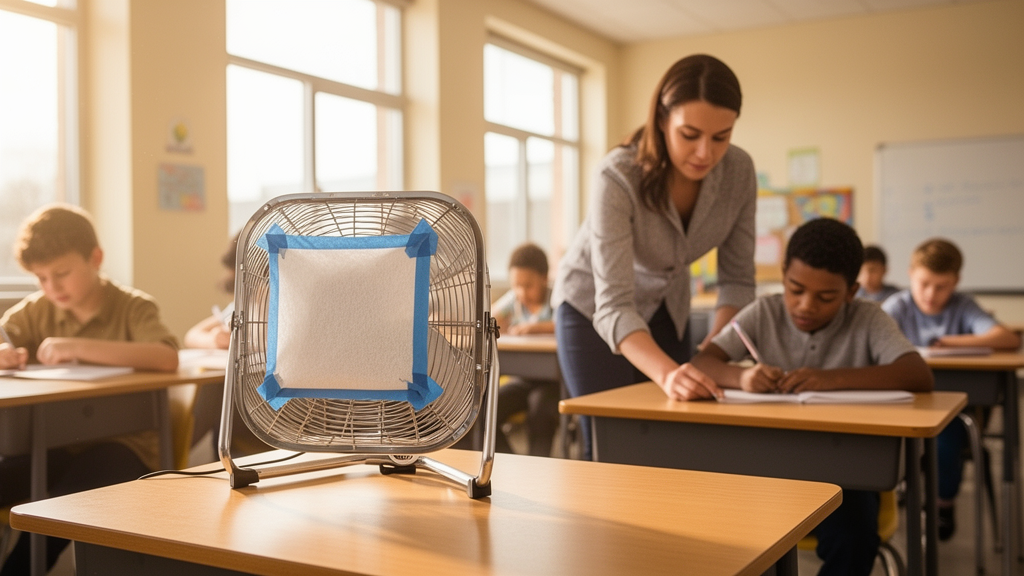
As students settle into a new school year and the cold and flu season gathers momentum, researchers continue to search for practical ways to make the air inside classrooms safer to breathe. A new study published in ACS ES&T Air offers some of the strongest real-world evidence yet that a humble, tape-and-cardboard contraption known as the Corsi-Rosenthal Box can do exactly that. Tested across dozens of live university class sessions, the do-it-yourself air filters reduced particulate matter throughout occupied classrooms by an average of 61 percent, operated at noise levels comparable to a quiet office, and cost a fraction of what commercial portable air purifiers typically demand.
The findings arrive at a moment when indoor air quality has moved from a niche technical concern to a mainstream public health priority. Misti Zamora, corresponding author of the study, emphasizes that the environments where children and school staff spend most of their day deserve particular attention. When schools lack adequate ventilation, harmful particles such as infectious respiratory aerosols, dust, mold spores, and pollen can accumulate, creating conditions that may undermine both student well-being and academic performance. Because classrooms are enclosed spaces where many people share the same air for extended periods, even modest improvements in air cleaning can translate into meaningful reductions in exposure.
Commercial portable air purifiers have long been the standard answer to this problem. These devices do clear airborne particles effectively and can help limit the transmission of respiratory diseases. The obstacle is economic. The smallest commercial units start at roughly 140 dollars per device, and many school districts simply cannot afford to equip every classroom, particularly when budgets are already stretched across staffing, materials, and building maintenance. For schools serving large numbers of students, the arithmetic of buying one purifier per room quickly becomes prohibitive, leaving ventilation as the only line of defense in many buildings.
The Corsi-Rosenthal Box emerged as a deliberately low-cost alternative to that commercial model. The design is strikingly simple: a standard box fan, four high-quality pleated air filters totaling about 60 dollars, two pieces of cardboard, and duct tape. The filters are arranged to form the sides of a cube, the cardboard serves as the top, and the box fan sits on top, pulling air through the filters and pushing cleaned air back into the room. Co-inventor Richard Corsi has demonstrated the assembly process in short videos, and the simplicity of the build means that schools, community groups, and even students themselves can construct the units without specialized tools or training.
Previous studies had already reported that Corsi-Rosenthal Boxes effectively remove airborne pollutants, but relatively few had assessed their performance in active, occupied classrooms, where doors open and close, people move around, and breathing, talking, and coughing continuously release new particles. To address that gap, Marina Creed, Kristina Wagstrom, Zamora, and colleagues set out to evaluate the system’s effectiveness and practicality under realistic conditions. The new study focuses specifically on university classes, offering a window into how the devices behave in rooms full of people going about their normal business.
The research team built two Corsi-Rosenthal Boxes and tested them during 59 class sessions held in a rectangular room with 14 to 30 students in attendance. The protocol was deliberately unobtrusive. The researchers switched on both boxes 10 minutes after each class began and then ran the fans at a low setting for the remainder of the 50-minute period. This design allowed the boxes to demonstrate their cleaning power without any special accommodation from instructors or students, mirroring how the units would actually be used in schools that adopt them.
The results were consistent and encouraging. By the end of each class, the boxes had reduced ultrafine, fine, and coarse particulate matter concentrations by 61 percent on average. That range matters because particles of different sizes carry different risks: ultrafine particles can penetrate deep into the lungs, while coarse particles include many allergens such as pollen and mold spores. The boxes produced between 46 and 55 decibels of noise, a level comparable to a typical office environment and quiet enough to avoid disrupting lectures or discussion. Air moved evenly around the rectangular classroom space, and the devices removed airborne particles at similar rates at three measurement points distributed around the room, indicating that the protective effect was not confined to students seated near the units.
That uniformity of protection is one of the study’s most significant practical implications. As Zamora notes, Corsi-Rosenthal Boxes are a safe, highly effective tool for improving indoor air quality without disrupting the learning environment, and the clean air circulated around the entire room, meaning every student receives the protective health benefits regardless of where they sit. In classrooms where seating is fixed or crowded, a device that only cleaned the air in its immediate vicinity would offer limited value. The demonstration that particle removal rates were similar at multiple locations suggests the boxes can serve an entire room rather than a privileged corner of it.
The economics remain just as compelling as the engineering. Zamora points out that commercial units can cost five to ten times more than these DIY air filters to provide the same amount of clean air, a comparison that reframes the debate about school air quality as a choice no community needs to make. This research proves, she argues, that communities do not need to choose between clean air and their school budgets. For districts weighing whether to invest in air cleaning at all, a device assembled from a box fan and hardware-store filters for roughly 60 dollars lowers the barrier to entry dramatically, and the ability to build multiple units for the price of a single commercial purifier multiplies that advantage.
The work is part of the University of Connecticut’s Indoor Air Quality Initiative, which provides resources for schools and instructional videos on how to build a DIY air purifier. The study’s authors acknowledge financial support, discounted materials, and donations from the Balvi Filantropic Fund, the Petit Family Foundation’s Haley’s Hope and Michaela’s Miracle MS Memorial Fund, TexAire Heating and Air Conditioning, The Home Depot, and the University of Connecticut’s Schools of Medicine, Engineering, and Nursing. As respiratory illnesses circulate each autumn and winter, the study suggests that one of the most effective tools against airborne transmission may already be sitting on a shelf at the local hardware store, waiting to be taped together and switched on.
Subject of Research: Performance of DIY Corsi-Rosenthal Box air filters in occupied classrooms
Article Title: DIY filter systems improve air quality in classrooms
Article References: DIY filter systems improve air quality in classrooms. (n.d.). Original publication
Image Credits: AI Generated
DOI: Not provided
Keywords: Corsi-Rosenthal Box, indoor air quality, classrooms, air filtration, particulate matter, DIY air purifier, box fan, airborne disease transmission, school ventilation, ACS ES&T Air, University of Connecticut, public health
Cite Scienmag News
Russell Cooper. (October 17, 2026). Low-Cost DIY Box Fans Cut Classroom Airborne Particles by 61 Percent. Scienmag. https://scienmag.com/low-cost-diy-box-fans-cut-classroom-airborne-particles-by-61-percent/
Russell Cooper. "Low-Cost DIY Box Fans Cut Classroom Airborne Particles by 61 Percent." Scienmag, 17 October 2026, https://scienmag.com/low-cost-diy-box-fans-cut-classroom-airborne-particles-by-61-percent/. Accessed 17 October 2026.
Russell Cooper. "Low-Cost DIY Box Fans Cut Classroom Airborne Particles by 61 Percent." Scienmag. October 17, 2026. https://scienmag.com/low-cost-diy-box-fans-cut-classroom-airborne-particles-by-61-percent/


