


A startup born from Penn State research has been selected to help solve one of the most pressing supply chain problems facing the United States: securing a reliable domestic supply of critical and strategic metals. Intel-E-Waste, a company whose technology builds on foundational research conducted at the University, was named one of only eight winners of the inaugural Tech Metal Transformation Challenge, a national program administered by the U.S. National Science Foundation through STRIDE Ventures. Chosen from a field of 130 applicants nationwide, the Intel-E-Waste-led team is now entering the first stage of a milestone-driven, multi-phase program aimed at strengthening American supply chains for the metals that underpin advanced manufacturing, defense technologies and the clean energy transition.
The first stage of the challenge runs for ten months, and the Intel-E-Waste team is receiving up to $2 million in federal funding during this initial phase, with Penn State supporting key research activities as a subrecipient of the award. The company will develop and validate a prototype system designed to extract, convert and return metals from complex domestic waste streams into high-performance materials suitable for advanced manufacturing. According to the project team, the award is intended to support what industry commonly calls de-risking: demonstrating that a new technology can integrate with current recycling facilities and produce materials that meet the exacting specifications required by industrial buyers. That validation step is often the most difficult hurdle between laboratory success and commercial deployment.
At the heart of the project is Mohammad Rezaee, co-founder and chief technology officer of Intel-E-Waste and Centennial Career Development Professor of Mining Engineering at Penn State. Rezaee described the company’s ambition in sweeping terms, framing the effort as a way to transform waste into a strategic national asset. Our goal is to help build an end-to-end domestic pathway for critical materials by converting the tsunami of e-waste and the upcoming wave of end-of-life solar panels into high-value feedstocks for U.S. manufacturing, Rezaee said. The approach, he explained, relies on utilizing the existing recycling and refining infrastructure and adding the missing transformation steps needed to recover and upgrade materials that are currently diluted or lost during conventional processing.
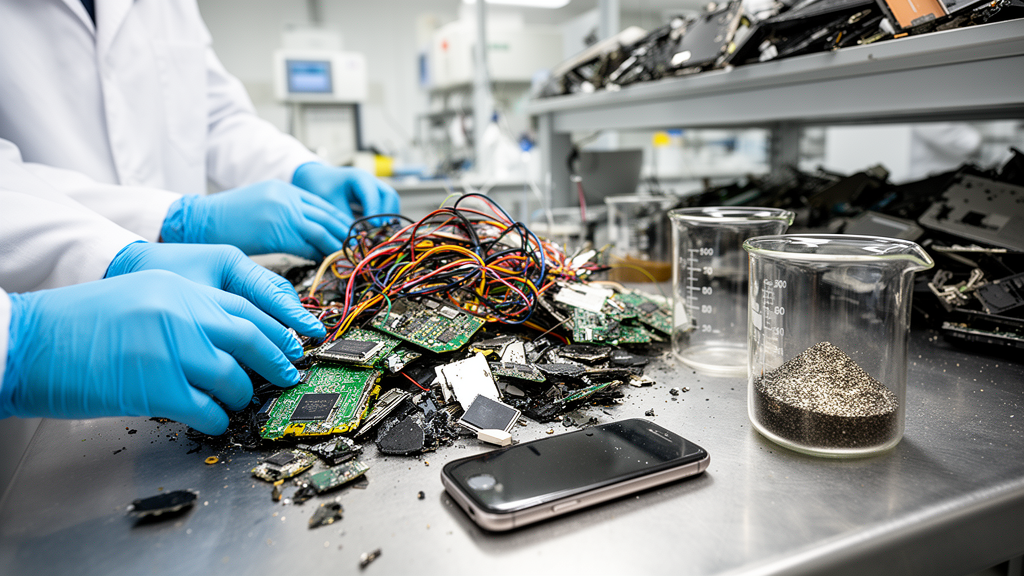
The problem Intel-E-Waste is targeting is both enormous and counterintuitive. Electronic waste is one of the fastest-growing waste streams in the world, and it is simultaneously one of the richest secondary resources for critical and strategic materials. Yet in the United States, most e-waste is processed through systems built primarily around bulk material recovery. Those systems are efficient at capturing high-volume commodities such as steel, aluminum and copper, but many critical and valuable materials are present in small concentrations and can be diluted, downgraded or lost entirely as they pass through conventional processing lines. The economics of recovery are skewed in a way that conventional recycling was never designed to address.
Rezaee pointed to the stark imbalance between mass and value in end-of-life electronics. The most valuable materials can represent less than 1% of the mass, but a very large fraction of the potential value, he said. That is exactly why selective recovery and upgrading are so important. If we treat all e-waste the same way, we lose the materials that matter most. This asymmetry explains why the company’s metal transformation modules are designed to sit between material recovery facilities and downstream processors, integrating with existing recycling infrastructure and upgrading complex end-of-life material streams into cleaner, higher-value fractions suitable for smelters, refiners and manufacturers. The NSF award will support scale-up, industry validation and partnership development to move the platform toward real-world deployment.
For the company’s leadership, the mission extends beyond waste management. Hassan Amini, CEO and co-founder of Intel-E-Waste, emphasized that the venture was conceived as a supply chain solution rather than a recycling one. Intel-E-Waste was built to solve a supply-chain problem, not just a waste problem, Amini said. The United States has growing volumes of end-of-life electronics and solar panels, while manufacturers need secure access to critical materials. Our platform is designed to connect those two realities through scalable, industry-compatible recovery and upgrading. That framing reflects a broader policy concern in Washington, where dependence on foreign sources for critical minerals has been identified as a vulnerability affecting everything from semiconductor fabrication to battery production and military systems.
The Tech Metal Transformation Challenge itself is structured to push breakthrough technologies from research and development toward market validation, scale-up and commercial deployment. Up to six teams may advance to Stage 2 for market validation, and up to four finalists may advance to Stage 3 to scale their technologies toward the market. That staged structure is central to Intel-E-Waste’s strategy. During Stage 1, the team is focusing on prototype development, product characterization, process validation and industry engagement, working to determine how the platform can be integrated into existing recycling facilities and how recovered materials can meet the specifications of downstream users, all within the United States. The project is intended to demonstrate that a domestic circular supply chain for critical materials can be technically feasible, commercially relevant and ready for scale-up.
Erwin Gianchandani, NSF assistant director for the Directorate for Technology, Innovation and Partnerships, which administers the award program, underscored the national stakes in a press release announcing the winners. The Tech Metal Transformation Challenge is an exciting program that addresses a national security imperative to secure the domestic supply chain for critical minerals through research and innovation, Gianchandani said. The winners of this challenge demonstrated their capability to create solutions that tackle the hardest technical gaps in critical materials recovery, gaps that directly impact U.S. manufacturing competitiveness and national security. Their work will reduce reliance on foreign sources and enable on-shoring of advanced manufacturing capabilities across key sectors like defense and energy, he added.
The project has attracted significant industrial and governmental partners. IBM and Aurubis are supporting the initial stage by providing real-world material streams and reference material, enabling the Intel-E-Waste team to evaluate its platform under practical operating conditions rather than idealized laboratory scenarios. The work will also involve collaboration with the U.S. Naval Research Laboratory, a partnership that reflects the national security implications of recovering critical materials from domestic end-of-life electronics. Rezaee noted that many of these materials are currently sourced through fragile or foreign supply chains, so developing domestic secondary sources could strengthen the nation’s ability to advance high-tech research and manufacturing. The involvement of a major metals refiner like Aurubis, alongside a technology giant like IBM, signals that established industry players see promise in the selective recovery approach.
While the technology has clear real-world applications today, its origins lie in fundamental science. The scientific foundation behind several elements of the company’s recovery approach traces to federally funded basic research at Penn State, supported by the U.S. Department of Energy’s REMADE Institute. Intel-E-Waste later used support from the DOE E-SCRAP Prize to begin scale-up planning and industry validation, helping shape the company’s pathway toward a deployable commercial platform. At Penn State, Rezaee is collaborating with co-principal investigators Sarma Pisupati, director of the Center for Critical Minerals; Barbara J. Arnold, chair of the mining engineering program; and Olumide Ogunmodimu, assistant professor of energy and mineral engineering. Together, the academic team brings expertise in critical minerals, mineral processing, separation science, process design and scale-up to support the company’s technology validation and deployment pathway.
The journey from laboratory discovery to startup also relied on a network of university innovation programs. The team went through the regional and national NSF I-Corps programs to test the feasibility of its business and commercialization pathway, interviewing recyclers, manufacturers, policymakers, smelters and downstream users. That customer discovery process helped pave the way for the formation of Intel-E-Waste and its commercialization strategy. The team also received support from Penn State’s Entrepreneur-in-Residence program, which connects startup teams with experienced entrepreneurs and executives who provide hands-on guidance through commercialization, and from the University’s Startup Leadership Network Board of Advisors Program, an industry-specific advisory board of seasoned executives who reviewed progress and advised on market entry, funding, organizational development and growth.
For Rezaee, the project illustrates how federal research funding, NSF I-Corps, university innovation programs, startup formation and industry partnerships can work in concert to move discoveries out of the laboratory and into deployment. It also highlights Penn State’s role in translating foundational research into practical technologies that address national needs. At the end of the day, this technology has to work for the recycling industry and for the manufacturers who need these materials, Rezaee said. That is what makes this project exciting. We are not just developing a process; we are building a pathway from discarded electronics and solar panels to domestic manufacturing. If the staged challenge succeeds in shepherding the platform through validation and scale-up, mountains of obsolete devices and decommissioned solar panels could become a meaningful domestic source of the materials on which the next generation of American technology depends.
Subject of Research: Domestic recovery of critical and strategic metals from electronic waste and end-of-life solar panels using selective metal transformation technology
Article Title: Startup from Penn State research to scale-up domestic critical mineral recovery
Article References: Startup from Penn State research to scale-up domestic critical mineral recovery. (n.d.). Original publication
Image Credits: AI Generated
DOI: Not provided
Keywords: critical minerals, e-waste recycling, Intel-E-Waste, Penn State, National Science Foundation, supply chain security, metal recovery, solar panel recycling, advanced manufacturing, circular economy, startup commercialization, national security
Cite Scienmag News
Denise Maddox. (October 17, 2026). Penn State Startup Intel-E-Waste Wins NSF Challenge to Recover Critical Metals from E-Waste. Scienmag. https://scienmag.com/penn-state-startup-intel-e-waste-wins-nsf-challenge-to-recover-critical-metals-from-e-waste/
Denise Maddox. "Penn State Startup Intel-E-Waste Wins NSF Challenge to Recover Critical Metals from E-Waste." Scienmag, 17 October 2026, https://scienmag.com/penn-state-startup-intel-e-waste-wins-nsf-challenge-to-recover-critical-metals-from-e-waste/. Accessed 17 October 2026.
Denise Maddox. "Penn State Startup Intel-E-Waste Wins NSF Challenge to Recover Critical Metals from E-Waste." Scienmag. October 17, 2026. https://scienmag.com/penn-state-startup-intel-e-waste-wins-nsf-challenge-to-recover-critical-metals-from-e-waste/


