


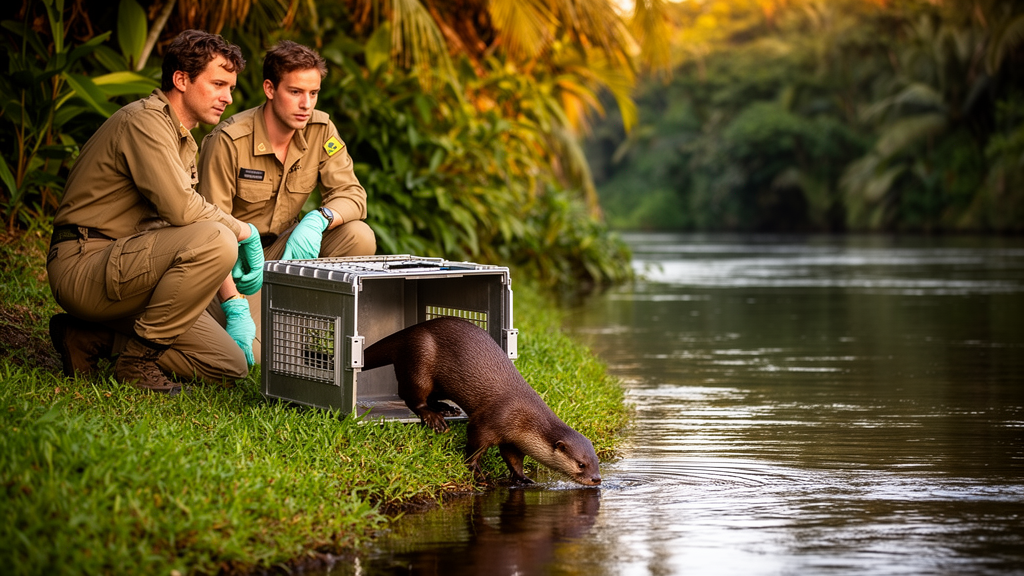
On June 4, 2025, two captive-born Neotropical otters slipped into the waters of Peri Lagoon on Southern Santa Catarina Island, Brazil, becoming what researchers describe as the first fully documented reintroduction of the species into a Neotropical estuarine system. The release, carried out at the Monumento Natural Municipal da Lagoa do Peri with nautical support from the municipal environmental foundation FLORAM, marked the culmination of a three-phase protocol developed by Instituto Ekko Brasil through Projeto Lontra. No immediate mortality or signs of distress were observed, and camera traps installed at natural den sites began documenting den usage and foraging behavior within days of the release.
The Neotropical otter (Lontra longicaudis) is under pressure across its extensive range. Habitat fragmentation disrupts connectivity between water bodies, agricultural and industrial pollution degrades aquatic ecosystems, road mortality takes a toll in developed regions, and diseases transmitted by domestic dogs pose serious health risks to wild populations. Recent research confirms that these multiple stressors are driving population decline throughout the species’ distribution. At Lagoa do Peri, long-term monitoring spanning 36 years has documented a consistent negative population trend, with at least four otter deaths recorded in 2018 alone—a figure researchers believe underestimates the true toll because dense riparian vegetation limits detection.
The site itself is ecologically significant. The freshwater lagoon lies within the Atlantic Forest biome at coordinates 27°43’S, 48°31’W, providing clean water, abundant prey, and suitable denning sites for the species. Field surveys documented seven active burrows throughout the lagoon system, and ecological assessments indicate a carrying capacity of 11 otters, roughly one individual per linear kilometer of coastline. The lagoon is formally protected as a municipal conservation area with on-site infrastructure for management, ensuring protection against development and habitat degradation.
Instituto Ekko Brasil occupies a unique position in otter conservation. Its facility is the only one in the world achieving consistent, successful births of Lontra longicaudis in captivity, documenting 15 births between 2016 and 2022 with a 60% survival rate to adulthood across nine individuals—the fourth generation born under human care. While captive breeding has been attempted in facilities in Venezuela and Colombia, documented successful reintroduction into wild estuarine systems remained limited, with previous efforts either not fully documented or lacking comprehensive post-release monitoring.
The reproductive cycle began on June 21, 2024, with documented copulation between Nanã, a female, and Lucky, a male. Following confirmation, the male was immediately separated according to protocol to ensure female tranquility and physical safety throughout gestation, which typically spans 90 days for the species. On September 27, 2024, three cubs—one female and two males—were born within the breeding enclosure. Approximately thirty days later, one male cub did not survive, leaving a pair under exclusive maternal care. The technical team maintained discreet observation with minimal human interference to preserve natural maternal bonding while monitoring health and growth.
Developmental milestones were tracked with precision. Weight measurements recorded bi-weekly using a digital scale with accuracy of ±0.01 kg showed cubs at 0.85 kg by day 30, 1.32 kg by day 45 when solid fish was introduced, 2.15 kg by day 60 with independent exploration confirmed, 3.48 kg by day 90 with autonomous hunting, 4.21 kg by day 120, and 5.67 kg by day 180 when they were deemed ready for release. Between 30 and 40 days of age, the mother transported the cubs to the pool for apnea training and water familiarity. By day 60, independent den egress was confirmed with proper rear buoyancy, and playful behavior was observed. Foraging success rates rose from 75% at day 45 to 95% by day 180.
Predatory training began at 5 to 6 months of age, using live prey including tilapia fish and chicks across three sessions per week over one month to autonomy. The mother actively taught essential hunting techniques while the cubs progressively developed their predatory instincts. The protocol required an 80% successful capture rate across three consecutive sessions as its success criterion. By the conclusion of training, the cubs demonstrated fully autonomous hunting behavior with coordination, timing, and predatory instincts developed to operate independently in their natural environment.
Preventing human imprinting proved equally critical. The team implemented what they call the Invisible Keeper strategy: painted viewing glass on the visitor trail prevented visual contact with humans, reduced exposure to human voices minimized habituation to human sounds, discreet keeper procedures avoided association of humans with food and care, and zero direct human interaction during the first 30 days protected the critical period for maternal bonding. The success indicator was clear—animals displayed defensiveness toward keepers, a trait considered essential for wild survival. No signs of human imprinting were detected during extensive behavioral assessments.
Before release, the cubs underwent comprehensive clinical screening including vaccination against canine distemper, leptospirosis, and parvovirus, along with a deworming schedule using praziquantel, fenbendazole, and ivermectin. Genetic screening employed microsatellite analysis across 12 loci, comparing the cubs with 15 wild individuals from Lagoa do Peri and requiring greater than 90% genetic similarity for release. Subcutaneous microchips compliant with ISO 11784/11785 standards were implanted for identification. Authorizations were secured from the Instituto do Meio Ambiente de Santa Catarina, FLORAM, and the Monumento Natural Municipal da Lagoa do Peri.
Post-release monitoring uses eight camera traps deployed at 100-meter intervals along the 11-kilometer coastline, with four focused on primary den sites and four on secondary activity areas. The effort totals 560 camera trap nights over 70 days. Initial data from June 10 to 30, 2025, revealed 127 den-use events, with 32% of detections showing successful foraging behavior. The animals demonstrated consistent use of three primary den sites, with home range estimated at 1.2 square kilometers based on GPS telemetry data. Monitoring remains ongoing.
The researchers acknowledge limitations. The sample size of two individuals restricts statistical generalization, and observations span only the immediate post-release period. Disease spillover between captive-born and wild otters remains a concern despite comprehensive pre-release health screening, and the release of only two individuals may introduce founder effects over time. Demographic stochasticity—random fluctuations in birth, death, and sex ratios—may significantly impact population establishment when initial cohorts are this small.
The team recommends that subsequent research incorporate larger cohorts of at least ten individuals, multi-year monitoring with standardized metrics including camera trap effort, GPS telemetry, and reproductive output, and expanded genetic analysis of both captive and wild populations across the species’ range. Such an approach would enable researchers to distinguish individual variation from protocol effectiveness and develop evidence-based guidelines for Lontra longicaudis conservation.
The protocol aligns with IUCN Guidelines for Reintroductions and the IUCN/SSC recommendations from 2013, complies with Brazilian Environmental Law including IBAMA Normative Instructions No. 7 and 179, and supports UN Sustainable Development Goals 14, 15, and 17. The researchers suggest that the three-phase model—maternal-led development, the Invisible Keeper strategy for survival training, and successful reintroduction—offers a replicable template that could be adapted to other threatened species and ecosystems facing similar conservation challenges, pending validation through additional reintroduction events and longer-term monitoring.
Subject of Research: From refuge to the wild: Strengthening the neotropical otter population
Article Title: From refuge to the wild: Strengthening the neotropical otter population
Article References: Carvalho Jr, O., Tosatti, M., Bez Birolo, A., & Esteves, P. (2026). From refuge to the wild: Strengthening the neotropical otter population. Estuarine Management and Technologies, 3, 187-199. https://doi.org/10.3897/emt.3.190120
Image Credits: AI Generated
DOI: 10.3897/emt.3.190120
Keywords: refuge, wild, Strengthening, neotropical, otter, population, scientific research
Cite Scienmag News
Margaret Porter. (October 17, 2026). Captive-born Neotropical otters return to the wild in Brazil. Scienmag. https://scienmag.com/captive-born-neotropical-otters-return-to-the-wild-in-brazil/
Margaret Porter. "Captive-born Neotropical otters return to the wild in Brazil." Scienmag, 17 October 2026, https://scienmag.com/captive-born-neotropical-otters-return-to-the-wild-in-brazil/. Accessed 17 October 2026.
Margaret Porter. "Captive-born Neotropical otters return to the wild in Brazil." Scienmag. October 17, 2026. https://scienmag.com/captive-born-neotropical-otters-return-to-the-wild-in-brazil/


