


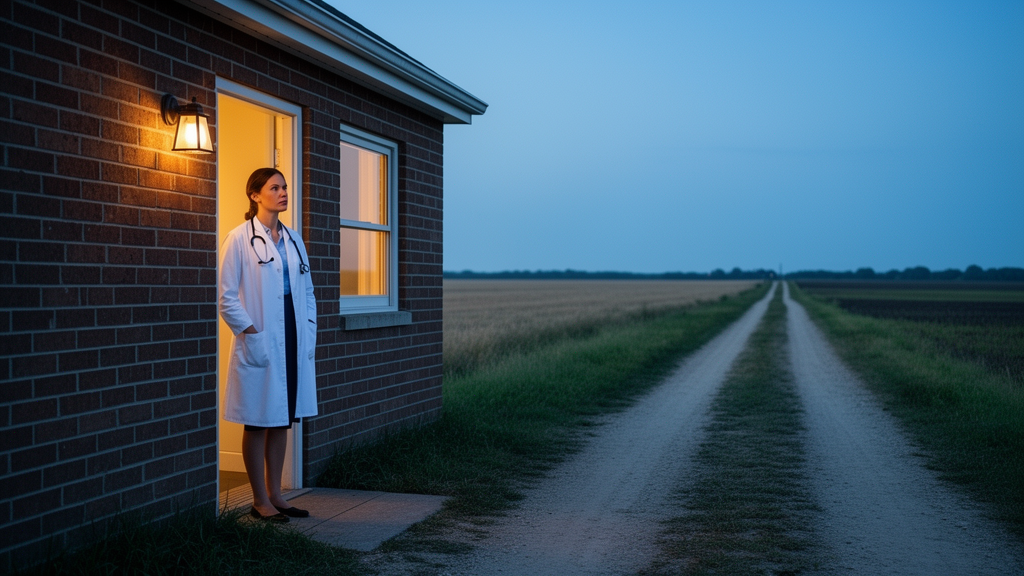
In the small towns and remote communities scattered across Australia, the nearest specialist hospital can be hundreds of kilometres away. When a patient arrives at a rural clinic at midnight with a complicated emergency, there is often no one to call but the local rural generalist doctor, a physician trained to work across the full breadth of medicine, surgery, obstetrics, anaesthetics and emergency care. Practising at that extent of scope demands something medical education rarely names out loud: clinical courage. A new qualitative study published in BMC Medical Education by Ruth Stewart of the University of Queensland, Lucie Walters of Adelaide University and colleagues explores how this courage develops in trainee rural generalists, and its findings suggest that courage is not a fixed personality trait but a learnable, teachable and socially supported capacity that grows through experience, mentorship and deep engagement with community.
The research team recruited participants from three groups connected to the Australian College of Rural and Remote Medicine, the national training body for rural generalist medicine: registrars undertaking rural generalist training, the rural clinical supervisors who oversee their day-to-day work, and medical educators involved in the formal curriculum. Each group took part in semi-structured interviews conducted over Zoom, which were recorded and transcribed for analysis. The researchers then applied a combination of inductive coding, in which themes emerge from the data itself, and deductive coding guided by Mezirow’s theory of transformative learning, a well-established framework in adult education that describes how learners’ frames of reference are fundamentally reshaped by disorienting experiences, critical reflection and dialogue with others.
The analysis surfaced a set of interlocking themes that together trace the registrar’s journey. The first concerned how registrars themselves understand clinical courage: not recklessness, but the willingness to act at the full extent of one’s competence when no alternative care is available, while recognising the limits of that competence. A second theme described the development of rural generalist clinical expertise, the slow accumulation of skills and judgement across disciplines that gives courage its foundation. A third, strikingly social theme showed that community engagement increases motivation, as registrars who come to know their patients as neighbours feel a stronger pull to provide care that would otherwise be inaccessible.
One of the most conceptually interesting findings is the theme the authors describe as adapting practice to prioritise patient values and ties to place. In urban tertiary settings, best practice is often defined by guidelines written for well-resourced hospitals. In a rural context, registrars described a shift in perspective: the patient is understood as a person embedded in a community, a family and a landscape, and clinically courageous practice means adapting guideline-driven care to honour what the patient values and where the patient lives. This represents a genuine transformation in the learner’s frame of reference, precisely the kind of perspective shift Mezirow’s theory predicts when professionals confront situations their original training did not prepare them for.
Alongside this shift in how care is conceived, the study documented a parallel shift in accountability. Trainees begin their careers primarily answerable to their supervisor or consultant, the senior clinician who reviews their decisions and carries ultimate responsibility. As clinical courage develops, registrars move toward shared decision making with patients, in which the doctor and the patient jointly weigh risks, benefits and personal circumstances. This redistribution of accountability is not a loss of oversight but a maturation of professional identity, and the researchers found that supervisors and educators play a crucial role in supporting registrars through this transformational learning journey rather than simply leaving them to sink or swim.
Courage, however, does not develop in a vacuum of approval. The final theme identified in the study, managing judgement, addresses a reality that rural clinicians know intimately: clinically courageous practice can attract censure from outsiders who do not understand the rural context. A metropolitan specialist reviewing a rural doctor’s decision may see only deviation from protocol, not the constraints of distance, time and resources under which the decision was made. Registrars must learn to withstand this external judgement, to reflect critically on their own actions without being paralysed by criticism from those unfamiliar with rural medicine, and to trust the local reasoning that guided them. The researchers argue that managing this judgement is an integral part of developing clinical courage, not a peripheral stressor.
The technical significance of this work lies in its explicit use of transformative learning theory as an analytical lens. By deductively coding interviews against Mezirow’s stages, the team was able to map registrar experiences onto a recognised developmental trajectory: a disorienting encounter with rural clinical reality, critical self-reflection, rational discourse with supervisors and peers, and ultimately a revised, more autonomous professional perspective. This theoretical grounding matters because it converts what might otherwise be anecdote into a structured model that training programmes can act upon. It suggests that the discomfort registrars feel when first facing rural cases alone is not a problem to be eliminated but a necessary catalyst in the learning process, provided it is accompanied by reflective dialogue and adequate supervision.
The practical implications for medical education are direct. The authors advocate that clinical courage should be made explicit throughout rural generalist registrar training, named and discussed in the curriculum rather than left implicit in the hidden curriculum of daily practice. They further propose that documenting clinically courageous management plans could facilitate teaching and learning, giving registrars and supervisors a concrete artefact around which to discuss reasoning, risk and values. Such documentation would also help registrars articulate, to themselves and to external reviewers, why a particular rural decision was defensible, directly supporting the theme of managing judgement.
There is also a workforce dimension that gives the study broader urgency. Rural communities worldwide struggle to recruit and retain doctors, and previous work has associated clinical courage with sustained clinical work in rural areas. If courage develops over time and is reinforced by community connection, then training pathways that deliberately cultivate it, through supervised exposure to full-scope practice, reflective supervision and genuine community immersion, may help produce doctors who not only can serve rural populations but choose to stay. The authors note that their insights may be transferable to registrars training for rural medicine in other countries, a claim strengthened by the international composition of the team, which includes researchers based in South Africa as well as Australia, and by the study’s dedication to the late Professor Jill Konkin of Alberta, Canada, a pioneer of clinical courage research since the field’s inception in 2016.
Funded by an Australian College of Rural and Remote Medicine Education Research Grant and approved by the University of Adelaide Human Research Ethics Committee, the study arrives at a moment when rural health systems are under visible strain. Its central message reframes an old ideal: the brave country doctor is not a romantic archetype but the product of a specific, describable educational process, one that blends accumulating expertise, transforming perspective, sharing decisions with patients, and learning to stand by difficult choices in the face of outside criticism. Making that process explicit, the researchers argue, is the next step in ensuring that remote communities continue to have access to care that would otherwise simply not exist.
Subject of Research: Development of clinical courage in rural generalist medical registrars
Article Title: Developing clinical courage in rural generalist registrars: a qualitative study
Article References: Stewart, R., Couper, I., Campbell, D., Williams, S., Moody, E., Padley, J., White, L., Pellegrini, D., & Walters, L. (2026). Developing clinical courage in rural generalist registrars: a qualitative study. BMC Medical Education. https://doi.org/10.1186/s12909-026-10610-2
Image Credits: AI Generated
DOI: 10.1186/s12909-026-10610-2
Keywords: clinical courage, rural generalist, medical education, registrars, transformative learning, Mezirow, rural health, Australia, ACRRM, supervision, community engagement, qualitative research
Cite Scienmag News
Courtney Benton. (October 17, 2026). How Rural Doctors Learn the Courage to Work Alone. Scienmag. https://scienmag.com/how-rural-doctors-learn-the-courage-to-work-alone/
Courtney Benton. "How Rural Doctors Learn the Courage to Work Alone." Scienmag, 17 October 2026, https://scienmag.com/how-rural-doctors-learn-the-courage-to-work-alone/. Accessed 17 October 2026.
Courtney Benton. "How Rural Doctors Learn the Courage to Work Alone." Scienmag. October 17, 2026. https://scienmag.com/how-rural-doctors-learn-the-courage-to-work-alone/


