


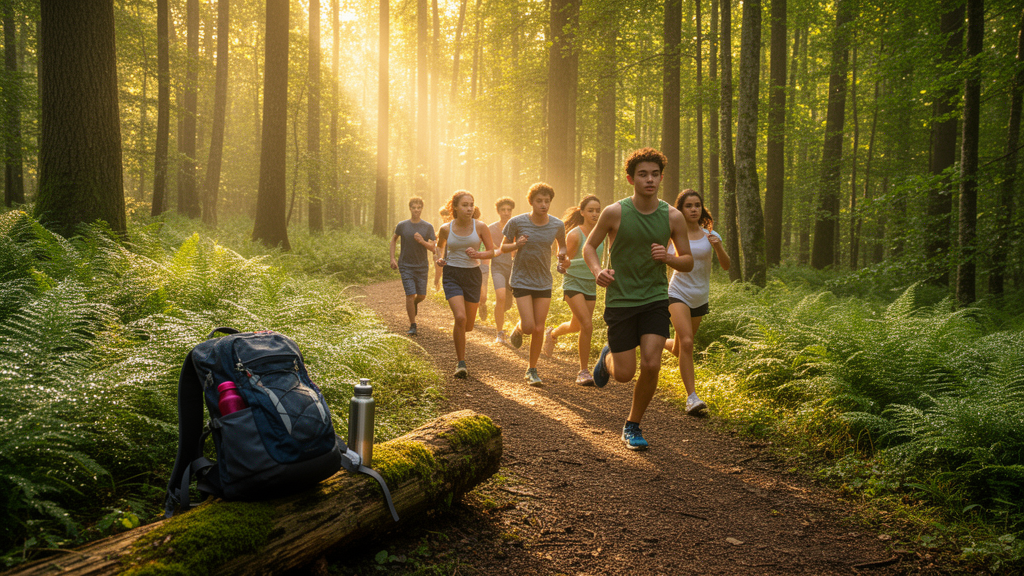
What if one of the most accessible tools for protecting young mental health is not a new drug or therapy app, but simply getting children and adolescents moving in parks, forests, and other natural spaces? A narrative review published in Frontiers in Psychiatry by Huihuang Huang and Xu Peng examined that question systematically, synthesizing twelve English-language empirical studies published since 2000 that involved young people aged 18 or younger engaging in so-called green exercise—physical activity undertaken with direct exposure to nature. The verdict is nuanced: green exercise shows genuine promise as a low-stigma, easily accessible complement to conventional mental health care, but the evidence stops well short of declaring it a universally effective intervention. The benefits, the authors conclude, depend heavily on the type of activity, its duration and structure, participant preferences, sex, and the social and environmental context in which it takes place.
The stakes are considerable. According to the World Health Organization figures cited in the review, roughly one in seven adolescents aged 10 to 19 experiences a mental disorder, and mental disorders account for about 15 percent of the global burden of disease in this age group. Depression, anxiety, and behavioral disorders rank among the leading causes of adolescent illness and disability worldwide. Regional data sharpen the picture further: an analysis of Global Burden of Disease 2021 data from 54 Asia-Pacific countries found that mental disorders were the leading non-communicable cause of years lived with disability among people aged 0 to 19 in 2021, with related disability-adjusted life years rising by just over 10 percent between 1990 and 2021. Because many adult mental disorders have their roots in childhood and adolescence, researchers are increasingly interested in scalable, prevention-oriented strategies that reach young people where they live, learn, and play.
This is precisely where green exercise enters the conversation. Evidence-based psychological treatments certainly exist—trauma-focused cognitive behavioral therapy, for example, produces stable reductions in pediatric post-traumatic stress symptoms at twelve-month follow-up. But treatment efficacy alone does not guarantee population-level impact. Few young people who need mental health services actually receive appropriate care, and barriers such as shortages of trained professionals, limited service capacity, poor geographic access, and persistent stigma remain formidable. Green exercise, by contrast, can be woven into everyday life, school routines, and community settings, and it carries relatively little of the stigma that still clings to formal clinical care. The review’s authors searched PubMed and Web of Science for studies published between January 2000 and July 2026, screening 1,832 unique records and ultimately including twelve studies that met their eligibility criteria—ranging from a twelve-participant Alpine hiking pilot to a survey of more than 20,000 Canadian students.
The theoretical scaffolding for the field rests on three well-known frameworks. Attention Restoration Theory proposes that sustained cognitive demands deplete our capacity for directed attention, and that natural environments help replenish it through experiences of being away and so-called soft fascination—stimuli that engage attention without demanding mental effort. Stress Reduction Theory emphasizes affective and physiological pathways, suggesting that safe, non-threatening natural settings promote positive emotions, dampen negative ones, and lower physiological arousal. The Biophilia Hypothesis offers a broader evolutionary account, proposing that humans possess an evolved tendency to affiliate with living organisms and natural processes. Together, these theories explain the environmental component of green exercise, but they do not fully account for benefits arising from the physical activity itself, from feelings of mastery and autonomy, or from social support—gaps the review explicitly set out to address.
To organize a heterogeneous evidence base, the authors grouped their findings into four mechanism-relevant themes: psychological restoration and stress regulation; mastery, autonomy, and person–activity fit; activity engagement and substitution for sedentary behavior; and social and contextual support. Across the studies, green exercise was associated with positive affect, life satisfaction, happiness, and self-esteem, and in some contexts with lower levels of stress, anxiety, internalizing symptoms, or psychosomatic complaints. Notably, the associations appeared more consistent for positive mental health indicators—happiness, vitality, life satisfaction—than for reductions in specific symptoms of distress, a pattern that held across several of the included studies and may reflect how green exercise operates on well-being rather than on pathology.
Some of the most striking findings came from studies of sustained, immersive activity. In a nine-day Alpine hiking expedition involving German pupils, perceived stress on the demand subscale of the Perceived Stress Questionnaire decreased, mindfulness scores rose substantially, and life satisfaction improved. The authors of that study suggested the changes might relate to the temporary interruption of school routines, reduced deadline pressure, and heightened attention to present-moment experience. Similarly, during the COVID-19 pandemic, US adolescents who experienced smaller reductions in outdoor play and nature-based activities also reported smaller declines in subjective well-being, and 76.4 percent of respondents said spending time outdoors in nature helped them cope with the stress of social distancing. In a large Canadian sample, adolescents who perceived nature connectedness as important showed a 25 percent lower prevalence of high psychosomatic symptoms, suggesting that the psychological meaning attached to contact with nature may matter alongside the sheer duration of outdoor activity.
Yet the experimental evidence delivers a sobering counterpoint. In a repeated-measures experiment with British schoolchildren, a 1.5-mile timed run improved self-esteem regardless of whether it took place in a rural country park or on an urban school campus, with no significant difference between the green and urban conditions. Another randomized trial compared the same aerobic and resistance circuit performed indoors, in an urban park, and in a nature reserve; while selected differences emerged in sustained attention, cognitive arousal, and vitality, there was no consistent nature gradient across outcomes. These results suggest that restorative effects may depend on whether an activity leaves enough attentional capacity for participants to actually engage with their surroundings. A timed run or a station-based circuit directs attention toward the task and other people, potentially crowding out the soft fascination that restoration theories require. Greener, in other words, is not automatically better.
The review also highlights pathways that operate through behavior and context rather than restoration. Among British preschool children, each additional hour per week of adventurous play—thrilling play involving risk—was associated with lower internalizing scores and higher positive affect, a pattern the study authors interpreted as repeated exposure to excitement and uncertainty helping children learn to regulate fear. Isotemporal substitution modelling from a study of more than 20,000 Canadian students estimated that replacing one hour per day of active outdoor play with active video games was associated with a 7 percent higher probability of high emotional problems and lower life satisfaction and prosocial behavior. And in a longitudinal cohort of over 4,400 US children, more outdoor play at age 9 predicted greater physical activity and lower anxiety at age 15, partially mediating the link between neighborhood collective efficacy and later anxiety—the only included study to formally test an indirect pathway.
The methodological caveats are substantial. Most of the twelve studies were cross-sectional or observational, several relied on retrospective or self-reported exposures and outcomes, and the experimental work involved small samples or acute designs. Nature exposure itself was inconsistently characterized—some studies measured explicitly natural settings while others simply recorded outdoor play, which does not guarantee a natural environment or meaningful physical exertion. Proposed mechanisms were rarely tested prospectively, cultural meanings of natural environments went largely unexplored, and the evidence was geographically concentrated in high-income countries in Europe, North America, and Australia, plus one study from China. Dose was operationalized in wildly different ways, from half an hour of weekly outdoor play to fourteen hours of weekly outdoor physical activity, making it impossible to identify a minimum effective dose or a clear dose-response relationship.
What emerges is a pragmatic, conditional picture rather than a prescription. The review’s authors suggest that offering varied green exercise options—adventurous and unstructured activities that build autonomy, walking or hiking that permits engagement with surroundings, park-based exercise that is simply practicable—is more defensible than prescribing a single activity or intensity on the assumption that greater greenness produces larger effects. Green exercise appears best understood as a promising but context-dependent complement to child and adolescent mental health promotion, one that should never replace indicated psychological or psychiatric care. The optimal activity type, intensity, frequency, and environmental conditions remain uncertain, and future research will need controlled longitudinal and factorial designs that prespecify and repeatedly measure potential mediators to determine how green exercise works, for whom, and under what conditions. Until then, the message for parents, educators, and policymakers is refreshingly modest: getting young people active outdoors is a reasonable, low-risk bet—but the magic, if there is one, lies in the fit between the child, the activity, and the place.
Subject of Research: Green exercise and mental health in children and adolescents
Article Title: Green exercise as a potential pathway to promoting mental health in children and adolescents: a narrative review
Article References: Huang, H., & Peng, X. (2026). Green exercise as a potential pathway to promoting mental health in children and adolescents: a narrative review. Frontiers in Psychiatry, 17, Article 1948114. https://doi.org/10.3389/fpsyt.2026.1948114
Image Credits: AI Generated
DOI: 10.3389/fpsyt.2026.1948114
Keywords: green exercise, mental health, children, adolescents, natural environments, physical activity, Attention Restoration Theory, stress reduction, well-being, outdoor play, narrative review, psychiatry
Cite Scienmag News
Glenn Wilkins. (October 17, 2026). Nature Workouts May Lift Young Minds, But the Science Says Context Is Everything. Scienmag. https://scienmag.com/nature-workouts-may-lift-young-minds-but-the-science-says-context-is-everything/
Glenn Wilkins. "Nature Workouts May Lift Young Minds, But the Science Says Context Is Everything." Scienmag, 17 October 2026, https://scienmag.com/nature-workouts-may-lift-young-minds-but-the-science-says-context-is-everything/. Accessed 17 October 2026.
Glenn Wilkins. "Nature Workouts May Lift Young Minds, But the Science Says Context Is Everything." Scienmag. October 17, 2026. https://scienmag.com/nature-workouts-may-lift-young-minds-but-the-science-says-context-is-everything/


