


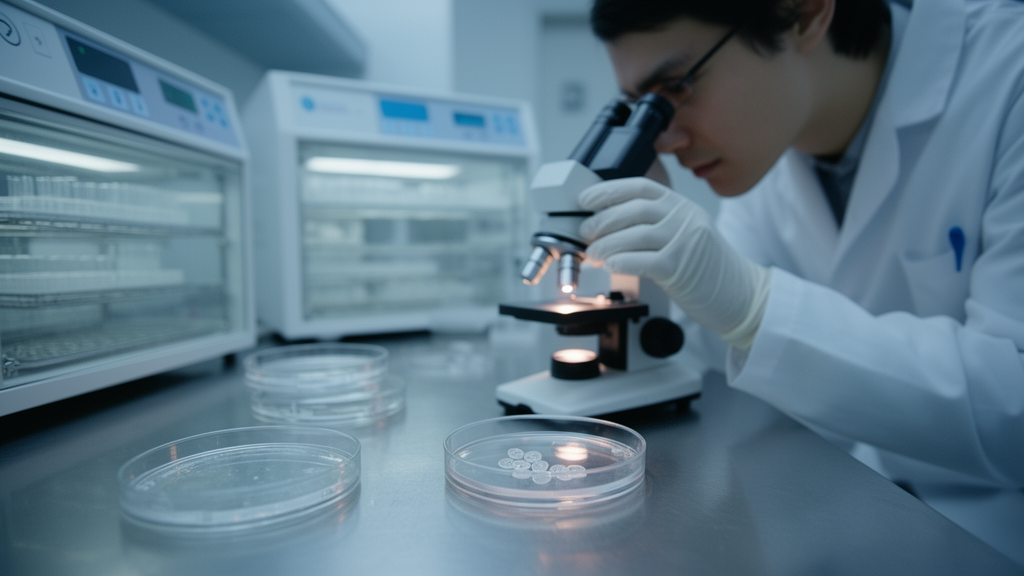
For a couple going through in vitro fertilization, few outcomes are as bewildering as this one: the ovarian stimulation works beautifully, the retrieval produces a healthy crop of ten to twenty eggs, and then the laboratory reports that not a single embryo has reached a stage suitable for transfer. A new retrospective study drawing on 42,931 fresh IVF cycles performed at Peking University Third Hospital between January 2017 and December 2024 now puts hard numbers on this rare but devastating scenario, and identifies the clinical factors that make it more likely. The research, published in the Journal of Ovarian Research, offers the largest analysis to date of what specialists call the absence of transferable cleavage-stage embryos in cycles that should, on paper, have plenty of raw material to work with.
The scale of the dataset is what gives the findings their statistical muscle. Across eight years of clinical practice, the team led by Jiangman Gao, Ying Huang and Rui Yang examined every fresh IVF cycle in which ten to twenty oocytes were retrieved, a range chosen deliberately because it represents a solid but not excessive ovarian response. The central question was deceptively simple: in how many of these cycles did the laboratory end up with no transferable cleavage-stage embryo, meaning no embryo at the two- to eight-cell stage that could be transferred fresh or cryopreserved for later use? The answer was 632 cycles out of 42,931, an incidence of 1.47 percent. That figure may sound small, but for the individual patients behind those 632 cycles, it meant an entire stimulation cycle, with all its hormonal burden, expense and emotional investment, ending without a single embryo to show for it.
To understand why this happens, it helps to trace the developmental gauntlet that every retrieved oocyte must run. After fertilization, whether by conventional IVF, where sperm and eggs are incubated together, or by intracytoplasmic sperm injection, where a single sperm is injected directly into the egg, the fertilized oocyte must activate, complete its second meiotic division, form pronuclei, and then begin cleaving into a multicellular embryo. Any failure along this chain, whether from oocyte activation defects, abnormal fertilization, chromosomal errors, or arrest at the earliest cleavage stages, can leave the laboratory with nothing viable. The cleavage-stage embryo, typically assessed on day two or day three after retrieval, is the earliest point at which a transfer decision is made in many clinics, so failures that manifest before that checkpoint are invisible until the cycle is already underway.
The multivariable logistic regression analysis, which adjusted for confounding factors across the entire cohort, revealed a striking pattern of protective and risk factors. On the protective side, secondary infertility, meaning patients who had previously conceived at least once, was associated with lower odds of the outcome, with an adjusted odds ratio of 0.753. Higher trigger-day estradiol levels, the hormone peak measured just before the final oocyte maturation trigger, also reduced the odds, as did a higher oocyte yield within the ten-to-twenty range. Each additional retrieved oocyte lowered the odds by roughly eleven percent, a dose-response relationship that reinforces the intuitive point that more eggs provide more chances for at least one to develop normally.
On the risk side, the findings are more technically revealing. Longer infertility duration independently increased the odds, with each additional year raising them by nearly five percent, a signal that the underlying reproductive biology of the couple, rather than the stimulation protocol alone, shapes the developmental potential of the oocytes. Higher total gonadotropin dosage was associated with dramatically higher odds, with an adjusted odds ratio of 7.353 when comparing the highest to the lowest dosage categories. This finding suggests that patients who require more hormonal stimulation to achieve the same oocyte yield may have oocytes of intrinsically lower developmental competence, a hypothesis that aligns with growing evidence that the quality of the ovarian response, not just its quantity, matters for embryo development.
The fertilization method itself emerged as one of the strongest independent predictors. Use of intracytoplasmic sperm injection, or ICSI, was associated with more than twice the odds of ending up with no transferable cleavage-stage embryo, with an adjusted odds ratio of 2.514. Even more dramatic was rescue ICSI, the procedure performed when conventional IVF fertilization fails and the laboratory intervenes by injecting sperm into the unfertilized eggs, which carried an adjusted odds ratio of 6.393. This finding makes biological sense: rescue ICSI is only deployed in cycles where fertilization has already failed, so the oocytes in question have already demonstrated compromised activation capacity. The procedure itself, while often successful at achieving fertilization, cannot reverse whatever oocyte-level defect caused the initial failure, and the resulting embryos may arrest at earlier cleavage stages than those from normally fertilized eggs.
Polycystic ovary syndrome, or PCOS, one of the most common endocrine disorders affecting fertility, showed a nuanced relationship with the outcome. In the overall population, PCOS was not significantly associated with the absence of transferable cleavage-stage embryos. But when the analysis was restricted to the ICSI subgroup, PCOS was associated with lower odds of the outcome, with an adjusted odds ratio of 0.593. This suggests that oocytes from PCOS patients, when fertilized by direct sperm injection, may have developmental potential comparable to or better than those from patients with other infertility diagnoses, a finding that challenges assumptions about PCOS oocyte quality and may reflect the distinctive hormonal milieu of PCOS patients, who often produce oocytes with robust activation capacity despite irregular ovulation.
One finding that may surprise clinicians is that surgically retrieved sperm, obtained through procedures such as testicular sperm extraction for patients with obstructive azoospermia, was not independently associated with the outcome once other factors were accounted for. This suggests that the developmental competence of oocytes, rather than the source of the sperm, is the dominant factor in whether a cycle produces transferable cleavage-stage embryos, at least in this cohort where sperm quality was presumably screened before use. The trigger-day estradiol level, a marker of the granulosa cell function and follicular maturity at the end of stimulation, emerged as a protective factor, with higher levels associated with roughly thirty-four percent lower odds, reinforcing the idea that the endocrine environment of the final follicular phase shapes oocyte quality.
For patients and clinicians alike, the practical implications are significant. The study suggests that patients with primary infertility, long-standing infertility, or those who require high gonadotropin doses to achieve a moderate oocyte yield should be counseled that their individual risk of ending up with no transferable cleavage-stage embryo is elevated, even when the retrieval produces ten to twenty eggs. The findings also raise questions about the judicious use of ICSI, which is often deployed for male factor infertility but is increasingly used in non-male-factor cases, and about the timing of rescue ICSI, which may be more effective when performed earlier rather than later in the fertilization window. As assisted reproduction continues to expand globally, studies of this scale, drawing on nearly 43,000 cycles from a single high-volume center, provide the statistical foundation for personalized risk counseling and for refining laboratory protocols to minimize the number of cycles that end without a single embryo to transfer.
Subject of Research: Factors associated with the absence of transferable cleavage-stage embryos in fresh IVF cycles with 10–20 retrieved oocytes: a retrospective analysis of 42,931 cycles
Article Title: Factors associated with the absence of transferable cleavage-stage embryos in fresh IVF cycles with 10–20 retrieved oocytes: a retrospective analysis of 42,931 cycles
Article References: Gao, J., Huang, Y., Tian, T., Chen, L., Li, R., & Yang, R. (2026). Factors associated with the absence of transferable cleavage-stage embryos in fresh IVF cycles with 10–20 retrieved oocytes: a retrospective analysis of 42,931 cycles. Journal of Ovarian Research. https://doi.org/10.1186/s13048-026-02315-3
Image Credits: AI Generated
DOI: 10.1186/s13048-026-02315-3
Keywords: Factors, associated, absence, transferable, cleavage-stage, embryos, fresh, cycles, retrieved, oocytes, retrospective, analysis
Cite Scienmag News
Ophelia Keating. (October 17, 2026). Why Some IVF Cycles Yield Plenty of Eggs but No Transferable Embryo. Scienmag. https://scienmag.com/why-some-ivf-cycles-yield-plenty-of-eggs-but-no-transferable-embryo/
Ophelia Keating. "Why Some IVF Cycles Yield Plenty of Eggs but No Transferable Embryo." Scienmag, 17 October 2026, https://scienmag.com/why-some-ivf-cycles-yield-plenty-of-eggs-but-no-transferable-embryo/. Accessed 17 October 2026.
Ophelia Keating. "Why Some IVF Cycles Yield Plenty of Eggs but No Transferable Embryo." Scienmag. October 17, 2026. https://scienmag.com/why-some-ivf-cycles-yield-plenty-of-eggs-but-no-transferable-embryo/


