

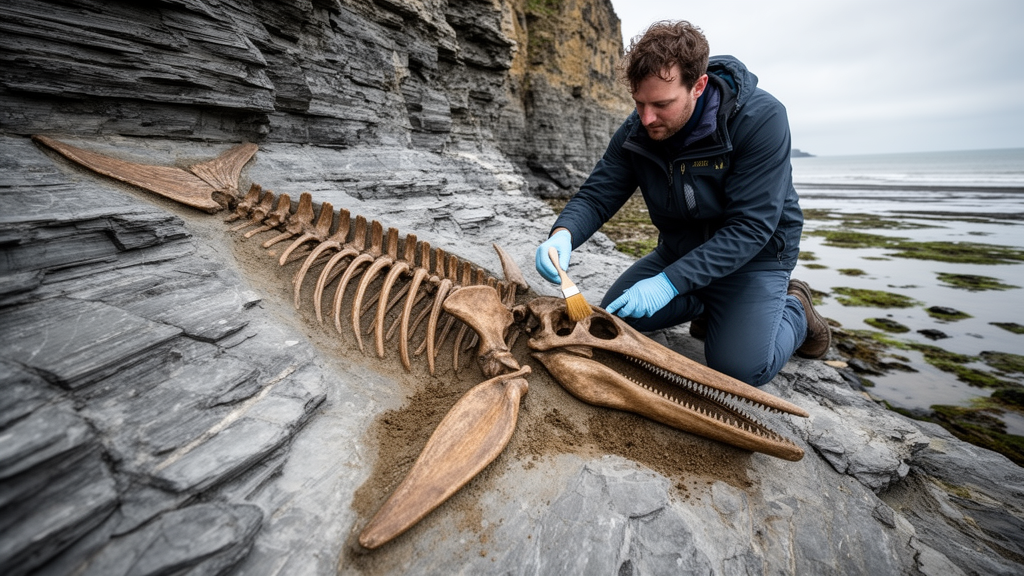
A nearly complete ichthyosaur excavated from the cliffs of Ravenscar near Whitby, Yorkshire, in 1981 has finally been formally described, and it is shaking up how palaeontologists delineate species in one of the most abundant genera of Early Jurassic marine reptiles. The specimen, catalogued as SMNS 55110 and now housed at the State Museum of Natural History Stuttgart, was collected by Swiss collector Urs Oberli from the Alum Shale Member of the Whitby Mudstone Formation. Dating to the Bifrons Zone of the lower Toarcian stage, roughly 180 million years ago, it represents one of the most complete and well-preserved publicly accessible ichthyosaurs ever recovered from the Toarcian of Yorkshire, and the new study identifies it as Stenopterygius quadriscissus, the first definitive example of that species from the United Kingdom.
The Toarcian stage of the Early Jurassic is famous among palaeontologists for the spectacular fossils of the Posidonienschiefer Formation in south-western Germany, where thousands of articulated ichthyosaur skeletons have been unearthed from the laminated black shales around Holzmaden. Britain, by contrast, has long seemed like a poor cousin. Although ichthyosaurs have been documented from the Whitby coastline, Strawberry Bank in Somerset and Rutland, most British Toarcian specimens are historical, fragmentary or poorly prepared, making confident identification notoriously difficult. Three genera are known from the Yorkshire area during this interval, Temnodontosaurus, Eurhinosaurus and Stenopterygius, but assessing the taxonomic position of most specimens has been a persistent headache for researchers.
Part of the problem lies in the tangled taxonomic history of Stenopterygius itself. Around the beginning of the twenty-first century, eight species were recognised as valid, diagnosed using intracranial ratios, dentition, body size, limb proportions and vertebral counts. In 2008, a major revision reduced the number to three, S. quadriscissus, S. triscissus and S. uniter, while re-assigning some material to the new genus Hauffiopteryx. In 2012, new bivariate and multivariate metrics allowed species determination across all ontogenetic stages, but the method depended on the pelvic girdle, hind-limb, articulated limbs and complete undamaged jaws, characters that are simply missing from most specimens. Small individuals lacking a hind-limb, like the Ravenscar ichthyosaur, remained impossible to refer to species with any confidence.
The new study tackled this gap by exploring postcranial metrics that work even when the skull or hind-limb is damaged or absent. The researchers measured the caudal skeletons of 40 specimens of Stenopterygius from the Posidonienschiefer Formation, assigned to species using independent criteria, and the proximal fore-limbs of 46 specimens in total. Two measurements proved especially powerful. The first is the ratio of postflexural length to total caudal length, essentially how much of the tail lies behind the tailbend. The second is the ratio of the ulnar facet to the radial facet of the intermedium, a small wrist bone whose articular surfaces for the radius and ulna differ measurably between species.
The results are strikingly clean. Stenopterygius quadriscissus has a postflexural length to total caudal length ratio of 0.39 on average, while S. triscissus averages 0.34, and the tailstock vertebral count differs as well, with a mean of 35.6 vertebrae in S. quadriscissus against 39.8 in S. triscissus. The intermedium ratio is even more decisive, with no overlap at all between S. quadriscissus, where the ulnar to radial facet ratio averages 0.84, and S. triscissus, where it averages 1.36. The third species, now called S. longipes, falls between the two with a ratio of 1.09. These metrics allowed the team to refer SMNS 55110 to S. quadriscissus, whose postflexural ratio of 0.42 and intermedium ratio of 1.01 sit squarely within the range of that species and outside the ranges of the others.
The comparative work also triggered two significant synonymies. Stenopterygius longipes, first named in 1876, had been declared a nomen dubium in 1998 on the grounds that its type skeleton, a large mounted specimen at the Palaeontological Collection of Tübingen University, might be a composite with fore-limbs that do not belong to the rest of the animal. Re-examination showed that the humeri are exposed in anterior view consistent with specimen taphonomy, that the pathological fusion and exostoses seen in the hind-limbs also appear in the fore-limbs, and that what was interpreted as a duplicated ulna is likely a fragment of the badly fractured right humerus. The team concluded the skeleton belongs to a single individual and that S. longipes is the senior synonym of S. uniter.
The second synonymy is even more dramatic. Magnipterygius huenei, erected in 2022 as a new genus of Early Jurassic ichthyosaur based on a small specimen from the Posidonienschiefer, was diagnosed by its small size, low vertebral counts and caudal proportions. The new study found that the holotype is actually an osteologically immature individual at postnatal stage 1, with a flat humeral articular surface, open sutures between fore-limb elements and a parietal bearing a dorsal triangular platform, all characters of very young Stenopterygius. Its low presacral count can be explained taphonomically, as headfirst seafloor arrival can displace cervical centra inside the skull, and counting presacral ribs instead yields 45 vertebrae, well within the range of S. quadriscissus. Its caudal proportions and intermedium ratio of 0.79 are likewise consistent only with S. quadriscissus, so Magnipterygius huenei is now considered a junior synonym of that species.
The description of SMNS 55110 itself reveals a remarkably informative skeleton. The specimen is 145.8 centimetres long, exposed on its right lateral side for most of its body length, with a complete articulated vertebral column of 134 vertebrae, 46 presacral, 80 preflexural and 54 postflexural. The skull is exposed ventro-laterally, revealing the mandible and palate in unusual detail, and at least 12 teeth are preserved near the jaws, with smooth crowns about 4 millimetres high and deep apicobasal grooves on the roots indicating plicidentine. Both fore-limbs are complete and fully articulated, showing the humerus, radius, ulna, carpals, metacarpals and phalanges in exquisite detail, though the hind-limbs and pelvic girdle are missing. Four dorsal ribs show callus formation at mid-shaft, evidence of traumatic injury sustained during the animal’s life, a common finding in juvenile Stenopterygius.
The taphonomic story behind the specimen is equally compelling. The unusually curled axial skeleton prompted the researchers to consider whether it might be a regurgitalite of a large predator, but no vertebral torsion, breakage, perimortem fractures or bite traces support that interpretation. Instead, a complex scenario emerges: the carcass arrived at the seafloor in a roughly dorsal orientation, the skull penetrated the soft sediment first and anchored the rostrum, the specimen rolled onto its left side, and current activity pushed the partially lifted postcranium while the skull stayed embedded, creating the curve in the vertebral column. The orientation of small bivalves called Meleagrinella clustered above the vertebral column, with their umbos directed down-current, supports this reconstruction, and their presence indicates deposition during a relatively short oxic to dysoxic period at the sediment-water interface.
The broader implications reshape the palaeobiogeography of Toarcian ichthyosaurs across Europe. The new metrics allowed the team to re-evaluate specimens from Luxembourg, Switzerland, France, Germany and Britain, confirming that S. quadriscissus ranged from south-western Germany to the Cleveland Basin of Yorkshire, including Luxembourg and the Wessex Basin at Strawberry Bank, while S. triscissus is confirmed only in the south-west German Basin and Switzerland and is absent from Strawberry Bank. The stratigraphic range of S. quadriscissus extends from the Tenuicostatum to Bifrons Zones, an estimated 3.3 million years. Differences in caudal morphology between the two species may even reflect differences in locomotor specialisation and habitat use, with the higher tailstock vertebral count of S. triscissus potentially indicating faster, more efficient swimming in more pelagic environments, while S. quadriscissus may have preferred nearshore habitats. The Ravenscar specimen also reinforces the presence of S. quadrisscus during the Bifrons Zone, making it one of the youngest stratigraphic occurrences of the species and demonstrating that these dolphin-like reptiles thrived in the northernmost reaches of the European epicontinental sea long after the hyperthermal Toarcian Oceanic Anoxic Event had reshaped marine ecosystems.
Subject of Research: Species delineation and palaeobiogeography of the Early Jurassic ichthyosaur genus Stenopterygius based on a new specimen from Yorkshire
Article Title: A well-preserved specimen of Stenopterygius quadriscissus ( Reptilia , Ichthyosauria ) from the Early Jurassic (Toarcian) of Yorkshire, UK and new insights into species delineation in the genus
Article References: Biot, T., Lomax, D. R., Miedema, F., & Maxwell, E. E. (2026). A well-preserved specimen of Stenopterygius quadriscissus (Reptilia, Ichthyosauria) from the Early Jurassic (Toarcian) of Yorkshire, UK and new insights into species delineation in the genus. Fossil Record, 29(1), 185-210. https://doi.org/10.3897/fr.29.185733
Image Credits: AI Generated
DOI: 10.3897/fr.29.185733
Keywords: Stenopterygius, ichthyosaur, Toarcian, Early Jurassic, Yorkshire, Whitby Mudstone Formation, SMNS 55110, taxonomy, palaeobiogeography, Magnipterygius, Posidonienschiefer, marine reptiles
Cite Scienmag News
Scienmag. (October 17, 2026). Ravenscar ichthyosaur fossil rewrites the species map of Early Jurassic seas. https://scienmag.com/ravenscar-ichthyosaur-fossil-rewrites-the-species-map-of-early-jurassic-seas/
Scienmag. "Ravenscar ichthyosaur fossil rewrites the species map of Early Jurassic seas." Scienmag, 17 October 2026, https://scienmag.com/ravenscar-ichthyosaur-fossil-rewrites-the-species-map-of-early-jurassic-seas/. Accessed 17 October 2026.
Scienmag. "Ravenscar ichthyosaur fossil rewrites the species map of Early Jurassic seas." Scienmag. October 17, 2026. https://scienmag.com/ravenscar-ichthyosaur-fossil-rewrites-the-species-map-of-early-jurassic-seas/


