


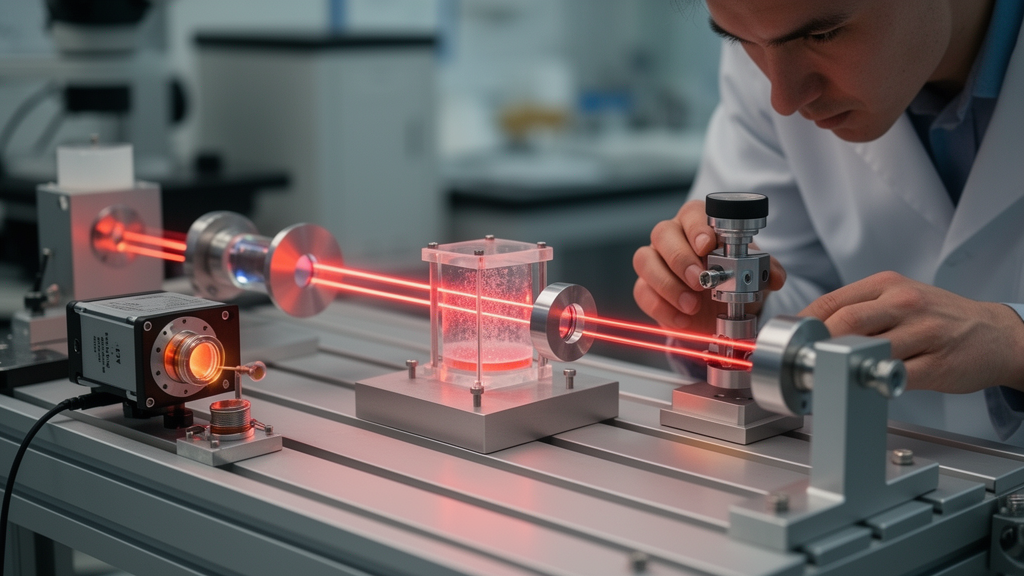
In the world of molecular detection, speed and precision rarely come cheap. Laboratories that want to identify trace gases in the atmosphere, diagnose combustion processes in real time, or spot the faint chemical signatures of disease have long had to choose between instruments that are fast and instruments that are accurate. A comprehensive new review published in the journal Opto-Electronic Technology argues that this trade-off is rapidly dissolving, thanks to a laser technique known as dual-comb spectroscopy, and that the technique’s most important growth is now happening in two spectral regions where molecules reveal themselves most clearly: the mid-infrared and the terahertz.
The review, authored by research groups led by Prof. Heping Zeng and Prof. Ming Yan at East China Normal University, together with Prof. Hua Li’s group at the Shanghai Institute of Microsystem and Information Technology of the Chinese Academy of Sciences and Prof. Min Li’s group at the University of Shanghai for Science and Technology, surveys the technological landscape of mid-infrared and terahertz dual-comb spectroscopy. It systematically maps the major approaches to generating the paired frequency combs at the heart of the method, weighs their respective strengths and limitations, and charts a course toward systems that are broader in coverage, more sensitive, more stable, and dramatically more compact than today’s laboratory instruments.
To understand why the technique matters, it helps to start with the optical frequency comb itself. A frequency comb is a light source whose spectrum consists of many discrete, evenly spaced, and precisely controlled spectral lines, rather like the teeth of a ruler laid out across the electromagnetic spectrum. Because the spacing and absolute frequencies of these lines can be locked to atomic standards, combs allow optical frequencies to be measured with extraordinary accuracy. That property transformed metrology, earning a share of the 2005 Nobel Prize in Physics, and it has since made combs indispensable for measuring and identifying molecules, whose absorption lines can be matched against comb teeth with exquisite precision.
Dual-comb spectroscopy takes the concept one step further by exploiting two combs whose line spacings differ slightly. When the two combs are combined on a detector, each pair of overlapping lines produces a beat note at a radio frequency, and the full optical spectrum is effectively downscaled into the radio-frequency domain, where it can be digitized and processed electronically. The result is a spectrometer with no moving parts that can record detailed, high-resolution spectra in microseconds to milliseconds, combining the precision of traditional Fourier-transform instruments with acquisition speeds they cannot approach. That speed is what enables real-time monitoring of transient phenomena, from flickering combustion plumes to rapidly evolving chemical reactions.
The mid-infrared region, spanning roughly the wavelengths where fundamental molecular vibrations occur, is often described as the molecular fingerprint region. Nearly every molecule produces a characteristic and intense pattern of absorption lines there, making the region ideal for identifying chemical species at very low concentrations. The terahertz region, lying between the microwave and infrared bands, provides complementary information drawn from molecular rotations and other low-energy motions. Together, the two regions offer a uniquely complete picture of molecular identity and dynamics, which is precisely why extending dual-comb spectroscopy into both has become a major research priority.
In the mid-infrared, four approaches dominate. Difference-frequency generation extends the excellence of near-infrared comb technology into longer wavelengths while preserving broad coverage and high mutual coherence, since the process is inherently energy-conserving and passive. Optical parametric oscillators deliver high output power and wide tunability, at the cost of greater system complexity. Quantum cascade lasers generate combs directly in the molecular fingerprint region and enable compact, electrically driven devices that fit in the palm of a hand, though their bandwidth remains narrower than that of nonlinear conversion approaches. Finally, integrated photonic platforms, including microresonator soliton combs and nonlinear waveguides, are driving miniaturization, promising chip-scale spectrometers that could move the technology out of the laboratory entirely.
The terahertz story follows a parallel arc with its own cast of technologies. Femtosecond-laser-based systems, in which ultrashort optical pulses excite terahertz emitters or photoconductive antennas, provide broad spectral coverage with densely spaced comb lines. Electro-optic frequency combs offer exceptional frequency stability and flexible electronic control, allowing the comb parameters to be tuned with the precision of microwave engineering. Terahertz quantum cascade lasers supply relatively high output power and strong potential for compactness. Perhaps most strikingly, the review highlights recent advances in self-detection and on-chip integration, in which a single quantum cascade laser device simultaneously serves as the light source, the local oscillator, and the detector, collapsing what was once a multi-component optical bench into a semiconductor chip and opening the door to genuinely simple terahertz spectrometers.
Across both spectral regions, the authors identify a common set of challenges that will define the next phase of the field: broadening spectral coverage beyond current limits, achieving more sensitive broadband detection, maintaining long-term mutual coherence between the two combs without burdensome stabilization hardware, and pushing system integration further. They also point to emerging quantum technologies as a promising avenue for detecting weak spectroscopic signals that would otherwise be buried in noise, potentially extending dual-comb methods to single-molecule sensitivity and quantum-enhanced measurement regimes.
The trajectory that emerges from the review is one of convergence: precision laboratory instruments steadily evolving into practical, deployable tools. Continued progress in integrated photonics, quantum-enhanced detection, self-detection schemes, and digital coherence correction, in which computational algorithms replace or supplement physical stabilization, is expected to raise performance while simultaneously reducing size, cost, and complexity. If that convergence continues, mid-infrared and terahertz dual-comb spectrometers could soon be monitoring air quality from drones, inspecting industrial processes on the factory floor, analyzing breath and tissue in clinical settings, and identifying unknown molecules in the field, all at speeds and sensitivities that were unthinkable a decade ago. The molecular fingerprint regions of the spectrum, long prized by chemists, may finally be getting instruments worthy of their richness.
Subject of Research: Mid-infrared and terahertz dual-comb laser spectroscopy for molecular detection
Article Title: Advances in laser spectroscopy open new possibilities for faster, more precise molecular detection
Article References: Advances in laser spectroscopy open new possibilities for faster, more precise molecular detection. (n.d.). Original publication
Image Credits: AI Generated
DOI: Not provided
Keywords: dual-comb spectroscopy, optical frequency combs, mid-infrared spectroscopy, terahertz spectroscopy, quantum cascade lasers, integrated photonics, molecular fingerprint region, trace-gas detection, difference-frequency generation, electro-optic combs, self-detection, spectroscopic sensing
Cite Scienmag News
Katie Riggs. (October 17, 2026). Dual-Comb Laser Spectroscopy Pushes Molecular Detection Into the Mid-Infrared and Terahertz Frontier. Scienmag. https://scienmag.com/dual-comb-laser-spectroscopy-pushes-molecular-detection-into-the-mid-infrared-and-terahertz-frontier/
Katie Riggs. "Dual-Comb Laser Spectroscopy Pushes Molecular Detection Into the Mid-Infrared and Terahertz Frontier." Scienmag, 17 October 2026, https://scienmag.com/dual-comb-laser-spectroscopy-pushes-molecular-detection-into-the-mid-infrared-and-terahertz-frontier/. Accessed 17 October 2026.
Katie Riggs. "Dual-Comb Laser Spectroscopy Pushes Molecular Detection Into the Mid-Infrared and Terahertz Frontier." Scienmag. October 17, 2026. https://scienmag.com/dual-comb-laser-spectroscopy-pushes-molecular-detection-into-the-mid-infrared-and-terahertz-frontier/


