


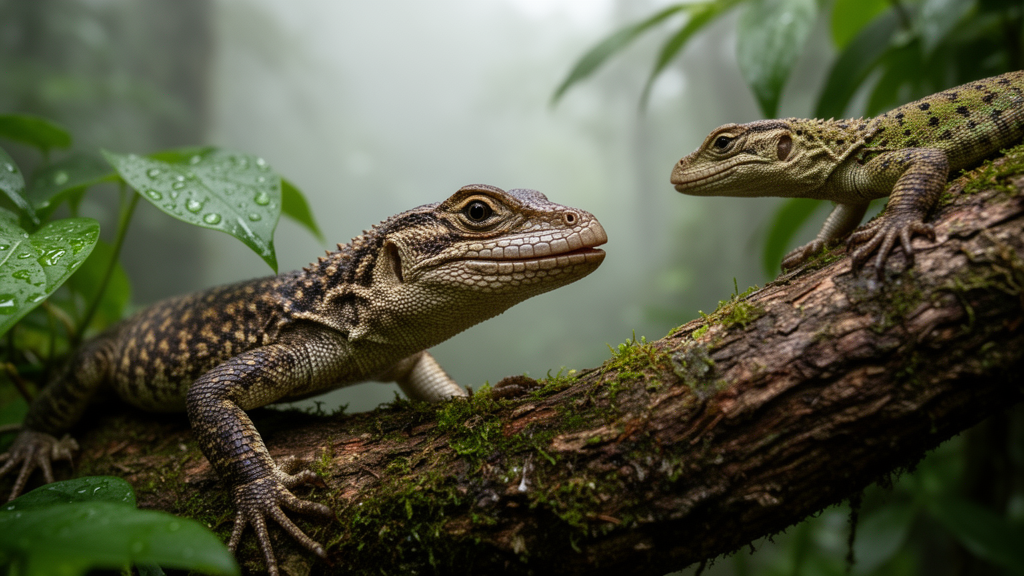
In the misty pine–oak and cloud forests of southeastern Guatemala, one of Central America’s most endangered lizards is quietly rewriting a familiar rule of reptile biology. A new study of Campbell’s Alligator Lizard (Abronia campbelli), a critically endangered species that lives almost nowhere else on Earth, shows that males and females are nearly identical in overall body size and weight, yet males carry strikingly broader heads. The finding, published in the journal Herpetozoa, suggests that sexual selection through male combat and mate-grasping, rather than simple differences in body size, is the dominant force sculpting the anatomy of this rare canopy dweller.
Sexual size dimorphism, the phenomenon in which males and females of the same species differ in dimensions such as body length, head size, or mass, is widespread across the animal kingdom. Lizards have long served as model organisms for studying these differences because their traits are easy to measure in the field and often reflect the different reproductive roles of the sexes. Males of many species evolve proportionately larger heads because aggressive encounters with rival males favour a stronger bite, while females may develop longer trunks to accommodate the production of offspring. These pressures can create hyperallometric or hypoallometric growth patterns, in which a trait scales either disproportionately faster or slower relative to overall body size, driving subtle but meaningful divergence between the sexes.
The genus Abronia, the alligator lizards of the subfamily Gerrhonotinae, offers a rich but understudied system for exploring such questions. These lizards are endemic to Mesoamerican highland forests, historically ranging from central Mexico to western Panama, and most of the roughly 39 recognized species are arboreal, decorated with vivid patterns of blue, green, cream, brown, and black that blend seamlessly into the epiphyte-laden canopy. Recent genomic work has complicated the picture by revealing that Abronia is nested within or closely allied with the terrestrial genus Mesaspis, meaning neither genus is monophyletic under its traditional definition. Despite their charisma, ecological and life-history data for most Abronia species remain sparse and anecdotal, and sexual size dimorphism has been formally analyzed in fewer than 15 percent of the described species.
Campbell’s Alligator Lizard is a micro-endemic of southeastern Guatemala, restricted to old-growth oak forests dominated by Quercus peduncularis and Q. brachystachys, where it shows a strong association with the epiphytic Spanish moss Tillandsia usneoides, its primary microhabitat. To investigate sexual dimorphism and tail loss in this species, researchers conducted diurnal surveys near Potrero Carrillo in the department of Jalapa between 2014 and 2016, capturing 54 adult lizards: 29 males and 25 females. Fieldwork was carried out under appropriate research licenses and collection permits, and each animal was measured, sexed, tagged with a passive integrated transponder, and released at its capture site.
The measurement protocol was deliberately conservative. Only individuals with a snout–vent length of at least 105 millimeters were included, a threshold above the 93 to 94 millimeters reported for the smallest adults in the original species description, ensuring that all subjects were reproductively mature. Using electronic calipers, the team recorded snout–vent length, measured from the tip of the snout to the anterior margin of the cloaca, and maximum head width, while body mass was determined with an analytical balance accurate to 0.01 grams. Sex was confirmed by manually everting the hemipenes, and each lizard was scanned with a PIT tag reader on subsequent captures to prevent duplicate measurements.
The results painted a clear picture of monomorphism in size coupled with dimorphism in shape. Male snout–vent lengths ranged from 89.0 to 129.8 millimeters, averaging 105.6 millimeters, while females ranged from 90.0 to 122.0 millimeters, averaging 106.1 millimeters, a difference that was statistically indistinguishable. Body mass told the same story: females averaged 27.3 grams and males 28.6 grams, with no significant difference. Head width, however, broke the symmetry decisively. Males averaged 23.3 millimeters compared with 18.8 millimeters in females, and an analysis of covariance using snout–vent length as the covariate confirmed that males had significantly broader heads relative to their body size, averaging about 19.3 percent wider than those of females.
The allometric analysis added further nuance. In females, the relationship between snout–vent length and body mass was hyperallometric, with a slope significantly greater than one, meaning heavier females become disproportionately heavier as they grow, a pattern potentially tied to reproductive investment. In males, the same relationship was essentially isometric, while head width scaled hypoallometrically with both body length and mass. The researchers interpreted this combination, monomorphic body size with disproportionately broad male heads, as evidence that head morphology in males is under strong intrasexual selective pressure, favoring bite power and gripping ability rather than sheer bulk.
Why would male Abronia campbelli need such robust heads? The answer likely lies in the species’ social life. Comparative data from related species show the same trend: males of Abronia monticola average 14.5 percent wider heads than females, A. graminea 11.3 percent, and A. taeniata 10.2 percent. In lacertilian lizards, dimorphism in head size arises from differential growth of the postorbital region, which houses the jaw abductor muscles that generate bite force. Larger heads translate into stronger bites, which can help males win territorial contests and gain access to females. Laboratory studies of the related A. vasconcelosii documented nine distinct behavior patterns, with bites from head to tail the most frequent in both male–male and female–female interactions. The authors of the new study observed similar antagonistic encounters in the wild, typically chases between same-sex individuals that sometimes ended in biting, as well as occasional bouts during incidental handling when lizards were briefly placed together.
Mate-holding behavior offers another compelling explanation. During copulation, male Abronia typically restrain females with a firm bite on the left or right side of the head, and these grips can last for hours. A male A. mixteca has been observed grasping a female on the temporal region for eight hours, A. deppii copulations have lasted approximately 18 hours, and captive male A. antauges have maintained a hold on a female’s head for nearly four hours; in the related genus Elgaria, mate-holding can exceed 24 hours. A broader head likely improves a male’s ability to maintain such a grip, directly influencing reproductive success. An earlier study of A. campbelli had even reported a larger head-width disparity, around 38 percent, hinting that the pattern in this species may be among the most pronounced in the genus.
Perhaps the study’s most surprising result concerned the tail. Caudal autotomy, the self-amputation of the tail to escape predators or rivals, occurred at remarkably low frequencies: 4.17 percent in males and 4.88 percent in females, with no significant difference between the sexes. By comparison, 72.2 percent of captured A. vasconcelosii have been reported with regenerated tails. The authors propose several non-exclusive explanations, including reduced intraspecific aggression, lower population densities associated with the species’ endangered status, or an inherently low autotomy threshold. For an arboreal lizard, the prehensile tail functions as a fifth limb, and its loss significantly impairs canopy performance, making its preservation essential. Notably, low tail-loss rates do not necessarily mean combat avoids the tail; inducing tail loss in a rival can itself be advantageous by removing a valuable locomotor structure. As the authors conclude, the intersection of morphology and social behavior in these endangered lizards underscores how much basic natural history remains to be learned before conservation efforts can be fully effective.
Subject of Research: Sexual size dimorphism and caudal autotomy in the critically endangered arboreal lizard Abronia campbelli
Article Title: It's not all about size: sexual size dimorphism and caudal autotomy of Campbell's Alligator Lizard, Abronia campbelli Brodie & Savage, 1993
Article References: Torres-Almazán, M., Schrei Godoy, K. T., Lock, B. A., Escobedo-Galván, A. H., & González-Maya, J. F. (2026). It's not all about size: sexual size dimorphism and caudal autotomy of Campbell's Alligator Lizard, Abronia campbelli Brodie & Savage, 1993. Herpetozoa, 39, 367-372. https://doi.org/10.3897/herpetozoa.39.e178597
Image Credits: AI Generated
DOI: 10.3897/herpetozoa.39.e178597
Keywords: Abronia campbelli, alligator lizards, sexual size dimorphism, caudal autotomy, sexual selection, Guatemala, Herpetozoa, arboreal reptiles, endangered species, bite force, allometry, male combat
Cite Scienmag News
Gavin Prescott. (October 17, 2026). Broader Heads, Not Bigger Bodies: Male Combat Shapes Endangered Guatemalan Alligator Lizard. Scienmag. https://scienmag.com/broader-heads-not-bigger-bodies-male-combat-shapes-endangered-guatemalan-alligator-lizard/
Gavin Prescott. "Broader Heads, Not Bigger Bodies: Male Combat Shapes Endangered Guatemalan Alligator Lizard." Scienmag, 17 October 2026, https://scienmag.com/broader-heads-not-bigger-bodies-male-combat-shapes-endangered-guatemalan-alligator-lizard/. Accessed 17 October 2026.
Gavin Prescott. "Broader Heads, Not Bigger Bodies: Male Combat Shapes Endangered Guatemalan Alligator Lizard." Scienmag. October 17, 2026. https://scienmag.com/broader-heads-not-bigger-bodies-male-combat-shapes-endangered-guatemalan-alligator-lizard/


