


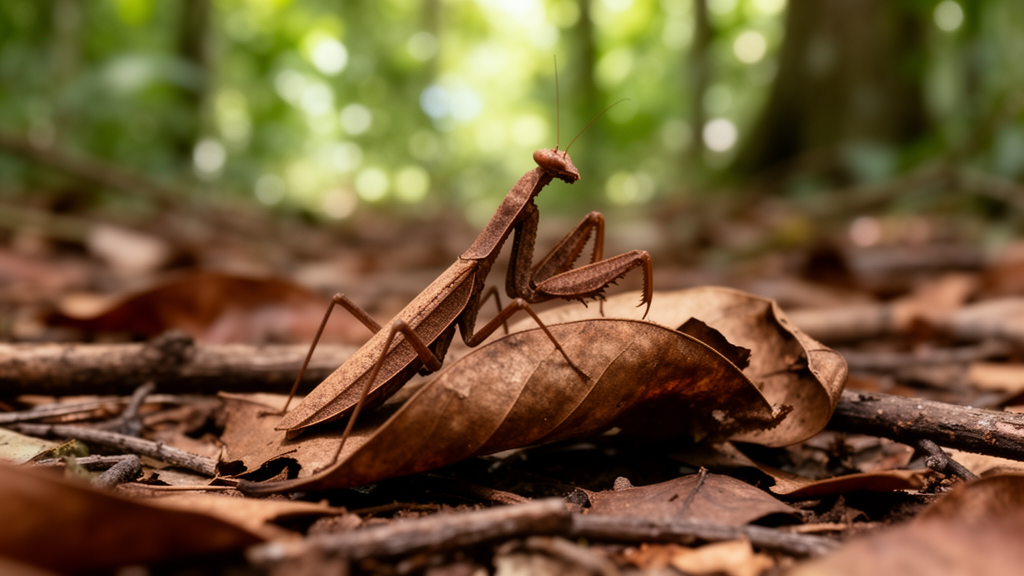
Deep in the Cerrado and Pantanal wetlands of Mato Grosso do Sul, Brazil, insects that look exactly like dead leaves have been quietly evading scientists for years. Now, a new study published in the Journal of Orthoptera Research has lifted the veil on two species of dry-leaf praying mantids from the genus Decimiana, recording them for the first time in this Midwestern Brazilian state and, in a move that has taxonomists excited, describing the female genitalia of both species for the very first time. The work, based on 21 specimens and two egg cases held at the Federal University of Mato Grosso do Sul, fills a stubborn gap in the knowledge of one of the Neotropics’ most cryptic insect families.
Acanthopidae, the family to which Decimiana belongs, is the third most diverse family of Neotropical praying mantids, with 42 species distributed across nine genera. What makes these insects so remarkable is their extraordinary resemblance to dry leaves at different stages of senescence, or even to lichen- and moss-covered bark. This is not mere coincidence but the result of millions of years of evolutionary refinement, producing insects whose bodies mimic the veins, edges, and discolorations of decaying foliage so precisely that even trained entomologists can walk right past them. The genus Decimiana itself comprises seven species of dead-leaf mantids endemic to the Neotropical region, and it was last thoroughly revised by Lombardo in 2000, with only three species added since then.
The two species now confirmed for Mato Grosso do Sul are Decimiana tessellata, originally described by Charpentier in 1841, and Decimiana hebardi, described by Lombardo in 2000. The researchers identified four adult males, five adult females, twelve nymphs, and two oothecae, the protective egg cases that mantids produce. Most strikingly, the majority of the nymphs were reared from two oothecae laid by a single female D. tessellata, giving the team a rare opportunity to observe intraspecific variation across life stages. One female nymph from a different locality could not be identified to species level but was still mapped as a new record for the genus in the state.
The study’s most significant contribution lies in the detailed description of the genitalia of both sexes. While male genitalia in Decimiana had been described before, the female genitalia had never been formally characterized for any species in the genus, with only one earlier portrayal from 1964 that was misidentified at the time. Using standardized dissection protocols, the team submerged terminalia in heated water between 80 and 100 degrees Celsius for fifteen minutes, extracted the phallic complex with a hypodermic needle, clarified the structures in warmed 10 percent potassium hydroxide, and neutralized them with acetic acid before dissecting each component individually. The dissected parts were then stored in microtubes containing glycerin and photographed using a Leica M205C auto-stacking stereomicroscope and a Nikon D3200 with a macro lens.
The results reveal striking differences between the two species. In D. tessellata, the proximal margin of the caudogyne, a key sclerotized structure in the female genitalia, is more deeply convex than in D. hebardi, creating a distinct structural profile. The spermathecal bulge of D. tessellata is far more ornate, with a variable number of invaginations in its lateral margins, compared to the more homogeneous margins of D. hebardi. Conversely, the margins of the coxal lobe and coxa 8 are more wrinkled in D. hebardi than in D. tessellata. The inner margin of gonapophysis 8 shows a smooth sinuous profile in D. tessellata but an almost straight profile in D. hebardi, while the outer margin of the same structure is noticeably more sclerotized in the latter species.
The bifurcated apex of gonapophysis 8 provides perhaps the most visually distinctive character separating the two species. In D. tessellata, the point of division occurs closer to the medial growth of the gonapophysis, and after bifurcation the upper part is elongated with a squarer apex while the lower part extends past the division point. In D. hebardi, the division occurs in the distalmost region, the upper part is elongated with a tapered outline, and the lower part does not extend far beyond the division point, presenting a rounded outline instead. These subtle but consistent differences in female anatomy offer taxonomists a powerful new toolkit for distinguishing species that are nearly indistinguishable by external morphology alone.
Male genitalia also show considerable variation between the two species, making adult identification straightforward once the structures are examined. The ventral phallomere, left phallomere, and right phallomere each display characteristic differences in the shape and position of sclerites such as the anterior process, the main posterior lobe, and the paired processes known as pia and pva. In D. hebardi, the pia is larger than the pva and appears attached to the membranous portion of the right phallomere, while in D. tessellata the relationship between these structures differs in ways that are clearly visible in the high-resolution images accompanying the study.
Geographically, the new records span seven municipalities across two distinct biomes, the Cerrado savanna and the Pantanal wetlands: Aquidauana, Campo Grande, Corguinho, Corumbá, Coxim, Jaraguari, and Porto Murtinho. D. hebardi was documented in Aquidauana, Corumbá, Coxim, and Campo Grande, while D. tessellata was recorded in Porto Murtinho, Corguinho, and Campo Grande. Although these occurrences are not particularly surprising given that both species are already documented in neighboring Brazilian states and Bolivia, the researchers note that large-scale collection biases present in entomological surveys have long distorted our understanding of mantid distributions. Thorough surveys in under-sampled Brazilian regions will most probably yield new records, novel biological data, and even undescribed species.
The study also carries a broader message about the state of praying mantis taxonomy. Rivera and Svenson noted in 2020 that in sexually dimorphic taxa such as the genera within Acanthopidae, roughly half of all species are known from only one sex, and this incomplete assessment has led to uncertainty in species delimitation. The historical practice of describing congeneric males and females under different species or genus names has plagued mantid systematics for over a century. The authors argue that reporting female external and genital morphological characters should become the standard procedure in Mantodea taxonomy, especially in highly cryptic and sexually dimorphic groups where external morphology alone is insufficient for reliable identification.
With the female genitalia of these two Decimiana species now described, a foundation for comparisons across Neotropical mantid lineages is beginning to take shape. Recent work on other genera such as Pseudomiopteryx, Acontista, and Metaphotina has already illustrated female genitalia with high-resolution imagery, enabling comparisons across close and distant taxa within Acanthopoidea. As these anatomical characters accumulate, they promise to feed directly into systematic and phylogenetic analyses, helping resolve relationships among lineages that have puzzled researchers for decades. For now, the dry-leaf mantids of Mato Grosso do Sul stand as a reminder that even in well-studied countries, extraordinary insects are still hiding in plain sight, perfectly camouflaged among the fallen leaves they so faithfully imitate.
Subject of Research: Unveiling details of the dry-leaf praying mantids: Insights into two species of Decimiana (Mantodea, Acanthopidae) and new records for Mato Grosso do Sul, Brazil
Article Title: Unveiling details of the dry-leaf praying mantids: Insights into two species of Decimiana ( Mantodea , Acanthopidae ) and new records for Mato Grosso do Sul, Brazil
Article References: Ferraz, B. R., Olivier, R. S., & Souza-Dias, P. G. B. (2026). Unveiling details of the dry-leaf praying mantids: Insights into two species of Decimiana (Mantodea, Acanthopidae) and new records for Mato Grosso do Sul, Brazil. Journal of Orthoptera Research, 35(1), 53-62. https://doi.org/10.3897/jor.35.148862
Image Credits: AI Generated
Keywords: Unveiling, details, dry-leaf, praying, mantids, Insights, species, Decimiana, Mantodea, Acanthopidae, records, Mato
Cite Scienmag News
Gavin Prescott. (October 17, 2026). Dry-leaf praying mantids revealed: Two Decimiana species newly recorded in Brazil. Scienmag. https://scienmag.com/dry-leaf-praying-mantids-revealed-two-decimiana-species-newly-recorded-in-brazil/
Gavin Prescott. "Dry-leaf praying mantids revealed: Two Decimiana species newly recorded in Brazil." Scienmag, 17 October 2026, https://scienmag.com/dry-leaf-praying-mantids-revealed-two-decimiana-species-newly-recorded-in-brazil/. Accessed 17 October 2026.
Gavin Prescott. "Dry-leaf praying mantids revealed: Two Decimiana species newly recorded in Brazil." Scienmag. October 17, 2026. https://scienmag.com/dry-leaf-praying-mantids-revealed-two-decimiana-species-newly-recorded-in-brazil/


