


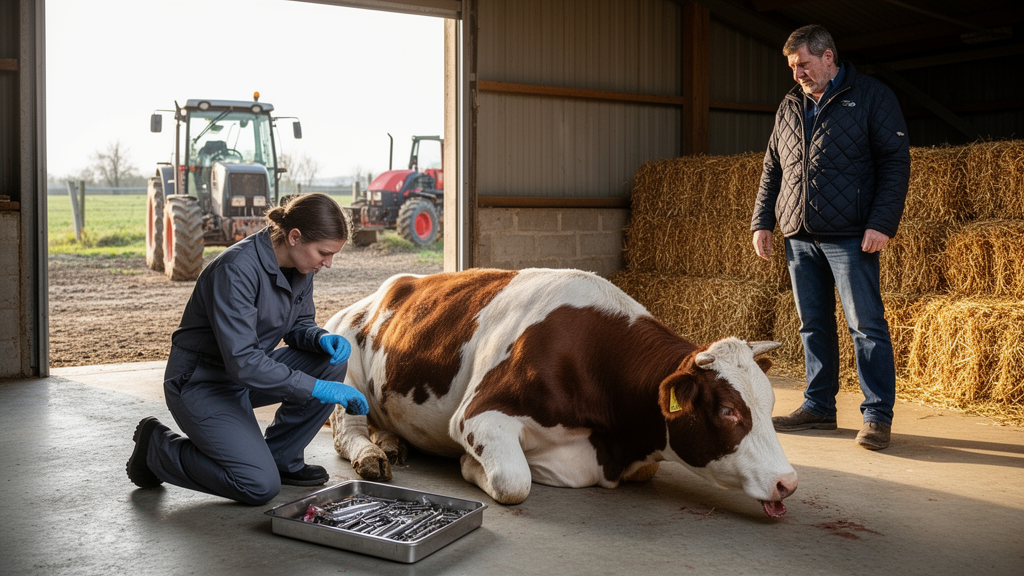
When a cow dies unexpectedly on a modern dairy or feedlot operation, the answer to why it died is often buried with the animal. Postmortem examination, or necropsy, is widely recognized as one of the most powerful diagnostic tools in veterinary medicine, capable of revealing the cause of death, exposing emerging disease threats, and guiding herd-level interventions. Yet a new scoping review published in Frontiers in Veterinary Science confirms what many field veterinarians have long suspected: despite its proven value, the procedure is rarely performed where it matters most—in the field, on the farm, at the moment of death.
The review, conducted by researchers at Texas Tech University School of Veterinary Medicine and Texas Tech University Health Sciences Center, systematically combed through nearly a thousand published studies to understand why field postmortem examinations (PMEs) remain so underused in cattle production systems. Led by Nathaly Vargas and Elpida Artemiou, the team followed the methodological framework of Arksey and O’Malley as refined by Levac et al., and reported their findings in accordance with PRISMA-ScR guidelines. Their search spanned PubMed, Scopus, Embase, Web of Science, and Google Scholar, supplemented by hand searching, citation tracking, and even AI-assisted search tools available through Scopus and Embase.
The numbers tell a striking story. Of 988 references initially identified, 328 were removed as duplicates, leaving 660 records for title and abstract screening. After 521 were excluded, 139 full-text articles were assessed for eligibility. In the end, only twelve studies—published between 2010 and 2024—met the inclusion criteria. That scarcity itself is a finding: the scientific literature on how, why, and whether field necropsies are actually performed in cattle operations is remarkably thin.
Inter-reviewer agreement, measured by Cohen’s kappa, was fair during title and abstract screening (κ = 0.285) but nearly perfect during full-text review (κ = 0.953), reflecting the greater clarity available when complete papers could be evaluated against the eligibility criteria. The twelve included studies spanned eight countries—five in the United States, and one each in Nigeria, Sweden, the United Kingdom, Ireland, Denmark, Canada, and Brazil. Seven were cross-sectional surveys, three were observational studies, one was experimental, and one was a field-based pilot feasibility study with a qualitative component.
What emerges from those twelve studies is a consistent picture of a diagnostic procedure that everyone values but almost no one performs routinely. Veterinarians across the included studies overwhelmingly regarded PME as a valuable tool for disease diagnosis, herd health management, and epidemiological surveillance. Yet the same studies documented persistent barriers: producer reluctance to authorize the procedure, time constraints, economic considerations, carcass disposal challenges, biosecurity concerns, and—perhaps most fundamentally—a lack of training in how to perform the examination properly.
One study cited in the review found that the primary reason practitioners declined to perform a PME was the producer’s refusal to authorize the service, reported by 69 percent of respondents. Time constraints followed at 44 percent, cost at 38 percent, and carcass disposal at 27 percent. Another study found that approximately 20 percent of veterinarians declined to perform on-farm PMEs altogether because of biosecurity risks, while those who did proceed often implemented extensive protective measures. Meanwhile, para-veterinarians in Nigeria demonstrated lower knowledge of zoonotic diseases and lower risk perception than fully qualified veterinarians, and reported inconsistent use of personal protective equipment during high-risk procedures.
The review also highlights a critical gap between theoretical knowledge and practical competence. Veterinarians may understand what a necropsy entails in principle, but the included studies revealed deficiencies in lesion interpretation, diagnostic sample collection, and the consistent application of standardized biosecurity practices. This aligns with international competency frameworks from the World Organisation for Animal Health, which emphasize that effective field PMEs require not just anatomical knowledge but integrated skills in diagnostic reasoning, sample handling, photographic and written documentation, and clear communication with producers.
Several of the included studies point toward technological solutions that could bridge this gap. A Swedish pilot study demonstrated that remote digital necropsy—where trained veterinarians conduct the examination on-farm while images are interpreted remotely by a bovine practitioner—showed good agreement with conventional field PME findings. In Canada, an experimental study found that real-time assistance from a veterinary pathologist increased the proportion of field PMEs reaching a definitive diagnosis from 66 percent to 96 percent, while also improving tissue sampling and diagnostic confidence. In Brazil, researchers found that combining tissue samples with photographic images improved diagnostic accuracy compared with photographs alone, and that smartphone messaging applications facilitated real-time communication between field veterinarians and diagnostic laboratories.
The review’s authors argue that these findings support a shift toward competency-based education that integrates foundational knowledge with deliberate practice in authentic field settings. Early-career bovine veterinarians expressed a preference for hybrid learning models combining online instruction with hands-on workshops, while practicing dairy veterinarians identified continuing education needs in areas such as neurologic disease recognition and gross lesion interpretation. The authors suggest that veterinary education should move beyond theoretical transmission of knowledge and instead emphasize simulated and real-world field conditions, structured feedback, adequate caseload exposure, and appropriate supervision.
Beyond individual diagnoses, the review frames field PMEs within a One Health perspective. Systematic lesion recognition, rigorous sample collection, standardized documentation, and laboratory confirmation can strengthen early-warning surveillance of emerging infectious and zoonotic diseases at the human-animal interface. Conversely, inconsistent use of personal protective equipment and gaps in zoonotic risk awareness among veterinarians and farm workers represent occupational vulnerabilities that current training approaches have failed to address. The authors acknowledge limitations, including the restriction to English-language publications between 2000 and 2025, the predominance of self-reported survey data susceptible to reporting and recall bias, and a strong geographical concentration in high-income countries—eleven of the twelve studies were conducted in the Global North, potentially limiting applicability to lower-resource settings where veterinary infrastructure and diagnostic access differ substantially.
Ultimately, the review concludes that field PMEs remain underutilized not because their value is in question, but because the systems, training, and incentives needed to perform them consistently are absent. Standardized protocols, competency-based curricula, digital documentation tools, and remote consultation with veterinary pathologists all offer promising pathways forward. But as the authors make clear, closing the gap between what veterinarians know and what they actually do in the field will require more than awareness—it will require deliberate, structured, and sustained investment in practical training tailored to the realities of modern cattle production.
Subject of Research: Barriers and training needs for field postmortem examinations in cattle production systems
Article Title: Field postmortem examination practices in cattle production systems: a scoping review of knowledge, attitudes, training and barriers
Article References: Vargas, N., Stuart, D., Marshall, E., Wenzlow, N., Roof, C., & Artemiou, E. (2026). Field postmortem examination practices in cattle production systems: a scoping review of knowledge, attitudes, training and barriers. Frontiers in Veterinary Science, 13, Article 1968345. https://doi.org/10.3389/fvets.2026.1968345
Image Credits: AI Generated
DOI: 10.3389/fvets.2026.1968345
Keywords: postmortem examination, necropsy, cattle production, veterinary education, One Health, scoping review, dairy, beef cattle, biosecurity, diagnostic sampling, telepathology, herd health
Cite Scienmag News
William Thompson. (October 17, 2026). Why Cattle Necropsies Rarely Happen on the Farm: Landmark Scoping Review Reveals Training Gaps and Barriers. Scienmag. https://scienmag.com/why-cattle-necropsies-rarely-happen-on-the-farm-landmark-scoping-review-reveals-training-gaps-and-barriers/
William Thompson. "Why Cattle Necropsies Rarely Happen on the Farm: Landmark Scoping Review Reveals Training Gaps and Barriers." Scienmag, 17 October 2026, https://scienmag.com/why-cattle-necropsies-rarely-happen-on-the-farm-landmark-scoping-review-reveals-training-gaps-and-barriers/. Accessed 17 October 2026.
William Thompson. "Why Cattle Necropsies Rarely Happen on the Farm: Landmark Scoping Review Reveals Training Gaps and Barriers." Scienmag. October 17, 2026. https://scienmag.com/why-cattle-necropsies-rarely-happen-on-the-farm-landmark-scoping-review-reveals-training-gaps-and-barriers/


