


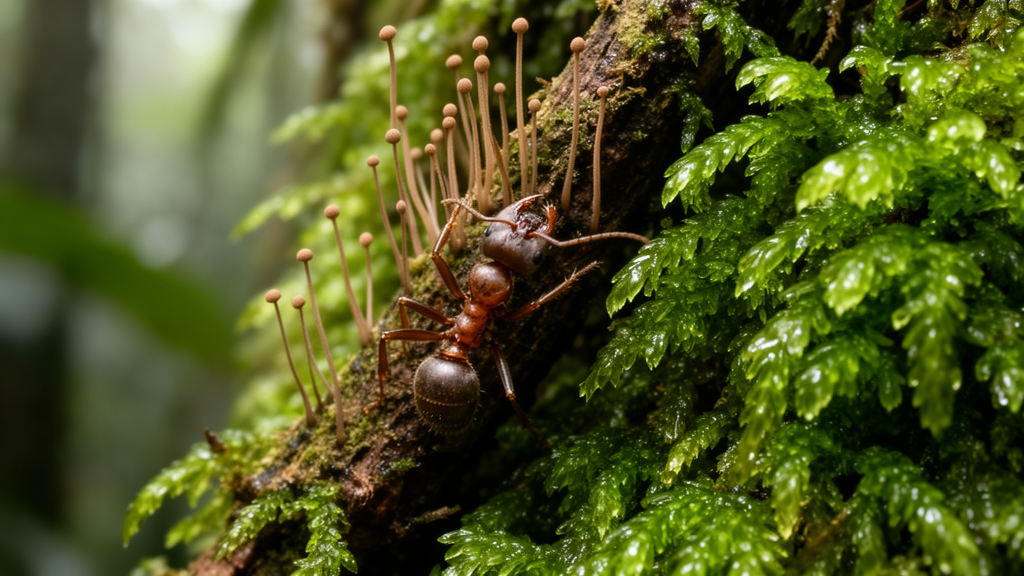
In the understory of the Amazon rainforest, the infamous “zombie-ant” fungus has been hiding a secret life. New research from the Adolpho Ducke Reserve near Manaus reveals that the parasitic fungus Ophiocordyceps, famous for hijacking the minds of ants, also lives quietly inside mosses as an endophyte, a symbiotic organism living within plant tissue. The findings challenge the long-held view that these fungi are purely entomopathogenic, meaning they infect only insects, and suggest they may have a hidden, plant-associated stage in their life cycle.
The study, led by mycologist João Araújo of the New York Botanical Garden and colleagues, focused on the Adolpho Ducke Reserve, a 100-square-kilometer patch of primary rainforest embedded within the city of Manaus. The team surveyed the reserve’s understory, documenting ants that had been killed by Ophiocordyceps and noting exactly where the fungal spore-bearing structures, called ascomata, emerged from the victims’ bodies. They then collected samples of the mosses and liverworts, collectively known as bryophytes, growing at these sites, along with additional bryophyte samples from elsewhere in the reserve.
Back in the laboratory, the researchers used DNA metabarcoding to identify the fungi living within the bryophyte tissues. They amplified a genetic marker called TEF1-alpha and sequenced the resulting DNA using Oxford Nanopore technology, a portable sequencing platform capable of reading long DNA fragments. The analysis revealed a startling diversity of fungal life: across all the bryophyte samples, the team detected 2,677 distinct fungal taxa, spanning a wide range of ecological roles from decomposers to plant pathogens.
Crucially, the most abundant group of fungi detected within the mosses was Ophiocordyceps itself. The researchers found DNA of these zombie-ant fungi in nearly every bryophyte sample, including mosses growing far from any infected ants. The team identified several species known to infect ants in the region, including Ophiocordyceps camponoti-renggeri, Ophiocordyceps kniphofioides, and Ophiocordyceps monacidis, among others. The detection of these species within moss tissues, rather than merely on their surfaces, suggests the fungi were living as endophytes within the plants.
The findings build on years of fieldwork by Araújo and colleagues, who had previously noticed that certain ant-infecting Ophiocordyceps species in the Amazon seemed to preferentially manipulate their victims into biting specific plants before dying. Infected Camponotus ants, for example, were repeatedly found locked in a death grip on moss carpets, particularly those of the moss Octoblepharum, with the fungal ascomata emerging from their bodies. Other species showed similar affinities for bromeliads, palm trees, and other understory plants. These observations hinted that the fungi might have some physiological connection to the plants their victims died on, but the mechanism remained unknown.
The new study provides the first direct evidence that Ophiocordyceps can live within bryophyte tissues in the Amazon. The researchers propose that the fungi may use mosses as a refuge or reservoir, persisting in the environment between ant infections. This hidden endophytic stage could serve several functions: it might allow the fungi to survive unfavorable conditions, such as dry seasons when ant hosts are scarce; it could provide a substrate for the fungi to reproduce sexually, which some species require to complete their life cycle; or it might even play a role in the fungi’s dispersal, with spores or fragments carried away by rain, wind, or animals.
The idea that Ophiocordyceps has a plant-associated stage is not entirely new. Previous studies in Asia had found that the caterpillar fungus Ophiocordyceps sinensis, which infects ghost moth larvae on the Tibetan Plateau, also lives within the tissues of alpine plants. And researchers had detected DNA of Ophiocordyceps within mosses in temperate regions of North America and Europe. But the Amazon study is the first to systematically document this phenomenon in the tropics, where the diversity of both fungi and bryophytes is far greater.
The researchers also note that the endophytic stage may explain some puzzling aspects of the zombie-ant fungi’s ecology. For example, the fungi are known to be highly host-specific, with each species typically infecting only one or a few ant species. Yet the fungi must also find their hosts in a complex, three-dimensional forest environment. If the fungi persist within bryophytes, which form extensive carpets on the forest floor and on tree trunks, they may be able to wait in ambush for passing ants, increasing their chances of infection. The fungi’s preference for certain plants, such as Octoblepharum mosses, may reflect the microhabitat preferences of their ant hosts, which often forage on these substrates.
The study also raises questions about the evolutionary history of the zombie-ant fungi. The researchers suggest that the endophytic lifestyle may be an ancestral trait, retained from the fungi’s origins as plant-associated organisms. Molecular studies have shown that Ophiocordyceps is closely related to other fungi that live within plants, and the ability to colonize plant tissues may have provided the evolutionary stepping stone for the fungi’s later colonization of insects. If so, the zombie-ant fungi’s famous mind-control abilities may have evolved from a more mundane capacity to live within plants.
The findings have implications for conservation as well. The Adolpho Ducke Reserve is one of the few remaining patches of primary rainforest within Manaus, and it faces pressures from urbanization and climate change. If Ophiocordyceps depends on bryophytes for part of its life cycle, then the conservation of these fungi may require the protection of the mosses and liverworts they inhabit. Bryophytes are sensitive to environmental changes, including drying and pollution, and their decline could have cascading effects on the fungi that depend on them.
The researchers plan to continue their work in the Amazon, investigating the physiological interactions between Ophiocordyceps and its bryophyte hosts. They hope to determine whether the fungi receive nutrients from the plants, whether they reproduce within the bryophyte tissues, and whether the endophytic stage is essential for the fungi’s survival. They also plan to survey other regions of the Amazon to see how widespread the phenomenon is. For now, the study stands as a vivid reminder that even the most famous parasites in the natural world may have hidden lives waiting to be discovered, living quietly within the green carpets of the rainforest floor.
Subject of Research: Ecology and life cycle of Ophiocordyceps fungi in Amazonian bryophytes
Article Title: Metabarcoding reveals a hidden endophytic stage of the 'zombie-ant' fungus in Amazonian mosses
Article References: Alves-Júnior, T., Araújo, J. P. M. D., Góes-Neto, A., Mendes-Pereira, T., & Zartman, C. E. (2026). Metabarcoding reveals a hidden endophytic stage of the 'zombie-ant' fungus in Amazonian mosses. IMA Fungus, 17, Article e196998. https://doi.org/10.3897/imafungus.17.196998
Image Credits: AI Generated
DOI: 10.3897/imafungus.17.196998
Keywords: mycology, parasitology, entomology, bryophytes, Amazon rainforest, symbiosis, fungi, Metabarcoding, reveals, hidden, endophytic, stage
Cite Scienmag News
Roger Howard. (October 17, 2026). Zombie-Ant Fungus Has a Secret Life Hidden Within Amazonian Mosses. Scienmag. https://scienmag.com/zombie-ant-fungus-has-a-secret-life-hidden-within-amazonian-mosses/
Roger Howard. "Zombie-Ant Fungus Has a Secret Life Hidden Within Amazonian Mosses." Scienmag, 17 October 2026, https://scienmag.com/zombie-ant-fungus-has-a-secret-life-hidden-within-amazonian-mosses/. Accessed 17 October 2026.
Roger Howard. "Zombie-Ant Fungus Has a Secret Life Hidden Within Amazonian Mosses." Scienmag. October 17, 2026. https://scienmag.com/zombie-ant-fungus-has-a-secret-life-hidden-within-amazonian-mosses/


