


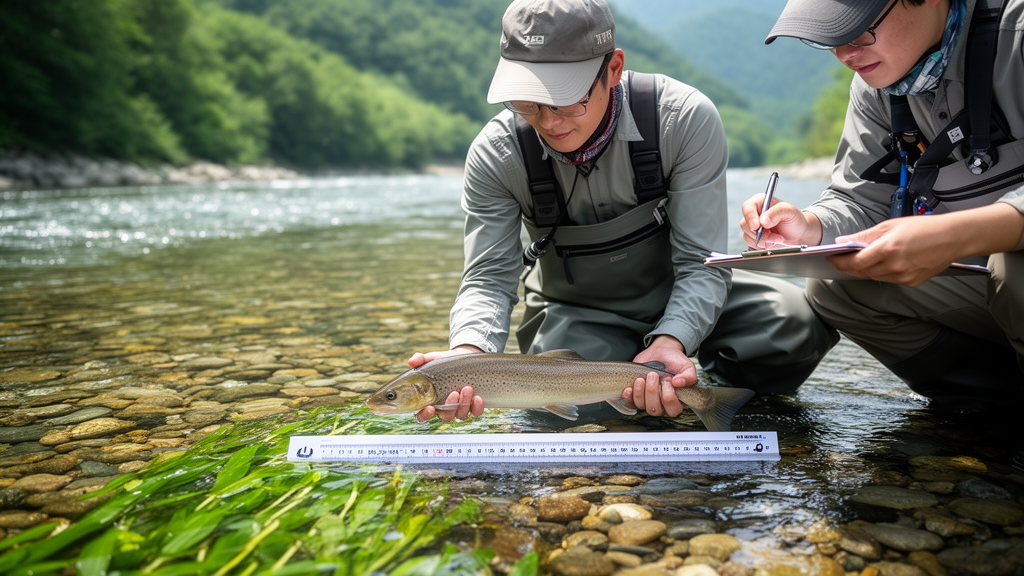
Along the shallow streams and deeper channels of southeastern Gyeongsangnam-do, South Korea, a team of fish biologists has quietly assembled one of the most detailed growth datasets yet published for the region’s freshwater fishes. Their new study, appearing in the journal Acta Ichthyologica et Piscatoria, reports length–weight relationships for 21 species sampled from two major drainage systems: the Ulju basin, which includes the Yangyang and Hoeya rivers near Ulsan, and the Miryang River system, which includes the Miryang River and the Danjang Stream. Together, these waterways drain hundreds of square kilometers of mixed mountain and agricultural landscape, and they harbor a fish community that includes both native Korean endemics and invasive global pests.
Length–weight relationships are among the oldest and most practical tools in fisheries science. The basic idea is deceptively simple: because fish grow in length and gain in weight in a predictable mathematical relationship, measuring just the length of a fish can allow researchers to estimate its weight with reasonable accuracy. That matters enormously in the field, where weighing every individual is time-consuming and sometimes impractical, especially for small or delicate species. The relationship also reveals something deeper about a fish’s body shape and condition: whether a population is well-fed, stunted, or under environmental stress. The equation at the heart of the method, W = a × L^b, captures this with two parameters, where the exponent b tells scientists whether a fish grows proportionally, becomes more elongated, or becomes more robust as it matures.
The research team, led by Korean and collaborating ichthyologists, sampled fish using a combination of methods tailored to the two very different environments. In the Ulju basin, where waters are shallower and more accessible, they used cast nets and small hand nets to capture fish in riffles and pools. In the deeper, wider channels of the Miryang River system, they deployed larger traps and gill nets. Every fish was identified to species, anesthetized with a standard fish anesthetic to minimize suffering, measured for total length to the nearest 0.1 centimeter, and weighed to the nearest 0.01 gram before being returned alive to the water. This careful, non-lethal approach reflects a growing commitment in Korean freshwater research to minimize harm while maximizing data quality.
The 21 species studied span a remarkable range of ecological roles and evolutionary histories. They include the crucian carp (Carassius auratus), a hardy omnivore found across Eurasia; the sharpbelly (Hemiculter leis), a fast-swimming minnow; the pale chub (Zacco platypus), a visually striking stream fish with vertical bars; and the Korean endemic dark sleeper (Odontobutis interrupta), a bottom-dwelling ambush predator found nowhere else in the world. Several loaches, small elongated bottom-dwellers beloved by aquarium enthusiasts, were also sampled, along with the rice fish (Oryzias latipes), a tiny surface-dweller famous in Japanese and Korean culture, and two globally notorious invasive species: the bluegill (Lepomis macrochirus) and the largemouth bass (Micropterus salmoides), both introduced to Korean waters decades ago with significant ecological consequences.
What makes the new dataset particularly valuable is how many gaps it fills. For four of the 21 species, no length–weight relationship had ever been published in FishBase, the world’s leading online database of fish information. These four include the Korean endemic dark sleeper (Odontobutis interrupta), the Korean endemic loach (Iksookimia koreensis), the Korean endemic gudgeon (Pseudopungtungia tenuicorpa), and the Korean endemic dark chub (Nipponocypris koreanus). For another seven species, only one or two previous records existed anywhere in the scientific literature. This means that for more than half the species studied, the new data represent either the first or among the very few quantitative growth measurements ever published, a striking reminder of how much basic biological information remains undocumented even in a well-studied country like South Korea.
The statistical analysis revealed a fascinating pattern in how these fish grow. The exponent b, which describes the allometric relationship between length and weight, ranged from about 2.9 to 3.5 across the 21 species. Values close to 3.0 indicate isometric growth, meaning the fish maintains the same body shape as it grows larger. Values below 3.0 suggest the fish becomes more elongated and slender as it matures, while values above 3.0 indicate it becomes proportionally heavier and more robust. Most species in the study clustered near the isometric value, which is typical for healthy fish populations in productive habitats. However, some species showed notable deviations, and the researchers suggest these differences may reflect species-specific body forms, habitat conditions, or feeding strategies rather than environmental stress.
Among the most ecologically significant findings concerns the endangered Korean endemic loach, Iksookimia koreensis. This small, cryptic bottom-dweller is listed as a threatened species in South Korea, and its populations have declined due to habitat loss, water pollution, and competition with introduced species. The new study provides the first published length–weight relationship for this species, establishing a quantitative baseline that can now be used by conservation managers to estimate biomass, assess population health, and monitor recovery in restored habitats. For a species whose very survival may depend on active management, even a simple growth equation represents a meaningful conservation tool.
The presence of invasive bluegill and largemouth bass in the dataset also carries practical weight. Both species were introduced to Korean waters in the 1970s and have since spread widely, preying on native fish and disrupting aquatic food webs. Accurate length–weight relationships for these invaders allow researchers to estimate their biomass from length measurements alone, which is essential for assessing their ecological impact and evaluating the effectiveness of removal programs. The new data thus serve both conservation and management purposes, providing tools for protecting native species and for quantifying the footprint of harmful introduced ones.
The study also highlights the value of regional datasets. While global databases like FishBase aggregate information from around the world, growth parameters can vary significantly between populations living in different climates, habitats, and food environments. A length–weight relationship measured in a Korean mountain stream may differ from one measured in a Vietnamese floodplain or a European lowland river, even for the same species. By providing locally calibrated parameters, the new study improves the accuracy of any biomass or condition assessments conducted in Korean waters, and it contributes to a growing global effort to fill geographic and taxonomic gaps in fish biology.
For the researchers, the work is part of a broader effort to document the freshwater biodiversity of the Korean Peninsula before it is further altered by climate change, urbanization, and continued species introductions. Many of the endemic species studied, including the dark sleeper and several loaches, are found only in limited geographic areas and remain poorly studied. As rivers are dammed, channels are straightened, and non-native species continue to spread, the basic biological data needed to manage and conserve these fish becomes ever more urgent. The new length–weight relationships, though seemingly modest in scope, represent a foundation upon which future ecological research, conservation planning, and fisheries management can be built.
The full dataset, including all 21 species with their regression parameters, confidence intervals, and sample sizes, is now available to researchers worldwide through the published paper. As freshwater ecosystems face mounting pressures globally, studies like this one demonstrate that even fundamental descriptive work—measuring fish, weighing them, and fitting a simple equation—remains an essential and sometimes urgently needed contribution to biodiversity science.
Subject of Research: Fish biology and freshwater ecology
Article Title: Length–weight relationships for 21 fish species ( Actinopterygii ) from southeastern Gyeongsangnam-do, South Korea
Article References: Gim, J.-S., Sung, M. S., Hong, D., Joo, G.-J., Kim, D.-K., & Jo, H. (2026). Length–weight relationships for 21 fish species (Actinopterygii) from southeastern Gyeongsangnam-do, South Korea. Acta Ichthyologica et Piscatoria, 56, 177-180. https://doi.org/10.3897/aiep.56.184228
Image Credits: AI Generated
Keywords: Length, weight, relationships, fish, species, Actinopterygii, southeastern, Gyeongsangnam-do, South, Korea, scientific research
Cite Scienmag News
Margaret Porter. (October 17, 2026). New Fish Growth Data Fill Gaps for Korean Rivers, Including Rare Endangered Species. Scienmag. https://scienmag.com/new-fish-growth-data-fill-gaps-for-korean-rivers-including-rare-endangered-species/
Margaret Porter. "New Fish Growth Data Fill Gaps for Korean Rivers, Including Rare Endangered Species." Scienmag, 17 October 2026, https://scienmag.com/new-fish-growth-data-fill-gaps-for-korean-rivers-including-rare-endangered-species/. Accessed 17 October 2026.
Margaret Porter. "New Fish Growth Data Fill Gaps for Korean Rivers, Including Rare Endangered Species." Scienmag. October 17, 2026. https://scienmag.com/new-fish-growth-data-fill-gaps-for-korean-rivers-including-rare-endangered-species/


