


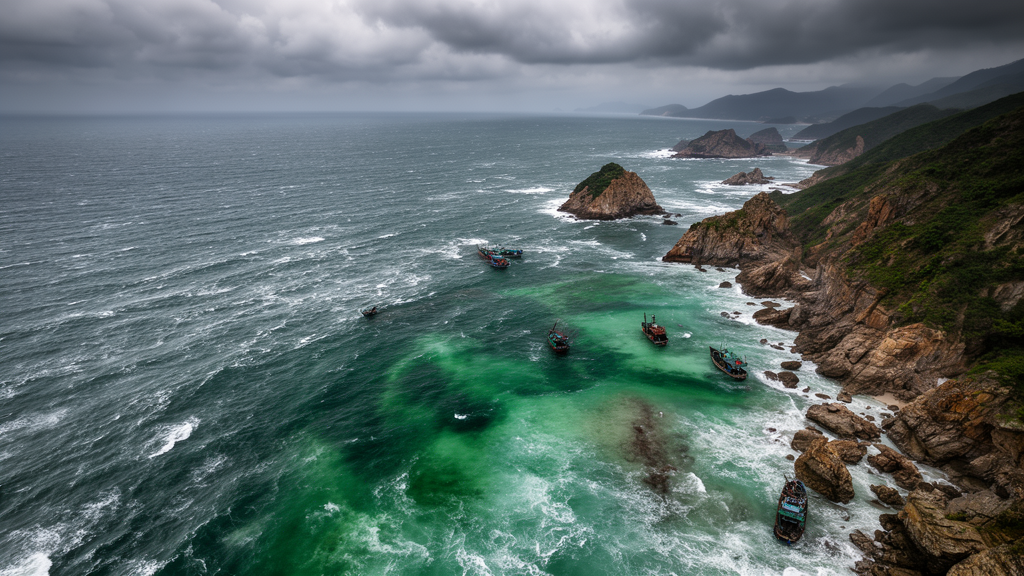
Every summer, a remarkable transformation unfolds along the eastern coast of Hainan Island in the northern South China Sea. Southwest monsoon winds push surface waters offshore, and in response, cold, nutrient-laden water rises from the depths to replace it. This process, known as coastal upwelling, turns an otherwise warm, nutrient-starved tropical sea into a brief but intense bloom factory. Now, a team of Chinese researchers has used a sophisticated coupled physical-biogeochemical model to trace exactly how nitrogen—the limiting nutrient in these waters—moves through the Qiongdong Upwelling system, revealing a tightly choreographed sequence of physical and biological events that unfolds over days and weeks.
The study, published in Frontiers in Marine Science, focused on the summer of 2010, when the Qiongdong Upwelling (QDU) generated a cold, nutrient-rich band stretching from the nearshore zone to approximately 20 kilometers offshore along the coast between Wanning and Wenchang. Using the Regional Ocean Modeling System (ROMS) coupled with the Fennel ecological model, the researchers simulated the three-dimensional circulation and nitrogen cycling at a horizontal resolution of roughly 3 kilometers, with 60 terrain-following vertical levels. The model was forced by hourly ERA5 atmospheric reanalysis data, daily HYCOM boundary conditions, and tidal forcing from ten major constituents, providing an unusually complete picture of the system’s dynamics.
Model validation was rigorous. The simulated sea surface temperature matched satellite-derived OSTIA data across 41,338 paired samples, with root-mean-square errors as low as 0.44°C in autumn and 0.48°C in winter. Vertical temperature profiles agreed with in situ observations from the PANGAEA database, yielding an RMSE of 1.60°C and a negligible bias of -0.03°C. Most impressively, simulated nitrate concentrations agreed with observed values across 77,672 paired samples throughout the water column, with a coefficient of determination of 0.97 and an RMSE of 2.35 μmol L⁻¹. The model realistically captured the three-dimensional nitrate distribution, giving the team confidence in the physical and biogeochemical foundation of their analysis.
The upwelling commenced in early June 2010, intensified through late June, and peaked between 20 June and 10 July before relaxing after mid-July. At its height, surface nitrate concentrations nearshore reached up to 3.0 μmol L⁻¹, while at approximately 30 meters depth, the nitracline concentration climbed to 8.0 μmol L⁻¹—substantially higher than in the surrounding offshore waters, which remained warm and nutrient-depleted. In contrast, ammonium concentrations were comparatively low within the upwelling region, generally below 0.2 μmol L⁻¹. This pattern reflects the rapid biological consumption of ammonium by phytoplankton, which preferentially utilize this reduced nitrogen form when both it and nitrate are available, owing to the lower metabolic cost of assimilation.
The elevated nitrate supply triggered pronounced chlorophyll blooms, with surface chlorophyll-a concentrations exceeding 4.0 mg m⁻³ in the upwelling core and reaching up to 5.0 mg m⁻³ near 19°N. Time-series analysis revealed a clear ecological succession driven by the upwelling event. Nitrate responded quickly, exhibiting only a ~1-day lag relative to the upwelling index—a measure defined as the sea surface temperature difference between offshore and nearshore waters at the same latitude. Phytoplankton, however, required roughly 8 days to reach their maximum response, while zooplankton lagged approximately 10 days behind the physical forcing. These delays are broadly consistent with observations from other upwelling systems, including the ~10-day lag reported for the Yuedong and Qiongdong regions of the northern South China Sea and the 7–12 day lag for copepod nauplii in the California upwelling system.
The biophysical correlation matrix confirmed the driver chain governing the system. The upwelling index correlated strongly with sea surface temperature and salinity, marking the cool, saline fingerprint of upwelled sub-pycnocline water. Crucially, it also showed a strong positive correlation with nitrate, confirming that upwelling transports nutrient-rich deep water into the surface layer. This inorganic nitrogen supply subsequently drove a bottom-up biological response, evidenced by significant correlations between the upwelling index and chlorophyll-a. The statistical linkage demonstrates that localized coastal upwelling directly dictates the magnitude of primary production in this coastal ecosystem, with most relationships appearing approximately linear except for the salinity-nitrate pairing, which showed a nonlinear character.
To quantify the sources and sinks of nitrogen, the researchers constructed a nitrate budget for the upwelling core—a domain bounded by 110.4°–111.3°E and 18.7°–19.6°N, extending vertically to 30 meters depth, where most biological nitrate consumption occurs. The budget revealed that vertical transport across the 30-meter horizon was the dominant nitrate source, contributing (12.5 ± 1.0) × 10⁹ mmol N d⁻¹, accounting for more than half of the total physical input. This vertical supply was predominantly advective, with vertical diffusion providing only an auxiliary (0.4 ± 0.04) × 10⁹ mmol N d⁻¹, roughly 3.1% of the vertical flux. Southern boundary advection supplied an additional (9.6 ± 3.5) × 10⁹ mmol N d⁻¹, while riverine input from the Wanquan River was negligible at just 0.2 × 10⁹ mmol N d⁻¹.
Nitrate was subsequently exported through the eastern and northern boundaries, consistent with the prevailing southwest monsoon circulation and offshore Ekman transport previously reported for the eastern Hainan upwelling system. The physical fluxes were balanced by biological net consumption, with the biological source-minus-sink term reaching (-14.7 ± 2.2) × 10⁹ mmol N d⁻¹, indicating that most of the newly upwelled nitrate was rapidly assimilated by phytoplankton. Based on the simulated biological nitrate uptake and the canonical Redfield ratio of carbon to nitrogen (106:16), the researchers estimated a new production rate of 10.4 ± 1.6 mmol C m⁻² d⁻¹—approximately twice the background value of ~5.0 mmol C m⁻² d⁻¹ reported for the oligotrophic basin of the northern South China Sea. This comparison highlights the important role of coastal upwelling in enhancing biological productivity in the QDU.
The researchers compared their modeled nitrate fluxes with those from a previous study based on radium isotope budgets, which reported an upwelling nitrate flux per unit area roughly twice as large as the present estimate. The discrepancy likely stems from the deeper calculation depth (35 meters) used in the earlier work, where nitrate concentrations are higher. The earlier study also reported a new production rate of 31.3 mmol C m⁻² d⁻¹, approximately three times higher than the current estimate. The difference may arise from multiple factors, including the exclusion in the present study of submarine groundwater discharge and atmospheric deposition—processes that together contribute 1.92 mmol N m⁻² d⁻¹ and may play a substantial role in the regional nitrate budget. In contrast, nitrogen fixation and riverine input play comparatively minor roles in supplying nitrogen to the QDU.
It should be noted that these results are based on a single-year simulation. Given the potential interannual variability in upwelling intensity and associated biogeochemical processes, the quantitative findings—budget terms, transports, and new production estimates—should be interpreted as specific to the 2010 summer case. Multi-year simulations would be required to evaluate the robustness of these conclusions under different climatic regimes. Nevertheless, by quantitatively linking upwelling, nutrient distributions, transport, biological utilization, and nitrate budgets, the study provides crucial constraints on nitrogen cycling in the Qiongdong Upwelling system. The results underscore the high efficiency with which the upwelling converts newly upwelled inorganic nitrogen into organic carbon production, sustaining the region’s high biological productivity and offering a scientific basis for assessing how this ecosystem may respond to future changes in monsoon forcing and climate.
Subject of Research: Nitrogen dynamics and nitrate budgeting in the Qiongdong coastal upwelling system
Article Title: Dynamics of nitrogen in the Qiongdong Upwelling system: insights from a coupled physical-biogeochemical model
Article References: Zhou, S., Yu, J., Wang, H. E., Li, Y., Gao, F., Lin, X., Zhu, J., Kao, S.-J., & Du, C. (2026). Dynamics of nitrogen in the Qiongdong Upwelling system: insights from a coupled physical-biogeochemical model. Frontiers in Marine Science, 13, Article 1975165. https://doi.org/10.3389/fmars.2026.1975165
Image Credits: AI Generated
DOI: 10.3389/fmars.2026.1975165
Keywords: Dynamics, nitrogen, Qiongdong, Upwelling, system, insights, coupled, physical-biogeochemical, model, scientific research
Cite Scienmag News
Violet Maxwell. (October 17, 2026). Monsoon-Powered Upwelling Turns Hainan’s Coast Into a Nitrogen Engine. Scienmag. https://scienmag.com/monsoon-powered-upwelling-turns-hainans-coast-into-a-nitrogen-engine/
Violet Maxwell. "Monsoon-Powered Upwelling Turns Hainan’s Coast Into a Nitrogen Engine." Scienmag, 17 October 2026, https://scienmag.com/monsoon-powered-upwelling-turns-hainans-coast-into-a-nitrogen-engine/. Accessed 17 October 2026.
Violet Maxwell. "Monsoon-Powered Upwelling Turns Hainan’s Coast Into a Nitrogen Engine." Scienmag. October 17, 2026. https://scienmag.com/monsoon-powered-upwelling-turns-hainans-coast-into-a-nitrogen-engine/


