

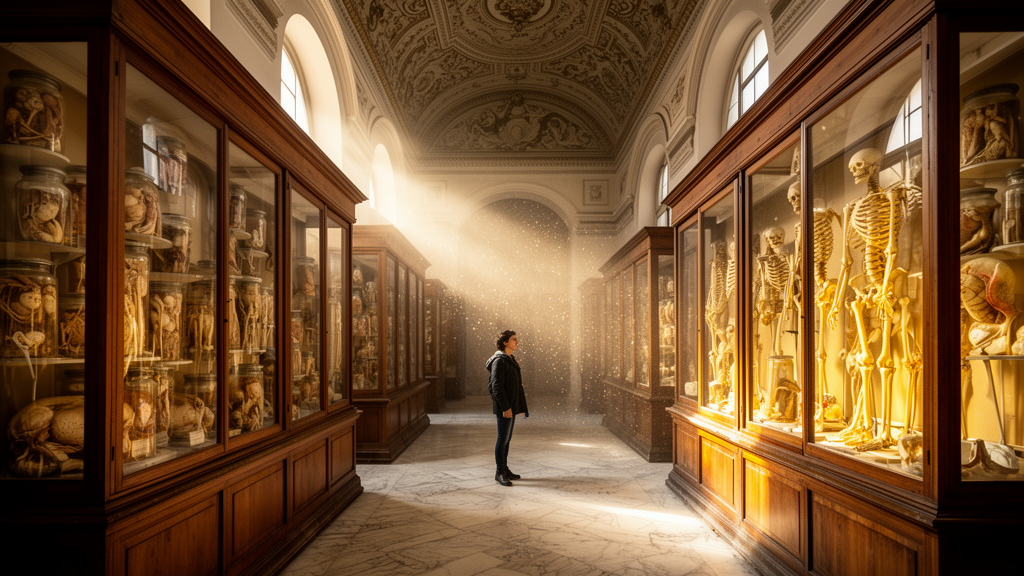
Deep in the historic center of Naples, the Anatomical Museum of the University preserves one of the most remarkable scientific collections in Italy. A new historical study traces its origins back through five centuries of Neapolitan medicine, from the private cabinets of Renaissance physicians to the modern halls where human and animal preparations, wax models and skeletal finds are once again being catalogued and identified. The research reconstructs how wars, epidemics and institutional upheavals repeatedly threatened the collections, and how generations of anatomists worked to keep them alive.
The museum’s institutional history is inseparable from the peculiar legal and academic environment that Naples developed centuries before its founding. The Assizes of Ariano, promulgated by Roger II around 1140, established one of the earliest state-controlled systems for licensing medical practitioners in Europe, requiring anyone wishing to practice medicine to submit to examination by royal officials and threatening imprisonment and confiscation of property for those who defied the rule. This regulatory framework was later consolidated by Frederick II, who in 1231 incorporated the assizes into the Liber Constitutionum and decreed that no one in the kingdom could teach medicine or surgery, or assume the title of doctor, without diligent examination in Salerno or Naples. The same legislation bound preparers of medicines by oath to produce them faithfully according to proper technique, in the presence of sworn witnesses, under penalty of confiscation of their movable goods. These provisions created an unusually early culture of professional accountability, one in which empirical competence mattered more than inherited authority, and they laid the administrative groundwork for the Studium founded in Naples in 1224, the first university established entirely by a sovereign rather than by religious or guild initiative.
At the time of the Studium’s foundation, medical instruction rested overwhelmingly on Galenic doctrine filtered through Aristotelian logic, a combination that had been elaborated and transmitted by Islamic scholarship. The medical literature of the Islamic Middle Ages, including the Al-Mansuri of the Persian physician and philosopher Abū Bakr al-Rāzī and the Canon of Medicine completed by Ibn Sina in 1025, continued to shape European medical training well into the sixteenth century, circulating not only in Latin translations but increasingly in the emerging vernacular languages. Against this backdrop of textual authority, the arrival of direct observation as the arbiter of anatomical truth represented a profound rupture. When Andreas Vesalius published his De humani corporis fabrica in Basel in 1543, at only twenty-nine years of age, his revolution consisted less in the sheer number of his discoveries than in his refusal to defer to Galenic tradition, grounding every claim in dissection of the human body itself. Vesalius had received his doctorate at Padua in 1537, and among the students who passed through his circles there was Gian Filippo Ingrassia, who carried the observational method south when he became professor of anatomy and medicine at the University of Naples in 1544, a chair he held until around 1556.
The Neapolitan tradition that Vesalius inspired found its most original early expression in Marco Aurelio Severino, whose Zootomia Democritaea, published in 1645, proposed that a single underlying design expresses itself in different forms across different species. This comparative vision, though not evolutionary in the Darwinian sense, loosened the Aristotelian assumption of immutable species and introduced a dynamic way of thinking about biological diversity. Severino’s work thus anticipated, by more than two centuries, the comparative anatomy that would later become the intellectual core of the museum itself. His detailed descriptions of animal structure demonstrated that careful observation across many species could reveal patterns invisible when each organism is studied in isolation, a principle that would eventually justify assembling human and animal preparations under one roof.
By the second half of the eighteenth century, Naples stood among the few Italian cities, alongside Paris, London and Edinburgh, that actively participated in the European intellectual debate shaping modernity. The city’s philosophers and scientists embraced Enlightenment ideals of rationality and empirical verification, a shift captured vividly by Antonio Genovesi, whose Elementa artis logico-criticae of 1752 dismissed scholastic metaphysics in favor of Newtonian physical principles. It was in this atmosphere that Domenico Cotugno developed the scientific philosophy that would define the museum’s ethos. Cotugno rejected the notion that scientific knowledge was fixed and ideally complete, applying instead the critical spirit of the Copernican revolution to anatomical questions. In the preface to his De aquaeductibus of 1761 he declared that he had given faith only to Nature, and in the same year he insisted that observations must be repeated many times and continuously, since Nature presents so many variations that only a great number of dissections can establish what is constant. His formulation that explaining means showing which initial conditions are relevant anticipated modern notions of scientific explanation, and his 1772 address The Spirit of Medicine reminded students that great men are prepared in schools but must ultimately become their own masters. Cotugno’s insistence on repeated dissection as the only path to reliable anatomical knowledge explains why a permanent collection of prepared specimens, available for comparison across decades, was not a luxury but a methodological necessity for the Neapolitan school.
The museum’s formal establishment in 1818, in a small room inside the University, was the work of Professor Francesco Folinea, but it grew out of decades of private accumulation by naturalists, apothecaries, anatomists and even botanists of the sixteenth and seventeenth centuries, who had assembled cabinets of human and animal preparations, both natural and pathological. The transition from private cabinet to public institution reflected a broader nineteenth-century conviction, articulated memorably by Stefano delle Chiaje, that museums instruct observers more than writings and words, simply through what the eye beholds. Under delle Chiaje the museum became a centralized institution for comparative anatomy, receiving rare specimens and developing a systematic catalogue of pathological anomalies, a tool that transformed isolated curiosities into a coherent scientific record.
The expansion of the collection was closely tied to the public life of Italian science. During the Seventh Congress of Italian Scientists, held in Naples from 20 September to 5 October 1845, it was decided to move the museum to the second floor of the University building, into a much larger and more prestigious hall. Such congresses, which gathered the leading scientific figures of the peninsula, served as occasions for demonstrating institutional prestige, and the decision to elevate the museum’s physical position signaled its new status as a showcase of Neapolitan science rather than a working annex of the anatomy chairs.
The museum’s subsequent history illustrates how political and natural catastrophes can fracture even the most carefully built scientific collections. Delle Chiaje’s death in 1860 coincided with Italian unification and the sweeping university reforms that followed, and the destruction of the manuscript catalogue he had personally compiled severed the institutional memory linking specimens to their provenance and significance. Without that catalogue, the collection’s scientific value as a documented record diminished even where the physical objects survived. Later shocks compounded the damage: the Second World War and the earthquake of 1980 each disrupted the unity of the collections, scattering or compromising materials whose original arrangement had itself been an act of scientific interpretation.
Current efforts to catalogue and restore the collections therefore represent more than housekeeping. Each specimen that is identified and documented partially reconstructs the lost intellectual architecture that delle Chiaje’s catalogue once provided, restoring to the museum its function as an instrument of comparative anatomy and a witness to five centuries of Neapolitan medical research. The half-bust of Cotugno that adorns the gallery leading to the museum serves as a fitting emblem of this continuity, linking the Enlightenment conviction that Nature alone deserves faith to the modern work of recovering, specimen by specimen, the evidence on which that faith was built.
Subject of Research: History and evolution of the Anatomical Museum of Naples
Article Title: The accomplishment of centuries of science and medical school: The Museo Anatomico in Naples
Article References: Torino, M., Cirillo, G., Basile, R., & Papa, M. (2026). The accomplishment of centuries of science and medical school: The Museo Anatomico in Naples. Natural History Collections and Museomics, 3, 1-15. https://doi.org/10.3897/nhcm.3.e171785
Image Credits: AI Generated
Keywords: Anatomical Museum of Naples, history of medicine, anatomy, wax models, pathological anatomy, Stefano delle Chiaje, Domenico Cotugno, University of Naples, paleopathology, scientific collections, Naples, museum history
Cite Scienmag News
Paul Hunter. (October 17, 2026). Inside the Anatomical Museum of Naples: Centuries of Science, Loss and Rediscovery. Scienmag. https://scienmag.com/inside-the-anatomical-museum-of-naples-centuries-of-science-loss-and-rediscovery/
Paul Hunter. "Inside the Anatomical Museum of Naples: Centuries of Science, Loss and Rediscovery." Scienmag, 17 October 2026, https://scienmag.com/inside-the-anatomical-museum-of-naples-centuries-of-science-loss-and-rediscovery/. Accessed 17 October 2026.
Paul Hunter. "Inside the Anatomical Museum of Naples: Centuries of Science, Loss and Rediscovery." Scienmag. October 17, 2026. https://scienmag.com/inside-the-anatomical-museum-of-naples-centuries-of-science-loss-and-rediscovery/


