


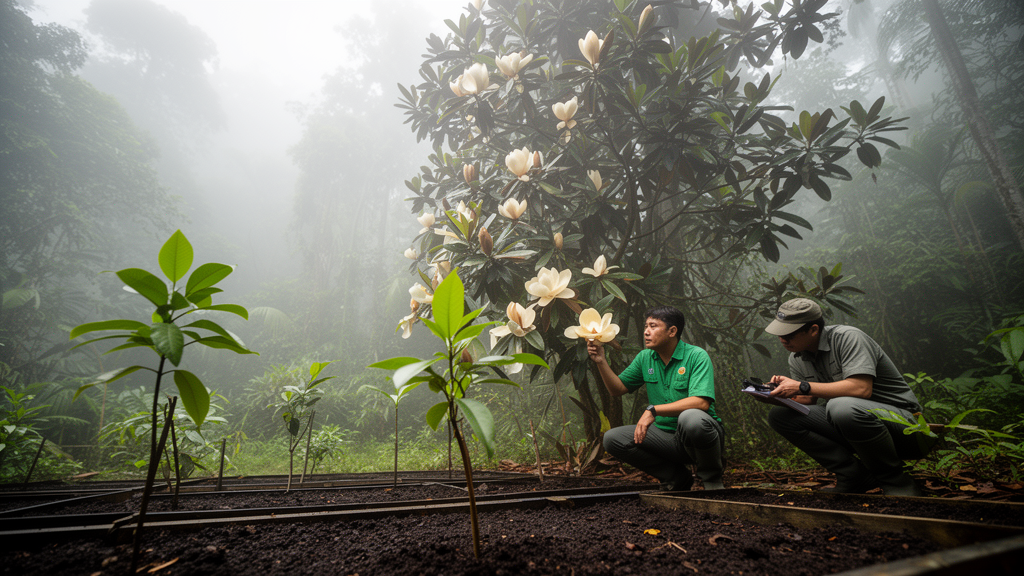
Deep in the highlands of Aceh Province, on the northern tip of Sumatra, botanists surveying tropical montane bogs have stumbled upon a tree that science barely knew existed in the wild. Magnolia sumatrae, a species endemic to Sumatra Island and long classified as Data Deficient by the IUCN Red List, has now been recorded in new locations that represent its northernmost distribution on the island. The discovery, published in the journal Nature Conservation, transforms what was once one of the most poorly understood Indonesian magnolias into a species with real population data, a formal conservation status, and a first line of defense against extinction.
Magnolia is one of the most threatened plant genera on Earth. Of the 344 species assessed for their extinction risk by the IUCN Red List, more than 55 percent are threatened with extinction, including 55 Critically Endangered species, 103 Endangered species, and 32 Vulnerable species. The main threats are silviculture, agriculture, and ranching. Yet even as most magnolias have been assessed, data deficiency remains a major constraint globally: 98 species are listed as Data Deficient, distributed across 31 countries, with the highest numbers in China and Indonesia. For Indonesia, the figure is exceptionally high, equal to 70 percent of the total number of Magnolia species found in the country. Magnolia sumatrae was one of these blind spots.
The species was first described based on a type specimen collected from Mount Singgalang in Sumatra Barat Province in 1878, and was later located on Mount Talamau in Sumatra Barat and in Gunung Leuser National Park in Aceh Province. Until now, it was not included on the list of protected plant species in Indonesia and had never been conserved in ex situ collections. To update its conservation status, researchers conducted population surveys in all previously known locations and, during general vegetation surveys in the regencies of Bener Meriah and Aceh Tengah, encountered a Magnolia whose vegetative and reproductive characteristics matched those of M. sumatrae. The finding represents a new record for the species and its northernmost distribution on Sumatra Island.
Identification was carried out using the identification key for Malesian Magnolia developed by Nooteboom. The newly collected trees can be differentiated from other Sumatran magnolias by a combination of characters: flower buds arising on brachyblasts in the axils of the leaves, a petiole longer than 5 mm, hairy young twigs, stipules free from the petiole or adnate only to its base, brachyblasts of 3 to 7 mm, glaucous leaves measuring 9 to 13 by 2.3 to 4 cm, and approximately 30 carpels. The species is morphologically similar to M. philippinensis, which differs by shorter tepals and fewer carpels and is known only from Thailand and the Philippines. The species has two synonyms, Michelia sumatrae Dandy and Michelia salicifolia A.Agostini.
The population data are striking. Across 14 survey locations in Bener Meriah and Aceh Tengah regencies, a total of 145 individuals were recorded, but only from three sites in Aceh Tengah Regency: 88 individuals in Burni Pepanyi, one in Pantan Reduk, and 56 in Berawang Baro. The species was not found in the other 11 locations. In these new areas, the largest individual observed reached a height of 12 m and a diameter at breast height of 28 cm. By contrast, surveys in the previously known locations recorded 166 individuals: 21 on Mount Leuser, 62 on Mount Bendahara, 73 on Mount Singgalang, and 10 on Mount Talamau, where individuals were generally larger, with the biggest reaching a dbh of 100 cm and a height of 25 m.
The population structure at all locations generally follows an inverse J-shaped pattern, with high numbers of individuals in the lower dbh classes and a gradual decrease in higher classes. This structure is commonly observed in rainforest tree species and indicates good regeneration capacity. However, disruption of the pattern was noted in some populations, such as on Mount Talamau, possibly due to successional processes and disturbances in the forest. The majority of individuals at all sites are immature, with a dbh of less than 5 cm; only 69 mature individuals were observed across the entire range, with the highest numbers on Mount Singgalang and in Berawang Baro, each with 23 individuals.
The new locations also revealed unexpected habitat flexibility. While individuals in the previously known sites were found in montane forests at elevations of 1,769 to 2,461 m, all trees in the new locations were found in relatively flat tropical montane bogs at elevations of 1,415 to 1,732 m. Tropical montane bogs had never been mentioned as habitat for M. sumatrae in previous publications, making this entirely new information. In fact, alongside M. virginiana, M. sumatrae is now one of the only Magnolia species known to grow in a bog habitat. But there is a catch: while the old sites are protected within national parks or nature reserves, the new bog habitats are currently unprotected under national or local regulations. Forest degradation and conversion into agricultural fields and coffee plantations were observed as the main threats, with the species growing in small, heavily degraded bog fragments situated in the middle of vegetable fields and coffee plantations. Aceh Tengah and Bener Meriah are the two regencies with the highest arabica coffee production in Aceh Province, with more than 67,949 people engaged in coffee farming.
Using the occurrence records from the study and previously collected herbarium specimens, the extent of occurrence and area of occupancy calculated by GeoCAT are 18,989 km² and 56 km², respectively, with eight locations considered. Under Criterion B of the IUCN Red List, the species now qualifies as Vulnerable B2ab(iii)+2ab(iii), meaning it faces a high risk of extinction in the wild due to its restricted area of occupancy, limited number of locations, and inferred continuing decline in the area, extent, and quality of habitat. The assessment relied only on Criterion B because population data were not conclusive enough for Criteria C and D; further surveys on Mount Mamas in Gunung Leuser National Park, the only additional known location not yet surveyed, are needed for better population size estimates.
To predict where else the species might survive, the researchers built an ensemble species distribution model integrating Random Forest and Support Vector Machine algorithms, using 94 occurrence records and environmental variables including climate, topography, edaphic properties, and land cover. The model performed excellently, with AUC values above 0.90 and TSS values above 0.80. The most prominent environmental predictor was annual mean temperature, followed by elevation and precipitation seasonality. The species has an optimum temperature between 15 and 20 °C, cooler than the 20 to 26.4 °C range commonly reported for magnolias, and the model predicts suitable habitat between 1,000 and 2,500 m, with an optimum of approximately 1,500 to 1,800 m above sea level. The total area of the current predicted distribution is 2,103.76 km², covering approximately 0.74 percent of the study area across Aceh, Sumatra Utara, and Sumatra Barat provinces. Aceh has the highest potential distribution, and approximately 38 percent of the potential distribution falls within protected areas, including Gunung Leuser, Kerinci Seblat, Batang Gadis, and Barumun national parks. Notably, the model predicts potential habitat in Sumatra Utara Province, where no records of the species have been available so far, offering a clear target for future surveys.
For the first time, plant materials of M. sumatrae have been collected to serve as ex situ collections: six wildings gathered from the Mount Bendahara area now grow at the Bogor Botanic Gardens, making the species the 11th Indonesian native Magnolia available in the country’s ex situ collections. These collections serve as a backup should in situ populations disappear, a material source for population reinforcement programs, and effective material for public display and awareness campaigns. Burni Pepanyi is part of the Burni Bias and Pepanyi Tropical Important Plant Areas, and the population there comprises approximately 28.29 percent of the global total, well above the 10 percent threshold for priority species designation. The available data show a disjunct distribution of M. sumatrae in the northern and central parts of Sumatra, and further surveys in the Lake Toba area, especially the western mountain range, should determine whether the populations are truly distinct. Conservation can be achieved through formal protected areas or through local community initiatives, such as local NGOs on the northern Gayo Plateau, while additional ex situ collections should target the northern Gayo Plateau and Sumatera Barat populations. From a name on a herbarium sheet to a species with mapped habitat, counted trees, and a living safety net, Magnolia sumatrae has finally stepped out of the data deficit shadow.
Subject of Research: Conservation status, distribution, and population of the Sumatran endemic tree Magnolia sumatrae
Article Title: Population, expanded distribution, and conservation of the Sumatran endemic tree Magnolia sumatrae (Dandy) Figlar & Noot.
Article References: Arico, Z., Mustaqim, W. A., Condro, A. A., Yudaputra, A., Rinandio, D. S., Linsky, J., Primananda, E., & Robiansyah, I. (2026). Population, expanded distribution, and conservation of the Sumatran endemic tree Magnolia sumatrae (Dandy) Figlar & Noot.. Nature Conservation, 64, 27-40. https://doi.org/10.3897/natureconservation.64.172897
Image Credits: AI Generated
DOI: 10.3897/natureconservation.64.172897
Keywords: Magnolia, Sumatra, plant conservation, IUCN Red List, species distribution modeling, endemic species, Aceh, botanic gardens, Population, expanded, distribution, conservation
Cite Scienmag News
Margaret Porter. (October 17, 2026). Rare Sumatran magnolia finds new populations and its first safety net. Scienmag. https://scienmag.com/rare-sumatran-magnolia-finds-new-populations-and-its-first-safety-net/
Margaret Porter. "Rare Sumatran magnolia finds new populations and its first safety net." Scienmag, 17 October 2026, https://scienmag.com/rare-sumatran-magnolia-finds-new-populations-and-its-first-safety-net/. Accessed 17 October 2026.
Margaret Porter. "Rare Sumatran magnolia finds new populations and its first safety net." Scienmag. October 17, 2026. https://scienmag.com/rare-sumatran-magnolia-finds-new-populations-and-its-first-safety-net/


