


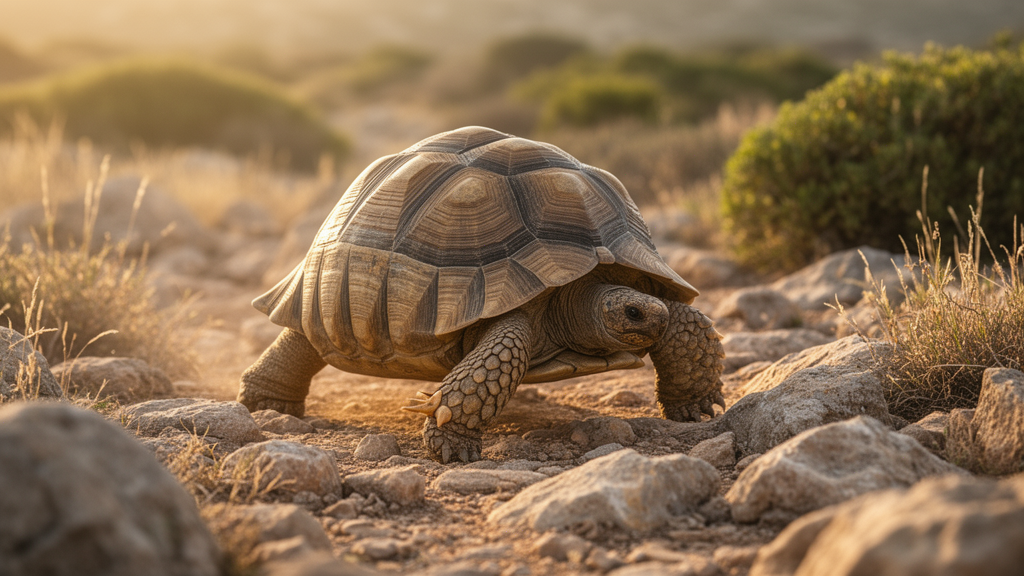
A remarkable new fossil discovery from Armenia is rewriting the deep-time history of one of the Mediterranean’s most familiar reptiles. Paleontologists have described Testudo sahakyanae, a new species of true tortoise from the Early Pliocene Jradzor site, dated between approximately 4.16 and 3.98 million years ago. The species, named in honor of Dr. Lilit Sahakyan of the Institute of Geological Sciences in Yerevan, is not just another addition to the fossil record. It is the best-dated fossil representative of the genus Testudo ever recovered, and it sits phylogenetically as the sister group to the living spur-thighed tortoise complex, Testudo graeca, offering the first solid fossil anchor for a lineage whose origins have long been suspected to lie in the Caucasus.
The material itself is extraordinary by the standards of fossil tortoises. More than 1,460 specimens were recovered from eleven fossiliferous levels in the Jradzor diatomite mine in Ararat Province, representing at least 80 individual animals. Roughly one-third of the specimens are identifiable and taxonomically informative. The collection includes several complete and partial shells, rare cranial elements, and a wealth of postcranial bones, making the Jradzor tortoise one of the most completely documented fossil occurrences of the genus anywhere in Eurasia. Only the recently described Testudo lohanica from the Late Miocene of Romania preserves comparable cranial material, and the Armenian fossils represent only the second record of cranial remains for an extinct species of Testudo.
Assigning the Jradzor tortoise to the true Testudo lineage required a careful anatomical audit. Members of Testudinidae are recognized by an alternating pattern of neural and costal plates, the coincidence between the costo-peripheral sutures and the pleuro-marginal sulci, a well-developed epiplastral lip, short pectoral scutes, and complete fusion of the femoral trochanters. The Jradzor material shows all of these features, with an average carapace length of around 30 centimeters and the largest individuals reaching up to 35 centimeters. Crucially, every preserved hypoplastron and xiphiplastron, across both sexes and all ontogenetic stages and all stratigraphic levels, consistently shows a clear movable hinge between the hypoplastra and the xiphiplastra, the single diagnostic character of the derived genus Testudo and one of the few non-homoplastic features in the otherwise highly homoplastic family of tortoises.
The skull and mandible remains, CT scanned at 18 micrometer resolution at the University of Fribourg, reveal a mosaic of features that tie the new species to the graeca complex while distinguishing it from all living and extinct relatives. The mandible carries a large circular prearticular foramen, present in Testudo graeca but absent in Testudo marginata, and a deep fossa Meckelii with a triangular dorsal opening that is much wider than in any of the living species. The supraoccipital process is notably shorter than in the extant graeca, and the dentary shows a slightly concave dorsal border matching the graeca condition rather than the taller dentary of marginata or the straighter dentary of lohanica. The entoplastron is consistently much larger and wider than in any compared species, and the last neural plate is a large hexagonal element with short posterolateral sides, consistent with the reduced seven-plate neural series seen in the living graeca and marginata.
The most striking feature, however, lies in the dermal armor. The Jradzor tortoise possessed robust, conical thigh spurs posterior to the femur, and CT scans revealed that these spurs are completely ossified internally, with a bony core. The living Mediterranean spur-thighed tortoise carries only a single conical spur on each side of the tail, made entirely of keratin without any bony core. Testudo sahakyanae had at least one to two bony thigh spurs in close contact, a condition otherwise seen in geochelonine tortoises such as the African spurred tortoise Centrochelys sulcata and in extinct members of Hesperotestudo and Titanochelon. This suggests that the lineage leading to the modern graeca complex experimented with different types of dermal armor and coverings before settling on the purely keratinous spur of the living species.
To resolve the phylogenetic position of the new species, the team constructed a total-evidence matrix combining 175 morphological characters with molecular data from Pereira et al. (2017), yielding a combined matrix of 41 taxa and 12,529 characters analyzed under implied weights in TNT. The analysis consistently recovered Testudo sahakyanae within the derived clade of true Testudo, and always in a more derived position than Testudo lohanica, based on the mixed morphotype of the suprapygal plates, the low ventral keel on cervical vertebra 7, the major trochanter of the humerus extending beyond the humeral head, and the presence of thigh spurs. The species is always recovered as a member of the graeca complex rather than the marginata plus kleinmanni clade, anchored by the prearticular foramen and the deep anal notch.
The new material also forced a critical re-evaluation of previously known fossil taxa that have been used in molecular clock calibrations of the graeca complex. Testudo eldarica from the Late Miocene of Azerbaijan is confirmed as a member of true Testudo based on its movable hinge. However, Testudo kuchurganica from the Early Pliocene of Ukraine was surprisingly recovered outside Testudo, associated instead with the Chersine clade, a fragile placement supported only by narrow gulars and the coincidence of the humero-pectoral sulcus with the posterior end of the entoplastron. Testudo burtschaki, known only from isolated specimens lacking any hinge-bearing material, is recommended for treatment as a nomen dubium. Testudo chernovi, which lacks a hypo-xiphiplastral hinge, likely represents the same non-Testudo taxon as kuchurganica. These revisions mean that several fossil species previously used to calibrate the origin of the graeca complex are unsuitable for that purpose.
The chronostratigraphic framework of the Jradzor site is what elevates this discovery from important to exceptional. The fossiliferous levels are dated by both magnetostratigraphy and radioisotopic methods to between 4.16 and 3.98 million years ago, precisely overlapping the calculated early divergence of the graeca complex in the southern Armenian Lesser Caucasus. Previous molecular clock analyses by Fritz and colleagues suggested a Caucasian origin for the complex, with subsequent range expansions across the Mediterranean, calibrated to the Early Pliocene at approximately 4.10 to 4.20 million years ago. The Jradzor fossils testify that graeca-like tortoise populations were present and diverse in the region at exactly that point in time, making Testudo sahakyanae an ideal candidate for future molecular calibrations of the origin and early divergence of the complex.
The depositional context adds another layer of scientific interest. The tortoise remains are found in recurring pyroclastic flow deposits across successive stratigraphic levels, suggesting that Testudo sahakyanae persisted in challenging environments with continuous volcanic eruptions. The holotype specimen, JRD-25/226, preserves an almost complete shell and most of the appendicular skeleton, though it is heavily cracked, flattened, and compressed by the violent burial processes. Interestingly, the JZ-7 layer, which yielded the richest mammalian assemblage, contained no tortoise remains at all, leading the authors to conclude that the depositional environment was simply unfavorable for fossilization rather than that tortoises were absent from the living assemblage.
The description of Testudo sahakyanae proves that true Testudo populations have inhabited the Southern Caucasus since at least the Early Pliocene, a clade that continues there to the present day with two extant subspecies, Testudo graeca armeniaca and Testudo graeca ibera, both belonging to the well-supported mitochondrial DNA Clade A. The new species is the first extinct tortoise species described from Armenia and sheds light on the origin and early evolution of the modern Mediterranean tortoises. An emerging picture suggests that the Romanian and Armenian extinct tortoises carried different types of dermal armor on their forelimbs and hindlimbs respectively, with lohanica bearing a continuous protective shield of sutured polygonal osteoderms on its forelimbs while sahakyanae had forelimbs apparently free of such coverings but bore bony thigh spurs posterior to the femur. This diversity of armor strategies within a single clade hints at a rich evolutionary experimentation that paleontologists are only beginning to document.
Subject of Research: Paleontology and evolutionary biology of a new Early Pliocene tortoise species from Armenia and its phylogenetic relationship to the Testudo graeca complex
Article Title: A new species of a bony spur-thighed tortoise from the Early Pliocene (MN15) of Jradzor site, Armenia, and the origin of the Testudo graeca ( Testudines , Testudinidae ) complex
Article References: Vlachos, E., & Vasilyan, D. (2026). A new species of a bony spur-thighed tortoise from the Early Pliocene (MN15) of Jradzor site, Armenia, and the origin of the Testudo graeca (Testudines, Testudinidae) complex. Swiss Journal of Palaeontology, 145, 553-578. https://doi.org/10.3897/sjp.145.182210
Image Credits: AI Generated
Keywords: Testudo sahakyanae, tortoise evolution, Armenia fossils, Pliocene paleontology, Caucasus origin, spur-thighed tortoise, species, bony, spur-thighed, tortoise, Early, Pliocene
Cite Scienmag News
Gavin Prescott. (October 17, 2026). Ancient Armenian tortoise with bony thigh spurs rewrites the origin story of the Mediterranean spur-thighed tortoise. Scienmag. https://scienmag.com/ancient-armenian-tortoise-with-bony-thigh-spurs-rewrites-the-origin-story-of-the-mediterranean-spur-thighed-tortoise/
Gavin Prescott. "Ancient Armenian tortoise with bony thigh spurs rewrites the origin story of the Mediterranean spur-thighed tortoise." Scienmag, 17 October 2026, https://scienmag.com/ancient-armenian-tortoise-with-bony-thigh-spurs-rewrites-the-origin-story-of-the-mediterranean-spur-thighed-tortoise/. Accessed 17 October 2026.
Gavin Prescott. "Ancient Armenian tortoise with bony thigh spurs rewrites the origin story of the Mediterranean spur-thighed tortoise." Scienmag. October 17, 2026. https://scienmag.com/ancient-armenian-tortoise-with-bony-thigh-spurs-rewrites-the-origin-story-of-the-mediterranean-spur-thighed-tortoise/


