


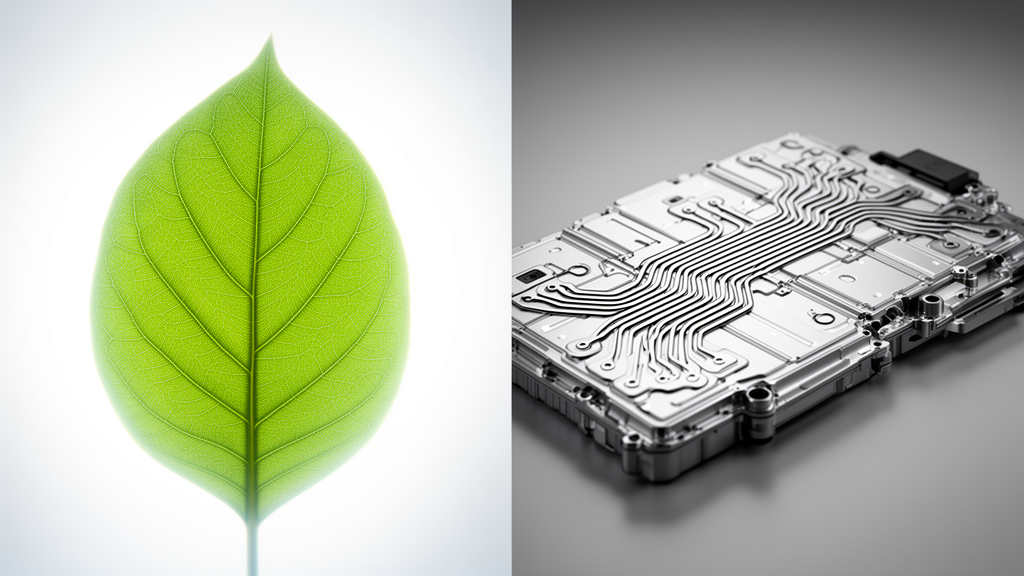
Electric vehicles live or die by the health of their batteries, and the health of a battery depends on how well engineers can keep it cool. A new comparative study published in Results in Engineering pits two very different design philosophies against each other for the liquid cooling channels that snake through the cooling plates of an electric vehicle power battery pack. One philosophy borrows its shapes from nature, copying the branching architecture of leaf veins, the cellular geometry of honeycombs, and the winding paths of serpentine channels. The other abandons imitation altogether and lets a mathematical algorithm, topology optimization, carve the most efficient channel geometry out of a solid block of design space. The verdict: each approach wins on a different metric, and the choice between them depends on what a designer values most.
The stakes are considerable. During operation, power batteries generate substantial heat, and inadequate heat dissipation does more than shave performance. Excessively high operating temperatures accelerate battery aging, hasten capacity degradation, reduce driving range, and can trigger thermal runaway, a chain reaction that in severe cases leads to fire or explosion. Yet cooling itself consumes energy, so the central engineering challenge is to maximize heat removal without inflating the power needed to pump coolant through the system. The research team, led by Miao Li and Min Xiong with colleagues at institutions supported by the National Natural Science Foundation of China, set out to determine which channel design strategy best meets specific requirements for peak temperature, temperature uniformity, and energy consumption.
The benchmark system is a power battery pack comprising twelve series-connected battery modules, each built from twenty cylindrical 18650 lithium-ion cells with a nominal voltage of 3.6 volts, arranged in parallel with liquid cooling plates on both sides. Rather than simulating the entire pack, the researchers exploited the identical structure of each module and modeled a single representative module in three dimensions. The most punishing operating condition considered was high-temperature fast charging at an ambient temperature of 43 degrees Celsius and a charge rate of 4C, from 30 to 80 percent state of charge. Under these conditions the cells generate heat at a power density of 1.2 times ten to the fifth watts per cubic meter, a figure the team adopted as a constant simplification. Coolant, an ethylene glycol water solution, enters at 25 degrees Celsius with a flow velocity of 0.5 meters per second, and the copper cooling plate substrate strips heat from the cells by conduction into the flowing liquid.
The baseline against which all new designs were judged is the traditional straight channel liquid cooling plate, a configuration with six parallel branch channels commonly used in commercial battery modules. The numerical model was first validated against experimental data from a previously reported straight channel system, with maximum errors of 7.24 percent for flow rate versus pressure drop and 3.27 percent for maximum temperature, demonstrating reliability. Under the 4C charging condition, the straight channel design produced a peak battery temperature of 38.73 degrees Celsius, comfortably below the 45 degree upper limit for normal operation, but a stable operating temperature of 30.30 degrees Celsius, just above the optimal 20 to 30 degree window. The fluid pressure drop, which dictates pumping energy consumption, stood at 981.43 pascals. All four new channel designs were then created using the same fluid volume fraction of 0.5, ensuring a fair comparison of channel morphology at identical material usage.
Three of the new designs came from the bionic design method, which translates efficient natural transport structures into engineered channel layouts. The leaf vein-shaped channel copies the fractal, multi-level branching and self-similar architecture that allows plants to distribute water with remarkable efficiency, increasing channel surface area and improving coolant distribution uniformity. The honeycomb-shaped channel exploits the large surface area and internal multi-branching nature of cellular structures, which promotes higher fluid velocity along inner channel sections while flow along the sides remains slower, thinning the thermal boundary layer and enhancing heat transfer. The serpentine channel, inspired by winding natural paths, increases contact area between coolant and plate while the curved geometry slows the coolant, prolonging its residence time and improving cooling performance.
The fourth design emerged from topology optimization, a computational method that requires no natural template. The researchers formulated a multi-objective optimization problem on a two-dimensional design domain matching the cooling plate dimensions, with inlet and outlet ports arranged in parallel at diagonal corners. Using the Brinkman penalty model, the design domain is treated as a porous medium whose resistance depends on a design variable, the unit pseudo-density gamma, which characterizes material distribution at every element. When gamma equals one the element is fluid and flow proceeds unpenalized; when gamma equals zero the element is solid and flow velocity is driven to zero. The objective function balances maximizing heat transfer against minimizing coolant power dissipation, with a weighting coefficient of 0.5 giving equal priority to both goals. Density filtering via a Helmholtz partial differential equation addressed grid dependency and ill-posedness, while a hyperbolic tangent projection method eliminated grey-scale elements, yielding a crisp fluid-solid boundary that produces channel geometry close to practically manufacturable designs. The optimized two-dimensional channel shape was then extruded along the plate thickness to construct the three-dimensional cooling channel.
The thermal comparison revealed subtle but meaningful differences. Peak temperatures across all designs clustered tightly: 38.65 degrees for the leaf vein channel, 38.43 for honeycomb, 38.42 for serpentine, and 38.37 for the topology-optimized design, the latter achieving a 0.93 percent reduction compared with the straight channel baseline. The topology-optimized channel therefore controlled the highest temperature reached during the entire charging process better than any other configuration. During the early simulation phase, module temperature rose as heat accumulated faster than the coolant could remove it, but as time progressed the temperature declined and stabilized once the system reached thermal equilibrium.
Temperature uniformity within individual cells matters as much as absolute temperature, because non-uniform temperatures can drive excessive charging or discharging in particular cells, accelerate aging, and raise safety hazards. The researchers quantified uniformity using the temperature standard deviation of individual cells, where a smaller value indicates a more even distribution. Compared with the straight channel plate, the leaf vein, honeycomb, and topology-optimized designs all reduced the standard deviation, with the topology-optimized plate exhibiting the most superior uniformity across the cells analyzed.
Stable operating temperatures told a different story. The honeycomb, serpentine, and topology-optimized channels achieved stable operating temperatures of 29.21, 29.09, and 29.49 degrees Celsius respectively, all below 30 degrees and within the optimal operating range, representing reductions of 3.60, 3.99, and 2.67 percent compared with the straight channel. The leaf vein channel, by contrast, produced a stable temperature of 30.47 degrees, slightly higher than the baseline. For applications demanding prolonged stable operation, the honeycomb and serpentine structures proved preferable, while temperature uniformity as the priority pointed toward the leaf vein or topology-optimized structures.
Energy consumption, reflected in the pressure drop the coolant experiences, delivered the study’s most striking contrast. The topology-optimized design achieved the lowest pressure drop at 855.25 pascals, a 12.86 percent reduction versus the straight channel, with the leaf vein channel second lowest at 877.52 pascals, a 10.59 percent reduction. The honeycomb channel increased pressure drop by 4.87 percent, and the serpentine channel proved the most expensive by far, at 1579.16 pascals, a 60.90 percent increase that translates directly into higher pumping power under the same flow rate. Although the serpentine channel offered minor thermal improvement, its flow resistance should weigh heavily in practical applications. Taken together, the results show that when both heat dissipation performance and energy consumption are considered, the topology-optimized cooling channel holds distinct advantages, while bionic designs excel in specific niches. Beyond battery thermal management, the researchers note that the channel optimization methods can extend to cooling high heat flux electronic devices such as chips and CPUs, and future work will incorporate turbulence-based optimization models and sensitivity analyses of key operating parameters to better match channel structures to real operating conditions.
Subject of Research: Liquid cooling channel design for electric vehicle power batteries using bionic and topology optimization methods
Article Title: Liquid cooling channels designs by both bionic design method and topology optimization method for electric vehicle main power battery
Article References: Li, M., Xiong, M., Lin, C., Yang, J., Ding, X., & Zhang, H. (2026). Liquid cooling channels designs by both bionic design method and topology optimization method for electric vehicle main power battery. Results in Engineering, 32, Article 113473. https://doi.org/10.1016/j.rineng.2026.113473
Image Credits: AI Generated
DOI: 10.1016/j.rineng.2026.113473
Keywords: electric vehicle, power battery, liquid cooling, topology optimization, bionic design, thermal management, lithium-ion battery, pressure drop, thermal runaway, battery pack, Liquid, cooling
Cite Scienmag News
Denise Maddox. (October 17, 2026). Leaf veins and algorithms: two design routes race to cool EV batteries. Scienmag. https://scienmag.com/leaf-veins-and-algorithms-two-design-routes-race-to-cool-ev-batteries/
Denise Maddox. "Leaf veins and algorithms: two design routes race to cool EV batteries." Scienmag, 17 October 2026, https://scienmag.com/leaf-veins-and-algorithms-two-design-routes-race-to-cool-ev-batteries/. Accessed 17 October 2026.
Denise Maddox. "Leaf veins and algorithms: two design routes race to cool EV batteries." Scienmag. October 17, 2026. https://scienmag.com/leaf-veins-and-algorithms-two-design-routes-race-to-cool-ev-batteries/


