


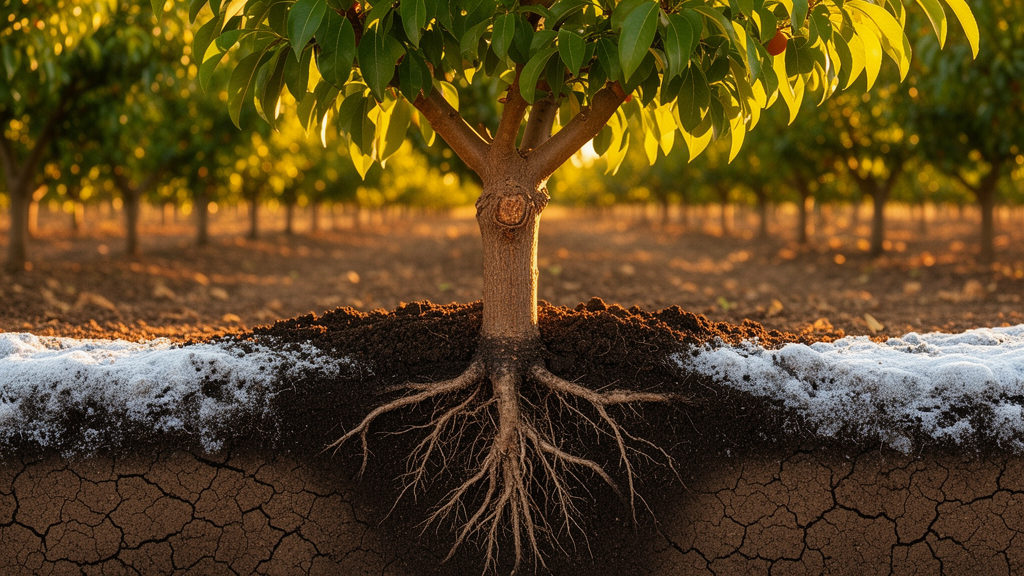
When a fruit tree wilts in a drought or struggles in salty soil, the solution may lie not in the branches that bear the fruit but in the hidden half of the plant underground. A new synthesis published in Frontiers in Horticulture brings together more than two decades of research on how rootstocks, the root systems onto which prized fruit cultivars are grafted, confer tolerance to drought, salinity, temperature extremes, flooding and nutrient limitation. The review, which draws on peer-reviewed studies from 2000 to 2026 with an emphasis on the most recent five years, argues that the rootstock is not a passive anchor but an active signalling organ that reshapes the physiology of the entire plant. As climate change intensifies abiotic stress on perennial fruit crops, the authors contend that rootstock science is poised to become one of the most powerful tools for keeping orchards productive without altering the fruit-determining scion cultivars that growers and consumers depend on.
The central insight of the review is that stress tolerance in a grafted plant emerges from the coordinated action of four signalling subsystems that couple the rootstock to the scion. The first is hydraulic regulation, the management of water flow through the vascular system. The second is ion homeostasis, the selective exclusion or compartmentalization of toxic ions such as sodium and chloride. The third is hormonal and mobile molecular signalling, in which chemical messengers travel from root to shoot and back. The fourth is graft-union integrity, the structural and functional quality of the junction where rootstock and scion meet. Each of these subsystems can be measured, manipulated and, increasingly, bred for. The authors emphasize that previous reviews have treated rootstock breeding, stress physiology, rootstock diversity and long-distance signalling as separate topics, and that an integrated cross-crop synthesis linking causal mechanisms with practical breeding criteria has been lacking.
One of the most striking findings concerns the role of water transport proteins known as aquaporins. In the experimentally separated systems reviewed, measured aquaporin activity, rather than the abundance of aquaporin transcripts, showed a stronger correspondence with hydraulic performance. This distinction matters because gene expression data are far easier to collect than direct measurements of protein function, and many breeding programs have relied on transcript-based markers. The review suggests that rootstocks with high aquaporin transcript levels do not necessarily conduct water more efficiently, and that phenotyping pipelines should prioritize direct flux and conductance measurements over gene expression readouts when the goal is to predict hydraulic performance under stress.
The review also reframes long-standing debates about abscisic acid, the hormone most closely associated with plant drought responses. Root abscisic acid biosynthesis contributes to rootstock-conferred drought tolerance in the systems examined, but the authors caution that leaf abscisic acid concentrations must always be interpreted against the plant’s actual water status. A scion may accumulate abscisic acid simply because it is dehydrated, not because the rootstock has signalled it to close its stomata preemptively. To resolve this ambiguity, the authors highlight the value of hormone ratios rather than single-hormone measurements. In the systems tested, ratios such as cytokinin to ACC and ACC to abscisic acid proved informative and merit systematic evaluation as breeding criteria. This shift from concentration-based to ratio-based phenotyping represents a conceptual advance in how rootstock effects on scion physiology are quantified.
Ion homeostasis emerges as another critical axis of rootstock-mediated tolerance, and the review identifies a persistent source of confusion in the literature. Sodium-driven toxicity and chloride-driven toxicity are not interchangeable phenomena, yet studies often conflate them. Rootstocks differ in their capacity to exclude each ion at the root level, to restrict transport to the shoot, and to compartmentalize ions within tissues. The authors argue that distinguishing sodium-specific from chloride-specific mechanisms is essential for breeding rootstocks suited to particular salinity profiles, whether those involve coastal salt spray, irrigation water high in sodium salts, or soils dominated by chloride accumulations. This reframing turns a methodological inconsistency into a testable breeding target.
A fourth contradiction addressed in the review concerns the widely discussed trade-off between dwarfing and drought tolerance. Many commercial rootstocks that reduce scion vigor, a desirable trait for high-density orchards, have been assumed to compromise drought performance. The authors treat this proposed trade-off not as an established fact but as a hypothesis requiring rigorous testing across genetic backgrounds and environments. If the trade-off proves conditional rather than universal, it opens the door to breeding compact rootstocks that maintain hydraulic resilience under water limitation, a combination that would be transformative for intensive fruit production in water-scarce regions.
Methodologically, the review prioritizes studies that establish causal links rather than mere correlations. Reciprocal grafting onto biosynthetic or transport mutants, direct flux and conductance measurement, isotope tracing and map-based cloning are highlighted as the gold standards for demonstrating that a rootstock trait actually causes a scion response. This evidentiary bar is important because the rootstock-scion interaction is notoriously difficult to disentangle. A rootstock may alter scion behavior through water supply, through hormonal signals, through mobile RNAs or small peptides, or through changes in the root microbiome, and only experimental designs that separate these channels can identify the true mechanism. The authors note that transport has emerged as an important limiting step in several of the systems they examined, underscoring the value of measuring actual movement of water and ions rather than inferring it from gene expression.
Perhaps the most consequential message for breeders is a note of caution about cross-crop generalization. The core molecular toolkits that plants use to respond to abiotic stress are conserved across lineages, but the review finds that they are deployed divergently by different fruit crop groups. This means that molecular markers validated in one crop, such as apple or grapevine, may not transfer directly to other crops such as citrus, stone fruits or tropical species without further validation. The authors call for ideotype-driven breeding pipelines in which the desired rootstock phenotype is defined first, in terms of hydraulic conductance, ion exclusion capacity, hormone signalling profiles and graft-union performance, and markers are then validated within each target crop rather than imported wholesale from distant relatives.
The review concludes with a forward-looking agenda that emphasizes flux-based, ratio-based and activity-based phenotyping alongside the more traditional concentration-based, single-hormone and transcript-based criteria. It also draws attention to a significant gap in the literature: tropical and subtropical fruit crops remain under-resourced in rootstock research relative to temperate species, despite facing some of the most acute climate pressures. As droughts lengthen, saline intrusion spreads and temperature extremes intensify, the ability to swap the underground half of a fruit tree while preserving the fruit cultivar above represents a uniquely flexible adaptation strategy. The authors argue that with better mechanistic understanding and more rigorous phenotyping, precision rootstock breeding could deliver climate-resilient orchards faster than any other single intervention in perennial fruit crop improvement.
Subject of Research: Rootstock-mediated abiotic stress tolerance mechanisms and precision breeding in fruit crops
Article Title: Rootstock-mediated abiotic stress tolerance in fruit crops: physiological mechanisms, long-distance hormonal and molecular signalling, and implications for precision rootstock breeding
Article References: Jayavigneshwaran, M. K., Dishri, M., Das, U., & Poonguzhali, S. (2026). Rootstock-mediated abiotic stress tolerance in fruit crops: physiological mechanisms, long-distance hormonal and molecular signalling, and implications for precision rootstock breeding. Frontiers in Horticulture, 5, Article 1988535. https://doi.org/10.3389/fhort.2026.1988535
Image Credits: AI Generated
DOI: 10.3389/fhort.2026.1988535
Keywords: rootstock, abiotic stress, drought tolerance, salinity, fruit crops, grafting, plant hormones, aquaporins, precision breeding, climate resilience, Rootstock-mediated, abiotic
Cite Scienmag News
Sloane Callahan. (October 17, 2026). Hidden Signals From Below: How Rootstocks Arm Fruit Trees Against Drought, Salt and Heat. Scienmag. https://scienmag.com/hidden-signals-from-below-how-rootstocks-arm-fruit-trees-against-drought-salt-and-heat/
Sloane Callahan. "Hidden Signals From Below: How Rootstocks Arm Fruit Trees Against Drought, Salt and Heat." Scienmag, 17 October 2026, https://scienmag.com/hidden-signals-from-below-how-rootstocks-arm-fruit-trees-against-drought-salt-and-heat/. Accessed 17 October 2026.
Sloane Callahan. "Hidden Signals From Below: How Rootstocks Arm Fruit Trees Against Drought, Salt and Heat." Scienmag. October 17, 2026. https://scienmag.com/hidden-signals-from-below-how-rootstocks-arm-fruit-trees-against-drought-salt-and-heat/


