


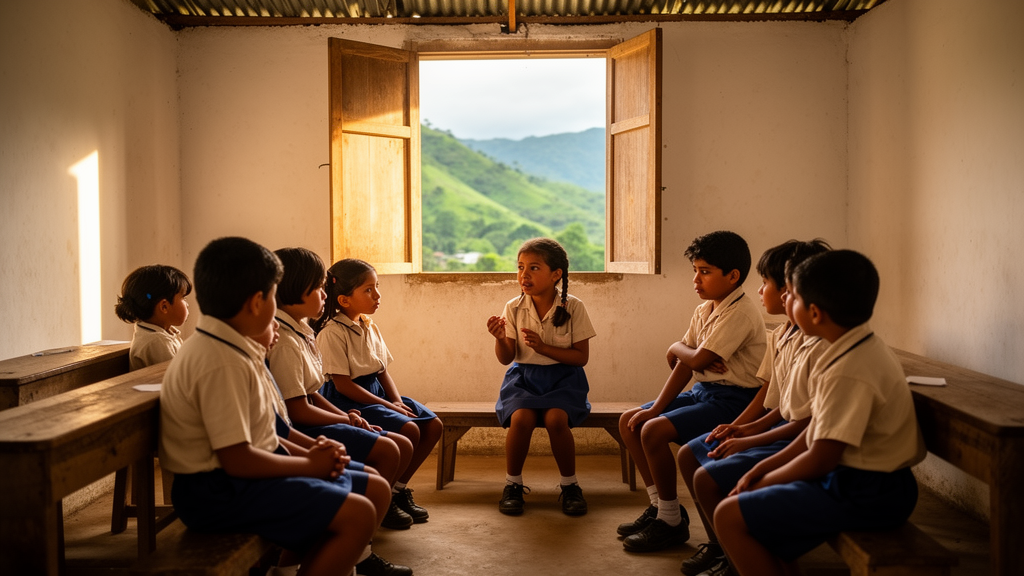
In the rural communities of Northern Colombia, where decades of armed conflict and deep poverty have shaped everyday life, children and teenagers carry their own understanding of what it means to be bullied. A new mixed-methods study published in BMC Psychology offers one of the most detailed portraits to date of how young people in these settings perceive bullying and cyberbullying, and the findings challenge some of the assumptions embedded in school-based prevention programmes designed far from such communities.
The research, led by Ana Maria Chamorro Coneo of Universidad del Norte in Barranquilla together with colleagues at Durham University, focused on pupils aged 10 to 17 in communities affected by armed conflict and severe deprivation. Populations with these characteristics remain markedly under-represented in the bullying literature, even though roughly one in three students worldwide experiences bullying and its psychological consequences can extend well into adulthood. In regions where violence has been a normalised feature of social life, the researchers argue, the way children conceptualise peer aggression matters enormously for how interventions are designed and received.
The study used a convergent mixed-methods design, combining quantitative and qualitative strands conducted in parallel. In the quantitative strand, 202 pupils completed a free-word-association task, generating a total of 1,737 evoked words: 928 in response to the prompt of bullying and 809 in response to cyberbullying. This technique, rooted in social representations theory, asks participants to produce the first words that come to mind, revealing the spontaneous cognitive landscape surrounding a concept rather than their agreement with researcher-imposed definitions.
The researchers then grouped the evoked terms into conceptually related categories and examined how those distributions varied by age group and gender. Because each pupil generated multiple associations, the data were clustered within individuals, and the team handled this methodological challenge with participant-level permutation tests, a non-parametric approach that preserves the grouping of responses within pupils rather than treating every word as an independent observation. This statistical care matters: naive comparisons of word frequencies can produce misleading significance when responses from the same child are correlated.
The quantitative results showed that canonical elements of bullying and cyberbullying, such as aggression, harm and intent, dominated the associative space. Yet the composition of responses shifted modestly but measurably across age groups, with a permutation p-value of .016. Among 10-to-12-year-olds, violence- and aggression-related terms accounted for 65.0 percent of responses, compared with 55.2 percent among 13-to-14-year-olds and 58.8 percent among 15-to-17-year-olds. Meanwhile, terms related to discrimination and exclusion rose from just 2.7 percent in the youngest group to 9.7 percent in the middle group and 7.1 percent in the oldest. In other words, as children grow older, their mental model of bullying appears to expand beyond raw physical aggression to encompass relational and prejudicial harm. No evidence of gender differences emerged, with a permutation p-value of .894, suggesting that boys and girls in these communities draw on broadly similar conceptual frameworks.
The qualitative strand added depth and texture to these patterns. The researchers conducted five focus groups with a total of 43 participants, using a codebook approach to Thematic Analysis in which coding decisions are anchored to a predefined and iteratively refined framework, enhancing transparency and reliability. During the discussions, pupils described physical, verbal, sexual and online peer aggression in vivid, sometimes unsettling detail. One phrase that gave the study its title captured a chilling social dynamic: another person’s suffering framed as a source of joy, a reminder of how cruelty can become entertainment within peer groups.
Yet the qualitative data also revealed conceptual slippage with practical consequences. Participants did not always reference repetition, one of the three defining criteria of bullying in most academic definitions, alongside intent and power imbalance, when describing what bullying means. Some used the terms bullying and school violence interchangeably, blurring the boundary between a targeted, repeated pattern of victimisation and more generalised peer conflict. The power imbalance dimension, when it did appear, was most often framed as unfair treatment tied to appearance, gender, race or social class, rather than as an abstract structural feature of a relationship.
These findings do not mean the pupils misunderstood bullying. The researchers emphasise that participants demonstrated an overall grasp of the core elements of bullying and cyberbullying, even where the edges of those categories occasionally blurred. But the blurring itself is diagnostic. In communities where everyday violence is familiar, distinguishing a one-off fight from a sustained campaign of victimisation may carry less intuitive weight than it does in the calm corridors of a well-resourced school. Prevention programmes that assume children arrive with a shared, textbook definition of bullying may therefore misfire, teaching distinctions that pupils do not yet recognise or failing to engage with the categories they actually use.
The authors draw two main implications for intervention. First, programmes in similar settings should explicitly target the distinctions between bullying, cyberbullying and broader school violence, particularly among younger pupils, and should tailor content to pupils’ own definitions and lived experiences rather than importing generic materials. Second, programmes should integrate components addressing prejudice and power imbalances, since the discrimination and exclusion themes that emerged in both strands of the study point to appearance, gender, race and social class as the fault lines along which victimisation is organised. Strengthening detection and prevention, the study suggests, requires engaging directly with the social hierarchies children already perceive.
Methodologically, the study also offers a template for research in hard-to-reach settings. The combination of free-word association with permutation-based inference and codebook thematic analysis allowed the team to quantify collective representations while preserving the voice of individual pupils, all under ethical procedures approved by the Institutional Review Board of Universidad del Norte, with written informed consent from parents or guardians and written assent from every child. Conducted without external funding, the work underscores how locally grounded research can illuminate the psychology of populations that global bullying scholarship has too often overlooked, and it suggests that the path to safer schools in conflict-affected regions begins with listening to how children themselves name the harm they see.
Subject of Research: Bullying and cyberbullying perceptions among children and adolescents in rural, conflict-affected communities of Northern Colombia
Article Title: “Another person’s suffering is my joy”: A mixed-methods study of bullying and cyberbullying in rural, conflict-affected communities of Northern Colombia
Article References: Chamorro Coneo, A. M., Hoyos de los Rios, O., Canchila, E., & Andres, F. E. (2026). “Another person’s suffering is my joy”: A mixed-methods study of bullying and cyberbullying in rural, conflict-affected communities of Northern Colombia. BMC Psychology. https://doi.org/10.1186/s40359-026-05646-4
Image Credits: AI Generated
DOI: 10.1186/s40359-026-05646-4
Keywords: bullying, cyberbullying, school violence, armed conflict, Colombia, children and adolescents, mixed methods, free word association, thematic analysis, social representations, power imbalance, school psychology
Cite Scienmag News
Glenn Wilkins. (October 17, 2026). In Rural Colombia, Children Define Bullying Through the Lens of Conflict. Scienmag. https://scienmag.com/in-rural-colombia-children-define-bullying-through-the-lens-of-conflict/
Glenn Wilkins. "In Rural Colombia, Children Define Bullying Through the Lens of Conflict." Scienmag, 17 October 2026, https://scienmag.com/in-rural-colombia-children-define-bullying-through-the-lens-of-conflict/. Accessed 17 October 2026.
Glenn Wilkins. "In Rural Colombia, Children Define Bullying Through the Lens of Conflict." Scienmag. October 17, 2026. https://scienmag.com/in-rural-colombia-children-define-bullying-through-the-lens-of-conflict/


