

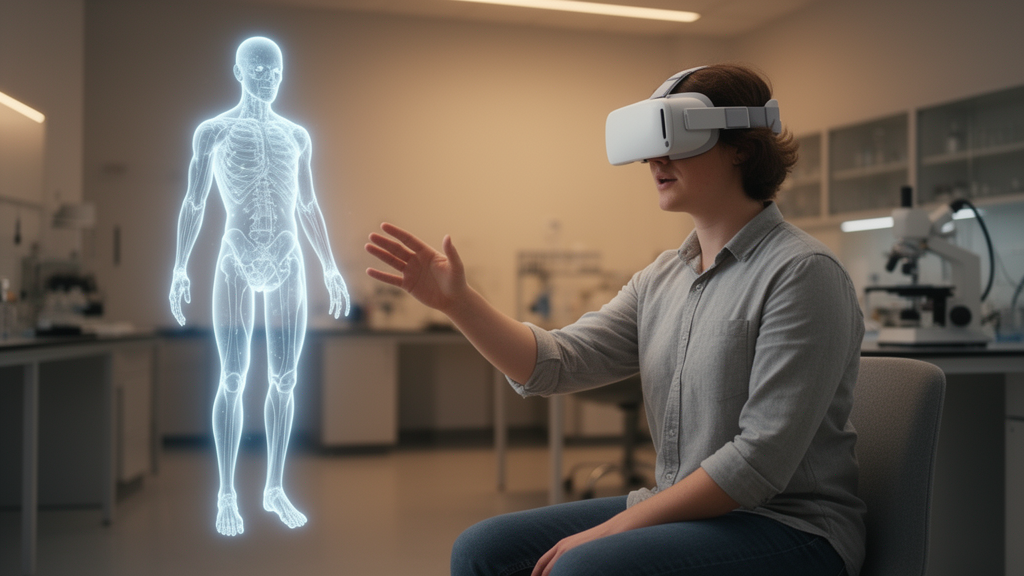
Virtual reality has long been promoted as a gateway to immersive digital worlds, but a new study from the University of Würzburg suggests that filling those worlds with supportive virtual characters may do more for how real the experience feels than for how much pain a person actually perceives. In research published in Frontiers in Virtual Reality, a team led by Isabel Neumann, together with Paul Pauli and Ivo Käthner, put 98 healthy volunteers into a virtual laboratory and delivered controlled heat pain to their forearms while virtual characters offered words of encouragement. The results reveal a fascinating split between the social power of virtual humans and their limits as pain-relieving agents.
The study was designed around a deceptively simple question: does it matter whether the comforting voice in your headset belongs to a human or a machine? According to the Threshold Model of Social Influences, avatars—virtual characters believed to be controlled by real people—should exert stronger social influence than agents, which are understood to be computer-controlled. The rival Media Equation Concept, however, holds that people respond to virtual characters much as they respond to real humans, regardless of who or what is behind them. Previous findings have supported both positions, with some studies showing delayed eye contact and more prosocial behavior toward avatars, while others found equivalent emotional wellbeing and self-disclosure whether participants believed they were talking to a person or a program.
To pit these theories against each other in the context of pain, the researchers built a mixed-design experiment. Participants were randomly assigned to believe they were interacting either with an avatar controlled by a confederate in another room or with a computer-driven agent. In reality, the virtual characters were identical in both groups—pre-programmed animations and scripts running in a virtual laboratory constructed in Unreal Engine and displayed through an HTC Vive head-mounted display. Within each group, every participant experienced three conditions: one in which an empathic virtual character offered verbal support, one in which an unempathetic character did the same, and a control condition with no virtual character present at all.
The pain stimulus itself was carefully calibrated. Using a Somedic MSA thermal stimulator with a Peltier thermode attached to the non-dominant forearm, the team first determined each participant’s individual pain threshold through a method-of-adjustment procedure, then added two degrees Celsius to ensure the stimulus was genuinely painful. During the main experiment, participants received heat pulses with an eight-second plateau, separated by at least thirty seconds to prevent habituation. Immediately before each stimulus, the virtual character delivered reassurance and praise—phrases such as telling participants they were doing a great job—accompanied by nodding and smiling. The empathic and unempathic behaviors were directed only toward hypothetical previous participants in a staged dialogue, while the direct support each participant received was identical across both empathy conditions.
Crucially, the researchers recorded not just what participants said about their pain but what their bodies did. Skin conductance was measured with electrodes on the non-dominant hand, sampled at 500 hertz and baseline-corrected around each pain stimulus. Heart rate was captured via electrocardiography with three electrodes on the upper body. Pain intensity and unpleasantness were rated on visual analog scales overlaid in the virtual environment, with the virtual character deliberately hidden during rating to avoid the well-documented effect of being observed on pain reporting. Presence and social presence were each assessed with a single item while participants remained immersed in the virtual world.
The manipulation checks confirmed that the experimental sleight of hand worked. Participants rated the high-empathy character as significantly more empathic and more helpful than the low-empathy character, and they worried less about being judged by the empathic one. Yet the agency manipulation proved shakier. Participants in the agent group actually rated the virtual characters as more human than those in the avatar group did, and after debriefing, the avatar group found the deception significantly less credible. This asymmetry would haunt the interpretation of the physiological findings that followed.
When the results came in, the social power of virtual characters was unmistakable. Participants reported a significantly higher feeling of presence in both virtual character conditions compared to the empty control environment, with mean presence ratings of roughly 66 on a 100-point scale versus about 59 in the control condition. The effect on social presence was even more dramatic: ratings jumped from a meager 8.7 in the control condition to around 57 when a virtual character was present, regardless of whether that character had displayed empathy or not. Simply having another entity in the virtual room—empathic or not—transformed how socially populated the world felt.
The physiological data told a more nuanced story. Participants in the avatar group showed significantly higher skin conductance levels than those in the agent group, suggesting that merely believing a human was behind the character raised general physiological arousal. This aligns with earlier work showing heightened arousal when people play games with what they believe are human-controlled avatars. However, no significant differences emerged in skin conductance responses to the pain stimuli themselves, and heart rate showed no meaningful effects of either agency or empathy. The arousal difference, the authors suggest, reflects excitement about the social situation rather than any change in how the body processed pain.
Most strikingly, the verbal support had no effect on pain at all. Neither pain intensity nor pain unpleasantness ratings differed across the empathic, unempathetic, or control conditions, and neither did agency group matter. This null result stands in tension with a substantial literature: a recent meta-analysis identified verbal social support as one of the most effective methods for reducing self-reported pain, with moderate effect sizes, and studies using the cold pressor task—where participants immerse a hand in ice water—consistently show analgesic benefits from encouragement. The authors propose several explanations. The cold pressor task involves pain tolerance, which is heavily shaped by motivational mechanisms, so support during that task may function as fuel for endurance. In contrast, the brief eight-second heat stimuli used here may have been too short for social support to exert its influence, particularly when delivered before rather than during the painful event.
The study also raises questions about whether participants truly perceived the virtual characters as capable of helping. Because supportive comments were described as pre-recorded and merely selected by the confederates or the computer, participants may have doubted that the characters could actually intervene on their behalf—a key ingredient, according to the social modulation of pain literature, for support to register as salient. Perceived helpfulness ratings were only low to moderate. Still, the findings carry practical weight for digital health. Virtual characters reliably deepen presence, and presence itself has been linked to reduced pain in VR analgesia research. The ability to manipulate perceived empathy in virtual characters opens avenues for training and practicing empathic clinical communication. What remains unresolved is whether virtual social support, delivered with the right timing, intensity, and credibility, can directly modulate pain perception—a question the authors say future research must now tackle with stronger manipulations and more sustained support paradigms.
Subject of Research: Effects of supportive virtual characters on presence and pain perception in virtual reality
Article Title: Impact of supportive virtual characters on presence and pain perception
Article References: Neumann, I., Pauli, P., & Käthner, I. (2026). Impact of supportive virtual characters on presence and pain perception. Frontiers in Virtual Reality, 7, Article 1827525. https://doi.org/10.3389/frvir.2026.1827525
Image Credits: AI Generated
DOI: 10.3389/frvir.2026.1827525
Keywords: virtual reality, virtual characters, avatars, agents, pain perception, social support, empathy, presence, social presence, skin conductance, digital health, psychophysiology
Cite Scienmag News
Scienmag. (October 17, 2026). Virtual Companions Boost Presence in VR But Fail to Ease Pain, Study Finds. https://scienmag.com/virtual-companions-boost-presence-in-vr-but-fail-to-ease-pain-study-finds/
Scienmag. "Virtual Companions Boost Presence in VR But Fail to Ease Pain, Study Finds." Scienmag, 17 October 2026, https://scienmag.com/virtual-companions-boost-presence-in-vr-but-fail-to-ease-pain-study-finds/. Accessed 17 October 2026.
Scienmag. "Virtual Companions Boost Presence in VR But Fail to Ease Pain, Study Finds." Scienmag. October 17, 2026. https://scienmag.com/virtual-companions-boost-presence-in-vr-but-fail-to-ease-pain-study-finds/


