


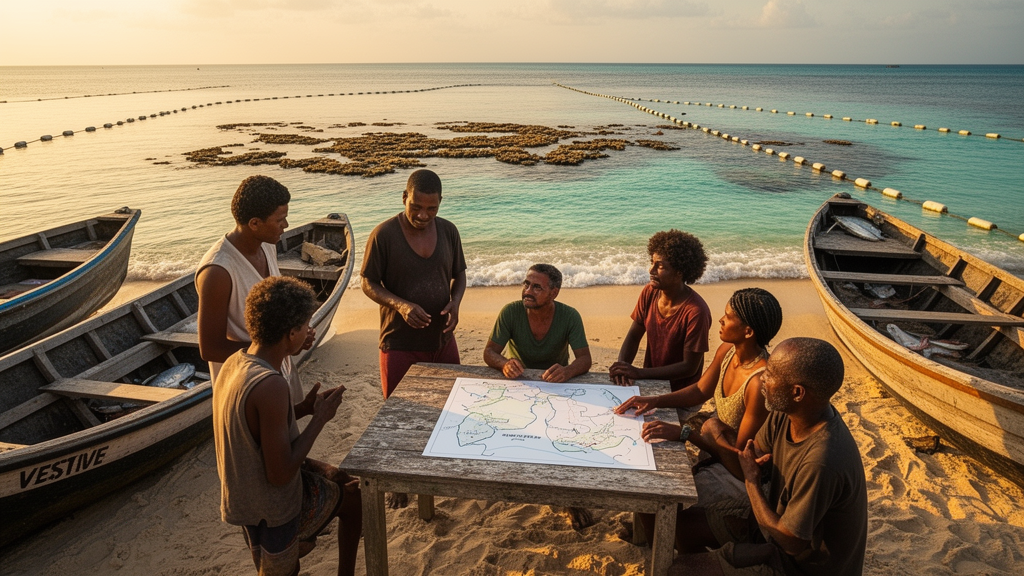
Marine protected areas (MPAs) have become the world’s favorite tool for safeguarding ocean life, but a sweeping new systematic review suggests that many of these conservation zones are failing for a surprisingly human reason: the communities living beside them are being consulted, not empowered. In a study published in Frontiers in Ocean Sustainability, researchers Gideon Walter Mutanda and Godwell Nhamo of the University of South Africa analyzed 68 peer-reviewed articles to understand why communities participate in MPA governance, how they are engaged, and where the process breaks down. Their findings paint a sobering picture of participatory governance that is often more ritual than reality.
The stakes could hardly be higher. Oceans host most of the planet’s biodiversity, yet they are experiencing significant degradation and species loss. International frameworks such as the UN’s Sustainable Development Goal 14 and the Convention on Biological Diversity have pushed countries to designate ever-larger swaths of ocean as protected. Under the Kunming-Montreal Global Biodiversity Framework, nations have committed to effectively conserving at least 30 percent of all ecosystems by 2030, and instruments like the EU Biodiversity Strategy and the BBNJ Agreement are driving a rapid expansion of MPAs worldwide. Currently, only about 3.4 to 5 percent of the global ocean is protected, meaning the pace of designation must accelerate dramatically to meet global targets.
But designation alone, the review emphasizes, is not enough. Drawing on the Convention on Biological Diversity’s Aichi Target 11, the authors note that effective and equitable governance is essential for protected areas to function. A 2018 analysis of 27 MPA sites worldwide found that inadequate stakeholder engagement was the most critical factor influencing MPA success or failure. Two of the six factors consistently linked to MPA effectiveness are community engagement and governance, according to earlier research cited in the review. When communities are excluded from decisions about conservation goals, boundaries, and rules, the result is often conflict, low compliance, and what conservation scientists call paper parks: areas that exist on maps but fail to protect anything in the water.
To bring order to a fragmented literature, the researchers conducted a systematic review guided by the PRISMA 2020 guidelines, searching Google Scholar, Scopus, and Web of Science for peer-reviewed articles published between 2010 and 2025. After importing 961 articles into the screening software Covidence and removing 446 duplicates, the team retained 68 studies for detailed analysis using Atlas.ti 25 software. The analysis was structured around the Stakeholder Participation Assessment Framework, or SPAF, a tool designed to evaluate participation in marine spatial planning and MPAs across four dimensions: why people participate, who participates, when they participate, and how participation is facilitated. The team applied both deductive coding based on SPAF dimensions and inductive coding for themes that emerged from the data itself.
The results reveal a striking asymmetry between the stated motivations for community participation and the actual depth of engagement. The dominant drivers fall into three conceptual perspectives: management, ethical, and social learning. Ethical motivations emerged as the most dominant overall, with participation promoted to capture local views, traditions, and indigenous knowledge, foster ownership of MPAs, empower local people through recognition of their rights, and minimize negative impacts on livelihoods. Management-oriented motivations included helping enforce MPA regulations, increasing awareness and positive attitudes toward conservation goals, gathering data for management purposes, and enabling the state to achieve conservation objectives. Social learning motivations emphasized knowledge exchange, collective learning, and capacity development. Legal compliance was also a recurring driver, cited in seven of the reviewed studies.
Yet the practice often falls short of the principle. The review found that community engagement in many MPAs remains passive and serves primarily as a tick-box exercise. Nearly half of the participatory methods identified across the 41 MPA sites were passive, meaning communities received information from authorities without any opportunity to provide input in return. Public hearings, citizen science, biodiversity monitoring, and written public submissions were the most popular engagement methods, but the number of methods used declines rapidly as one moves toward strategies that promote higher levels of engagement. Most MPAs relied on informative methods such as public hearings, radio interviews, and media awareness tools, followed by consultative methods like community committees and workshops that allow limited two-way exchange. Notably, zero publications in the review documented genuine empowerment, the highest rung on the participation ladder, where communities hold final decision-making authority.
The timing of engagement matters as much as the method. The review found that communities are mainly engaged during park designation and establishment, and during operations and administration, when support for enforcement is needed, rather than during the conception and planning stages when fundamental decisions about conservation goals, boundaries, and governance systems are first made. Only nine of the 41 MPAs examined, including the Sian Ka’an and Banco Chinchorro Biosphere Reserves in Mexico, the Soufriere Marine Management Area in Saint Lucia, and several locally managed areas in Myanmar, engaged communities across all three governance stages. This pattern suggests that participation is often treated as an event rather than a continuous process, undermining the social capital and trust built during early planning phases.
Who gets engaged is equally revealing. The community emerged as the most engaged group, appearing in 36 of the 68 reviewed articles, followed by fishers and anglers in 34 articles, with artisanal fishers more dominant than recreational ones. But many studies treated the community as a homogeneous category without distinguishing the different stakeholder groups within it. Only one reviewed article reported youth participation in marine park processes, and women were similarly represented in just one study. Small-scale business operators and secondary value-chain actors such as fish processors, brokers, and traders were also largely absent, despite their dependence on marine resources. The authors argue that this lack of a difference approach, whereby diverse stakeholder identities, interests, and vulnerabilities are explicitly recognized, can marginalize groups such as women, people with disabilities, and indigenous communities whose voices are often disregarded in conservation decision-making.
The review also documented persistent structural barriers. Limited community representation, weak legislative support, inadequate political commitment, limited funding for participatory governance, and political interference all constrain meaningful engagement. Participation limitations were most pronounced in operational and managerial aspects of MPAs, creating an imbalance between participatory rhetoric and communities’ actual involvement in core governance structures. In one illustrative case, fishers in Portugal’s Litoral Norte MPA reported that they were not properly consulted before the area’s designation and that the public hearings organized by managers during implementation were largely symbolic, held only to meet formal requirements. Such experiences, the authors note, can reinforce existing inequalities rather than redistribute power.
The researchers recommend that MPA authorities adopt stakeholder analysis, ideally using an intersectional approach that recognizes overlapping identities, interests, and vulnerabilities, to ensure that participation processes are inclusive and representative rather than relying on voluntary participation and self-selection. They also call for collaborative, empowering participatory models that institutionalize co-management arrangements, with communities involved in decision-making, enforcement, and monitoring. Marine citizen science, they argue, can equip communities with skills in biodiversity monitoring, fisheries assessments, and marine pollution tracking, building a new generation of citizen scientists. Ultimately, the authors conclude that MPA authorities should work with academia and other key stakeholders to develop, refine, and reform public engagement practices if global conservation goals, from the 30 by 30 target to the health of coastal livelihoods worldwide, are to be met.
Subject of Research: Community participation and stakeholder engagement in marine protected area governance
Article Title: Motivations for community participation in marine protected areas governance systems
Article References: Mutanda, G. W., & Nhamo, G. (2026). Motivations for community participation in marine protected areas governance systems. Frontiers in Ocean Sustainability, 4, Article 1808210. https://doi.org/10.3389/focsu.2026.1808210
Image Credits: AI Generated
DOI: 10.3389/focsu.2026.1808210
Keywords: marine protected areas, community participation, stakeholder engagement, marine governance, SPAF, PRISMA systematic review, ocean conservation, co-management, indigenous knowledge, citizen science, biodiversity targets, coastal communities
Cite Scienmag News
Margaret Porter. (October 17, 2026). Why Communities Join Marine Protected Area Governance: New Review Reveals Tick-Box Problem. Scienmag. https://scienmag.com/why-communities-join-marine-protected-area-governance-new-review-reveals-tick-box-problem/
Margaret Porter. "Why Communities Join Marine Protected Area Governance: New Review Reveals Tick-Box Problem." Scienmag, 17 October 2026, https://scienmag.com/why-communities-join-marine-protected-area-governance-new-review-reveals-tick-box-problem/. Accessed 17 October 2026.
Margaret Porter. "Why Communities Join Marine Protected Area Governance: New Review Reveals Tick-Box Problem." Scienmag. October 17, 2026. https://scienmag.com/why-communities-join-marine-protected-area-governance-new-review-reveals-tick-box-problem/


