


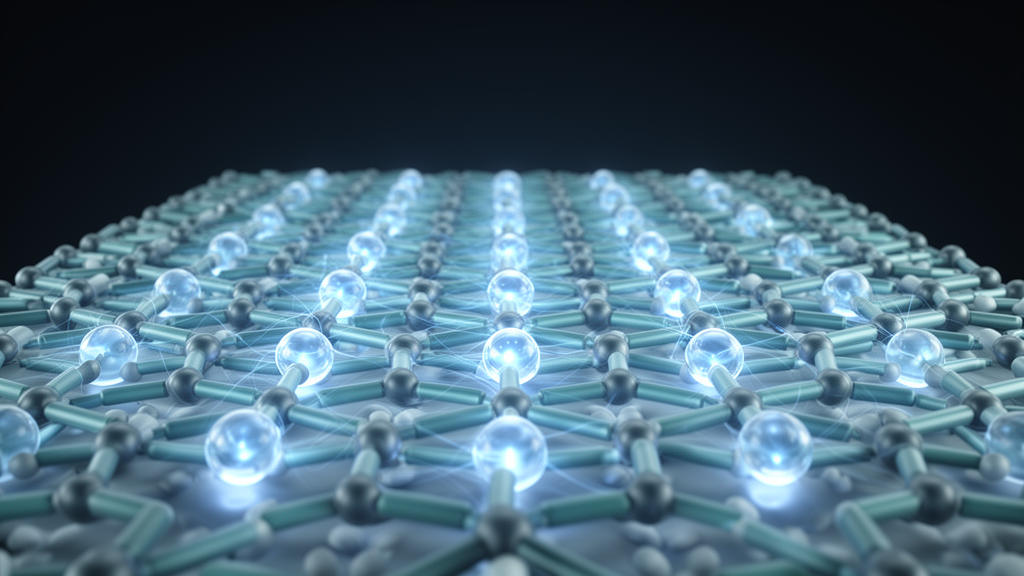
In the world of molecular materials, some of the most important players are the ones nobody notices. Counterions—the small charged partners that accompany positively charged molecules—are usually dismissed as mere spectators, quietly balancing charge without contributing anything meaningful to a material’s behavior. A new study from Japan challenges that assumption in striking fashion, showing that simply swapping one counterion for another can reshape a molecule’s geometry, redirect the flow of its electrons, alter how it responds to crushing pressures, and even change the way the molecules stack together in a crystal. The work, led by Professor Hiromitsu Maeda of Ritsumeikan University together with Professors Yohei Haketa and Yoichi Kobayashi of Ritsumeikan University and Professor Gaku Fukuhara of Kyushu University, was published in the journal Chemical Science on August 17, 2026.
The molecular platform at the heart of the study belongs to a class of compounds known as orthogonally arranged π-electronic systems. These architectures combine electron-donating and electron-accepting units oriented at right angles to one another, a geometry that produces distinctive electronic and photophysical behavior. Because the two components interact in a controlled but limited way, fine-tuning their electronic structure offers a route for regulating photoinduced electron transfer—the process in which an excited electron hops from one part of a molecule to another. Building on earlier work, the team explored complexes in which boron is bound to 1,3-diketones and 9-oxidophenalenone, an approach that generates electron-deficient cationic π-electronic systems with tunable properties.
The key synthetic innovation was the introduction of a phenalenyl unit into a molecular framework the group had previously studied. Phenalenyl units are prized in molecular electronics for their ability to stabilize unpaired electrons, and incorporating one into the boron-centered framework produced a cationic π-electronic system with two orthogonally arranged components. By introducing a phenalenyl unit into the previously studied anion-responsive molecular framework, the team created a cationic system in which counteranions could, in principle, influence molecular conformation, electronic states, and subsequent photophysical behavior. That expectation turned out to be correct, and in more ways than one.
To test how much influence the counterion really exerts, the researchers first prepared chloride ion pairs and then exchanged the chloride for a series of increasingly bulky and chemically distinct anions: tetrafluoroborate (BF₄⁻), hexafluorophosphate (PF₆⁻), tetrakis(pentafluorophenyl)borate (B(C₆F₅)₄⁻), and pentacyanocyclopentadienide. The results were unambiguous. The identity of the counteranion strongly influenced the shape of the anion-binding unit. Chloride, a small anion that binds tightly within the molecular cleft, induced the inversion of two pyrrole rings, flipping part of the receptor into a different orientation. Larger counteranions, unable to fit snugly into the binding pocket, favored an unbound conformation instead. Nuclear magnetic resonance and ultraviolet-visible spectroscopy confirmed these structural changes in solution, while quantum-chemical calculations revealed distinct electronic distributions between the electron-rich anion-binding region and the electron-deficient phenalenyl unit.
Those structural differences translated directly into differences in ultrafast electron dynamics. Using transient absorption spectroscopy, a technique capable of tracking events on femtosecond timescales, the researchers observed electron transfer from the dipyrrolyldiketone unit to the phenalenyl unit after photoexcitation, generating a reduced phenalenyl species. Remarkably, the speed of this process depended on which counterion was present. For the ion pair containing the bulky, weakly coordinating B(C₆F₅)₄⁻ anion, electron transfer occurred with a time constant of 200 femtoseconds. For the corresponding chloride complex, the reaction was even faster, completing within a time shorter than the 150-femtosecond instrumental response of the apparatus. In other words, simply binding or releasing a chloride ion provided a molecular switch for modulating ultrafast electron-transfer behavior—a level of control that is difficult to achieve by conventional structural modification of the π-framework itself.
The counterions also governed how the molecules responded to mechanical force. When the researchers subjected the ion pairs to hydrostatic pressures of up to 280 megapascals, the compounds responded reversibly, with their absorption spectra shifting gradually to longer wavelengths as pressure increased. This red shift reflects changes in the electronic structure of the molecules as they are compressed. Crucially, the magnitude of the response varied with the counterion. The B(C₆F₅)₄⁻ ion pair showed a pressure-induced spectral slope of −0.714 wavenumbers per megapascal, while the chloride complex responded more weakly, with a slope of −0.616 wavenumbers per megapascal. The smaller response of the chloride complexes was attributed to structural rigidification: because chloride binding locks the anion-binding unit into a defined conformation, the molecule has less conformational freedom to be squeezed into new electronic configurations under pressure.
Solid-state measurements added yet another dimension to the story. Single-crystal X-ray analysis revealed ion-pairing assemblies in which the orthogonal cations formed one-dimensional arrays through double π–π stacking interactions. These extended structures were stabilized by favorable electrostatic and dispersion interactions between the charged components. The analysis showed that counteranion-dependent conformations influence not only the properties of individual molecules but also the way they pack together in the crystal—a critical consideration, since charge transport in organic electronic materials depends heavily on how molecules arrange themselves in the solid state.
Taken together, the findings elevate counteranions from passive charge-balancing partners to active control elements in molecular design. As Maeda noted, counteranions are often viewed simply as charge-balancing partners, but the results show they can actively control molecular behavior, and the ability to regulate electron transfer and pressure-responsive photophysical properties could help establish new design strategies for stimulus-responsive electronic and photophysical materials. The study demonstrates that counteranion selection can, in a single molecular platform, control conformation, electronic states, electron transfer, pressure response, and solid-state assembly—five properties that materials chemists typically tune through laborious modifications of the molecular backbone.
The practical implications extend across several emerging technologies. Molecules whose optical properties shift predictably under pressure are natural candidates for pressure sensors, and the reversible, counterion-tunable nature of the response suggests a route to calibrating such sensors simply by choosing the right ion pair. The counterion-dependent electron-transfer rates point toward molecular switches in which binding events gate the flow of charge on femtosecond timescales. Meanwhile, the counterion-controlled crystal packing offers a handle on charge-transport behavior in bulk materials, which is essential for organic semiconductors. Because all of these effects arise from ion pairing rather than covalent synthesis, they can in principle be explored combinatorially, by screening counterions against a single cationic framework.
The broader lesson is one that resonates far beyond this particular molecular family. Supramolecular chemistry has long emphasized that weak, non-covalent interactions can dictate function, but the Ritsumeikan-led study provides an unusually complete demonstration of that principle, connecting ion identity to molecular shape, to ultrafast electron dynamics, to mechanical responsiveness, and to crystal architecture within one coherent framework. As researchers pursue smaller, lighter, and more energy-efficient electronic and photonic technologies, strategies that extract more function from fewer chemical modifications will only grow in importance. In this work, the humble counterion—the component traditionally treated as chemical ballast—emerges as a genuine design element, one that may help define the next generation of smart, stimulus-responsive molecular materials.
Subject of Research: Counterion-controlled conformation, electron transfer, and assembly in orthogonally arranged π-electronic cations
Article Title: Changing counterions gives molecular materials new electronic behaviors
Article References: Changing counterions gives molecular materials new electronic behaviors. (n.d.). Original publication
Image Credits: AI Generated
DOI: Not provided
Keywords: counterions, π-electronic cations, electron transfer, phenalenyl, boron complexes, pressure response, transient absorption spectroscopy, ion pairing, molecular switches, supramolecular chemistry, Chemical Science, Ritsumeikan University
Cite Scienmag News
Christina Coleman. (October 17, 2026). Counterions Emerge as Powerful Control Elements in Molecular Electronic Materials. Scienmag. https://scienmag.com/counterions-emerge-as-powerful-control-elements-in-molecular-electronic-materials/
Christina Coleman. "Counterions Emerge as Powerful Control Elements in Molecular Electronic Materials." Scienmag, 17 October 2026, https://scienmag.com/counterions-emerge-as-powerful-control-elements-in-molecular-electronic-materials/. Accessed 17 October 2026.
Christina Coleman. "Counterions Emerge as Powerful Control Elements in Molecular Electronic Materials." Scienmag. October 17, 2026. https://scienmag.com/counterions-emerge-as-powerful-control-elements-in-molecular-electronic-materials/


