


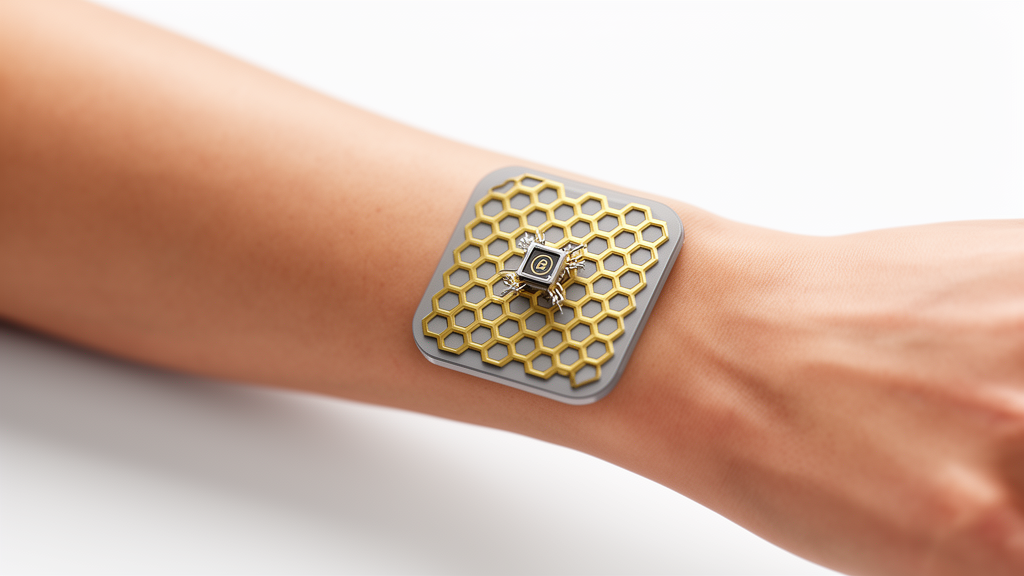
For the millions of people living with diabetes, the daily ritual of finger pricking is painful, infection-prone, and a constant reminder of the disease’s grip on their lives. Now, a team of engineers in India has developed a compact radio-frequency sensor that could one day replace the lancet entirely. In a study published in Frontiers in Antennas and Propagation, researchers at the Thapar Institute of Engineering and Technology in Patiala designed, built, and tested a cylindrical dielectric resonator antenna backed with a beehive-shaped artificial magnetic conductor, a metamaterial structure that dramatically boosts the antenna’s performance for non-invasive blood glucose monitoring. The device operates in the license-free industrial, scientific, and medical band around 2.4 gigahertz, the same crowded slice of spectrum used by Wi-Fi and Bluetooth, yet it can detect subtle changes in the electrical properties of human blood.
The physics behind the approach is elegantly simple. When an antenna radiates near a human body, the body reflects the radiation at a specific resonant frequency, and the return loss and resonant frequency differ from those measured in free space. Crucially, this difference varies with the glucose concentration in the blood. Glucose changes the dielectric constant and conductivity of blood plasma, so as sugar levels rise, the electrical signature the antenna sees shifts in a predictable way. By correlating these shifts with actual blood glucose levels, the sensor can translate an invisible electromagnetic change into a readable number, all without breaking the skin.
Choosing the right antenna was the central engineering challenge. The device had to be small enough to be portable, safe enough that its radiation would not harm tissue, and powerful enough that its main beam could penetrate deeply to reach the blood layer beneath the skin. The team selected a cylindrical dielectric resonator antenna made of alumina ceramic, a material prized in microwave engineering for its low dielectric loss compared with the ohmic losses of metallic radiators. Dielectric resonators have long served as high-Q elements in filters and oscillators, but researchers discovered decades ago that removing the metal shielding turns them into efficient radiators, offering a compelling alternative to conventional low-gain patch antennas.
The design process began with the dielectric waveguide model, which calculates antenna dimensions for a target resonant frequency. For a height of 6 millimeters, the equations called for a radius of 25 millimeters, far exceeding the team’s target footprint of 30 by 30 millimeters. The researchers settled on a 12-millimeter radius, but at those dimensions the antenna resonated near 9 gigahertz, nowhere near the 2.4-gigahertz ISM band needed for biomedical sensing. The solution was a defected ground structure, a series of precisely calculated slots etched into the copper ground plane. These slots disturb the ground plane’s current distribution, adding capacitance and inductance that shift the antenna’s resonance downward. Guided by surface current density maps, the team cut a rectangular slot, then two additional slots at its bottom corners where current concentrated, and finally a fourth slot along its lower edge, walking the resonance step by step into the target band.
The finished antenna resonates at 2.4 and 2.526 gigahertz with an impedance bandwidth of roughly 300 megahertz, spanning 2.35 to 2.6 gigahertz in simulation. It measures just 30 by 30 by 6 millimeters and initially achieves a gain of 3.6 dBi with a bidirectional radiation pattern. The team then added the study’s most distinctive feature: a beehive-shaped artificial magnetic conductor positioned behind the antenna. Hexagonal unit cells were chosen because their tight packing produces stronger magnetic coupling than conventional split-ring resonator designs. Over the operating band, the metasurface reflects waves in phase with the source, so the reflected waves constructively interfere with the original radiation. The result is a gain of 7.69 dBi, more than double the original, with reduced side lobes and improved front-to-back ratio.
Safety came next. Using CST Microwave Studio, the researchers simulated the antenna against the Hugo bio model, a 38-year-old male phantom with 31 tissue-mimicking structures, and against a simpler layered phantom of skin, fat, and blood. The antenna produced a specific absorption rate of just 0.036 watts per kilogram, well within the 1.6 watts per kilogram limit prescribed for human exposure. The team also verified the antenna’s radiation behavior experimentally, fabricating the prototype on Rogers RT/duroid 5880 substrate, waterjet-cutting the alumina resonator into its cylindrical shape, and testing it with a vector network analyzer. Measured impedance bandwidth matched simulation within a 1.6 percent error, and measured gain agreed closely with predicted values.
To test glucose sensitivity, the researchers turned to the Debye and Cole-Cole models, mathematical frameworks that describe how the dielectric properties of biological tissues change with frequency and composition. They calculated the dielectric constant and dielectric loss of human blood for glucose concentrations of 80, 110, 130, 150, and 170 milligrams per deciliter, spanning normal to hyperglycemic levels. The models confirmed that the dielectric constant and conductivity of blood plasma are inversely related to glucose concentration, a relationship that becomes more pronounced at higher frequencies. When these varying dielectric parameters were applied to the blood layer in the simulated phantom, the antenna’s S11 parameter shifted measurably with each glucose level, from -16.02 dB at 80 milligrams per deciliter to -15.75 dB at 170 milligrams per deciliter.
Those shifts translate into a sensitivity of 4.5 times ten to the minus three dB per milligram per deciliter, a figure the researchers argue makes the sensor a strong candidate for preliminary hyperglycemia monitoring. The device’s simplicity and low cost are equally important selling points. Unlike optical and thermal non-invasive methods, which require large and expensive instruments, RF-based sensors are small, cheap, and easy to handle, making them particularly attractive for developing nations where diabetes monitoring must be affordable and practical.
The implications reach beyond the laboratory. More than 9 percent of the global population is diagnosed with diabetes, and roughly 23 percent of cases go undiagnosed, according to figures cited in the study. Diabetes ranks as the seventh biggest contributing cause of death in recent reports from the American Diabetes Association and the World Health Organization. Early detection of prediabetes and continuous monitoring of blood glucose levels could help patients adopt healthier practices before the disease takes hold, and a painless, needle-free sensor could remove the barrier that keeps many people from checking as often as they should.
Significant hurdles remain before such a sensor reaches the clinic. The study relied on simulated phantoms and aqueous glucose solutions rather than clinical trials on human subjects, and real-world measurements must contend with motion, temperature, hydration, and the confounding effects of other blood constituents, though the researchers assumed minerals such as calcium, chloride, potassium, and magnesium have negligible impact on the electrical properties. Still, the combination of a compact footprint, a permissible safety profile, a doubled gain from the beehive metamaterial, and demonstrated sensitivity to glucose variation marks a meaningful step toward a future where checking your blood sugar requires nothing more than holding a small antenna against your skin.
Subject of Research: Non-invasive RF blood glucose monitoring using a cylindrical dielectric resonator antenna with an artificial magnetic conductor
Article Title: Design, development, and testing of a cylindrical dielectric resonator antenna backed with a beehive-shaped artificial magnetic conductor for non-invasive blood glucose monitoring
Article References: Upadhyay, N., Kaur, A., Pattanayak, A., & Singh, A. (2025). Design, development, and testing of a cylindrical dielectric resonator antenna backed with a beehive-shaped artificial magnetic conductor for non-invasive blood glucose monitoring. Frontiers in Antennas and Propagation, 3, Article 1494224. https://doi.org/10.3389/fanpr.2025.1494224
Image Credits: AI Generated
DOI: 10.3389/fanpr.2025.1494224
Keywords: Design, development, testing, cylindrical, dielectric, resonator, antenna, backed, beehive-shaped, artificial, magnetic, conductor
Cite Scienmag News
Neil Sanderson. (October 17, 2026). Beehive-Shaped Metamaterial Backing Boosts Tiny Antenna for Needle-Free Glucose Monitoring. Scienmag. https://scienmag.com/beehive-shaped-metamaterial-backing-boosts-tiny-antenna-for-needle-free-glucose-monitoring/
Neil Sanderson. "Beehive-Shaped Metamaterial Backing Boosts Tiny Antenna for Needle-Free Glucose Monitoring." Scienmag, 17 October 2026, https://scienmag.com/beehive-shaped-metamaterial-backing-boosts-tiny-antenna-for-needle-free-glucose-monitoring/. Accessed 17 October 2026.
Neil Sanderson. "Beehive-Shaped Metamaterial Backing Boosts Tiny Antenna for Needle-Free Glucose Monitoring." Scienmag. October 17, 2026. https://scienmag.com/beehive-shaped-metamaterial-backing-boosts-tiny-antenna-for-needle-free-glucose-monitoring/


