


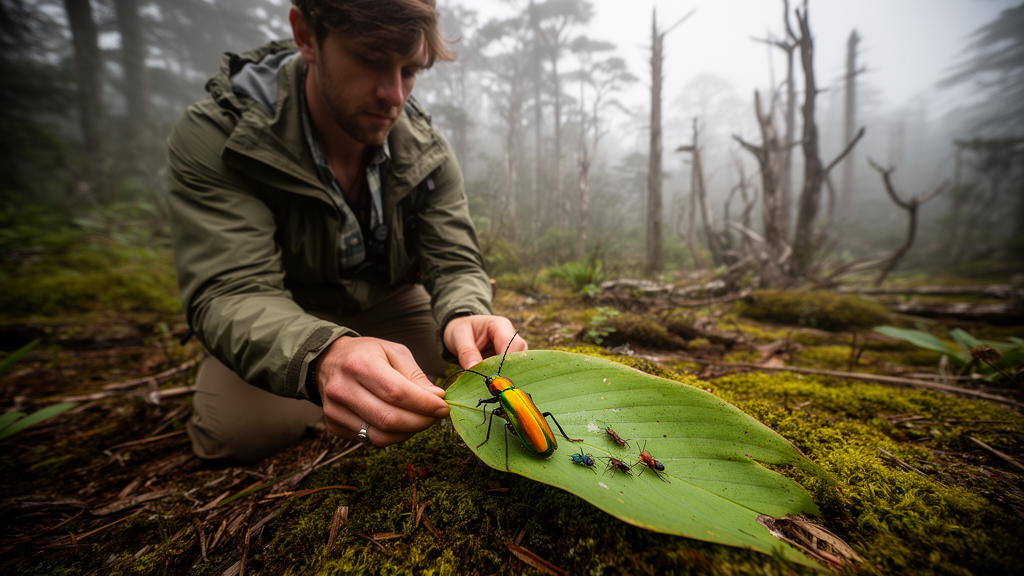
On the small volcanic island of Santa Maria, the easternmost outpost of the Azores Archipelago, a team of researchers has spent more than a year counting beetles, spiders, flies and other arthropods with an unusual goal: turning the fate of endangered snails into something measurable. The work, conducted under the LIFE SNAILS project, uses arthropod communities as living gauges of habitat quality, and its latest results have just been published in the Biodiversity Data Journal.
The project’s direct targets are not insects at all, but three threatened endemic molluscs found only on Santa Maria: the land snails Oxychilus agostinhoi and Leptaxis minor, and the semi-slug Azorivitrina angulosa. Two of these species are listed as critically endangered and one as endangered on the IUCN Red List. Because their survival depends entirely on the condition of the forest fragments they inhabit, the researchers needed a practical way to track how those habitats are faring. Arthropods, which respond quickly to disturbance, climate variation and habitat degradation, offered an ideal proxy.
The technical heart of the study is a device called a SLAM trap, short for Sea, Land and Air Malaise. Each trap is a metre-high tent-like structure of mesh that intercepts flying insects and guides them upward into a collecting container filled with propylene glycol, which kills and preserves the specimens. Crucially, the trap also functions as an artificial extension of the tree, allowing non-flying organisms such as spiders to climb into it. This broadens the range of arthropod groups sampled far beyond what a single technique could achieve.
Between 16 June 2024 and 15 December 2025, the team deployed these traps at 13 forest sites, most of them dominated by mixed vegetation of endemic, native and introduced plants. Eleven sites were monitored throughout the survey period, with two additional sites incorporated in the final season. The effort yielded 55 sampling events and a staggering total of 20,282 specimens. Of these, 15,055 individuals, representing 74% of the sample, were identified to species or subspecies level by a single taxonomist working with a team of trained parataxonomists.
The inventory revealed 172 species and subspecies, a community portrait that tells a familiar story of island ecology under pressure. Twenty-seven taxa were endemic, 48 native but not endemic, 77 introduced and 20 of uncertain colonisation status. Among the endemics, three species stood out for their abundance: the planthopper Cixius azomariae with 1,825 individuals, the barklouse Elipsocus azoricus with 695, and the spider Rugathodes acoreensis with 600. These figures provide a rare quantitative baseline for the invertebrate life of a forest that has been shrinking since Portuguese colonisation began in the fifteenth century.
Ten species were recorded for the first time on Santa Maria Island, though none represented a new record for the Azores Archipelago as a whole. Among the newcomers were the black soldier fly Hermetia illucens, a globally spreading saprophagous species prized in agriculture for its bioremediation and protein applications, and the flea beetle Phyllotreta procera, which appears to be gradually expanding across the archipelago, mirroring its spread elsewhere in Europe. Other new island records included a spider, a pseudoscorpion, three beetles and four hemipterans. Most of these arrivals were introduced species, reinforcing the pattern that exotic arthropods tend to colonise disturbed and exotic-dominated forests first.
The most consequential technical contribution of the study is the application of the IBI-SLAM index, an arthropod-based Index of Biotic Integrity developed specifically for Azorean forests. The index combines seven community metrics related to the endemic, native, saprophagous and introduced components of the assemblage, producing a score from 0 to 14 where higher values indicate higher biotic integrity. Because the index varies seasonally, temporal comparisons must account for sampling season, particularly when evaluating conservation interventions.
The results painted a picture of moderate but spatially heterogeneous forest condition. IBI-SLAM values predominantly fell within the moderate category across the monitored sites; none were classified as poor and only a few reached the good category. Mean values rose slightly from Summer 2024 to Winter-Spring 2025 and then declined in Summer-Autumn 2025, indicating temporal variation rather than a consistent directional trend. One site, SMR-SNAILS-T04, consistently recorded high values, while SMR-SNAILS-T08 showed the clearest decline over time. Lower scores were mainly associated with factors linked to introduced species, which are more common in forests dominated by exotic vegetation such as Pittosporum undulatum and Hedychium gardnerianum.
The researchers are careful to note that differences in IBI-SLAM values should not be interpreted as direct evidence of differences or changes in habitat quality, since the potential relationships between community components and the observed patterns were not tested independently. The index is calibrated using Azorean arthropod assemblages and should not be transferred uncritically to other regions, although its multi-metric logic can inform similar island-based monitoring tools elsewhere. This restraint reflects a broader principle in conservation science: indicators are powerful, but they require careful interpretation.
What makes this study significant beyond its technical achievements is its role in a larger conservation experiment. By establishing standardised, repeatable arthropod monitoring across the intervention areas of LIFE SNAILS, the team has created a framework that can evaluate whether restoration efforts are actually working. All specimens are preserved in 96% ethanol and housed in the Dalberto Teixeira Pombo insect collection at the University of the Azores, and the complete database has been published through the Global Biodiversity Information Facility as a Darwin Core Archive, making the data freely available to researchers worldwide. As pristine native forest now occupies only a very small proportion of the Azores, and remaining fragments are threatened by invasive alien plants, such long-term monitoring may prove essential for the survival of the island’s most vulnerable inhabitants, whether they crawl on six legs or carry a shell.
Subject of Research: Monitoring arthropods under the scope of LIFE-SNAILS project: II – Santa Maria Island data with implementation of the Index of Biotic Integrity
Article Title: Monitoring arthropods under the scope of LIFE-SNAILS project: II – Santa Maria Island data with implementation of the Index of Biotic Integrity
Article References: Vounatsi, M., Lhoumeau, S., Dal Lago, A., Wallon, S., Moura, N., Ponte, M., Abreu, R., & Borges, P. (2026). Monitoring arthropods under the scope of LIFE-SNAILS project: II – Santa Maria Island data with implementation of the Index of Biotic Integrity. Biodiversity Data Journal, 14, Article e203118. https://doi.org/10.3897/bdj.14.e203118
Image Credits: AI Generated
Keywords: Monitoring, arthropods, under, scope, LIFE-SNAILS, project, Santa, Maria, Island, data, implementation, Index
Cite Scienmag News
Gavin Prescott. (October 17, 2026). Tiny Sentinels: How Island Bugs Reveal the Health of a Vanishing Forest. Scienmag. https://scienmag.com/tiny-sentinels-how-island-bugs-reveal-the-health-of-a-vanishing-forest/
Gavin Prescott. "Tiny Sentinels: How Island Bugs Reveal the Health of a Vanishing Forest." Scienmag, 17 October 2026, https://scienmag.com/tiny-sentinels-how-island-bugs-reveal-the-health-of-a-vanishing-forest/. Accessed 17 October 2026.
Gavin Prescott. "Tiny Sentinels: How Island Bugs Reveal the Health of a Vanishing Forest." Scienmag. October 17, 2026. https://scienmag.com/tiny-sentinels-how-island-bugs-reveal-the-health-of-a-vanishing-forest/


