


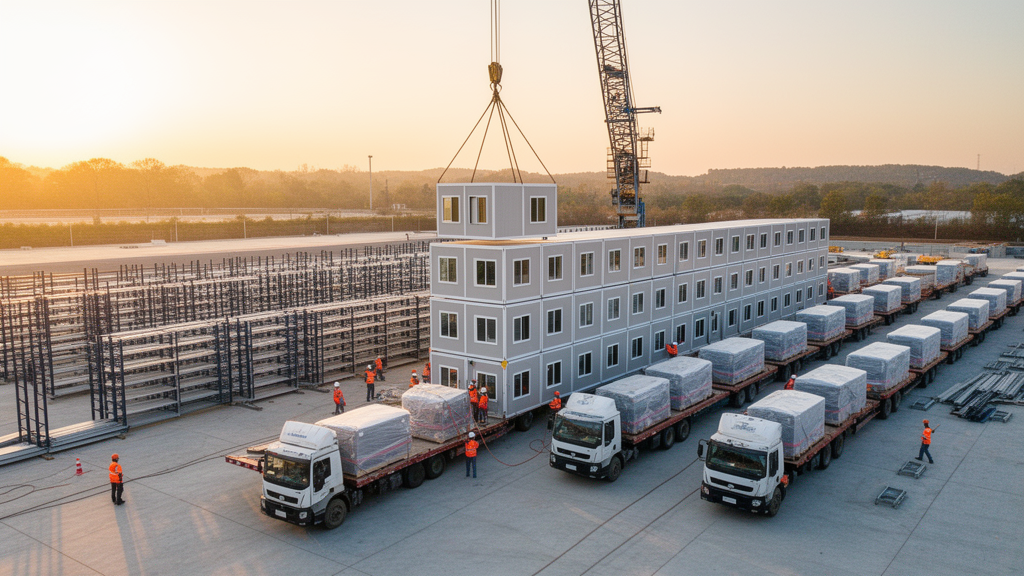
Prefabricated and offsite construction, often abbreviated as POC, has moved from the margins of the building industry to the center of debates about how the world will house its growing population. Instead of assembling structures brick by brick on a muddy site, industrialized construction manufactures modules, panels, and components in controlled factory environments and then transports them for rapid assembly. The approach promises higher quality, less waste, faster delivery, and a smaller environmental footprint. Yet a new editorial published in Frontiers in Built Environment argues that the technology itself is only half the story. The real bottleneck, the authors contend, lies in the supply chains that feed design, manufacturing, logistics, and assembly, and understanding how those chains perform may determine whether prefabrication can truly transform project delivery.
The editorial, authored by Rehan Masood of Otago Polytechnic in New Zealand, Volkan Ezcan of Liverpool John Moores University in the United Kingdom, and Salman Azhar of Auburn University in the United States, introduces a Research Topic that gathers empirical and theoretical work on supply chain performance in prefabricated and offsite construction. The authors frame the problem clearly: the construction industry faces relentless pressure to improve productivity, quality, sustainability, and resilience while demand for housing and infrastructure keeps climbing. POC offers a promising route, but its success depends not only on technological innovation in factories and on sites. It depends equally on how well manufacturers, suppliers, logistics providers, contractors, and clients coordinate across organizational and geographical boundaries.
Four studies anchor the Research Topic, and together they sketch a multidimensional picture of what supply chain performance really means in industrialized building. The first investigates supply chain visibility in industrial construction, highlighting the importance of timely and relevant information for coordination and decision making among project stakeholders. In conventional construction, a contractor can often see problems developing on site and react. In offsite construction, however, critical work happens far from the site, inside factories and warehouses, on trucks and in ports. When a module is delayed or a component arrives out of specification, the consequences ripple through the entire delivery sequence. Greater visibility, the editorial notes, helps organizations understand activities across the supply chain, identify potential problems earlier, and improve coordination among the many actors involved.
Visibility, in this context, is not simply a matter of goodwill or better communication habits. It is an information architecture problem. Effective coordination depends upon timely and accurate information exchange that allows stakeholders to align decisions and respond proactively to project demands. The editorial suggests that transparent information sharing can strengthen stakeholder relationships, support decision-making, and enhance overall supply chain performance. As POC systems become increasingly interconnected, the authors argue, visibility is likely to remain a critical enabler of productivity and collaboration, a conclusion that resonates with the industry’s growing interest in digital platforms that track components from production line to installation.
The second study shifts attention from information to process reliability. It examines continuous process improvement in industrialized housebuilding through the application of Failure Mode and Effects Analysis, or FMEA, a structured methodology borrowed from manufacturing and safety engineering. FMEA asks teams to systematically enumerate the ways a process can fail, estimate the severity and likelihood of each failure mode, and prioritize corrective actions before defects occur. Applied to factory-built housing, the study demonstrates how this disciplined approach can reduce rework and delays while improving process reliability and organizational learning. The underlying philosophy is a departure from traditional construction culture, where problems are often treated as isolated events to be fixed on the spot. Instead, the FMEA perspective emphasizes prevention, learning, and continuous optimization throughout the production process, echoing the quality management systems that transformed automotive and electronics manufacturing decades ago.
The remaining two studies broaden the discussion beyond operational metrics, and this is where the editorial makes its most provocative argument. One contribution is an evidence gap mapping study examining psychosocial work exposures and their relationship with workforce outcomes in construction, while highlighting how little research has specifically focused on offsite construction environments. Psychosocial exposures include factors such as workload pressure, job insecurity, and the social conditions of work, all of which shape employee wellbeing and performance. The editorial treats this as a reminder that organizational capability extends beyond technical resources and production systems. Factory conditions, repetitive tasks, and the coordination demands of industrialized construction create their own occupational health landscape, one that remains largely unmapped. The long-term sustainability of the sector, the authors argue, depends on attracting, developing, and retaining a healthy and capable workforce, making social and human considerations an essential component of supply chain performance rather than an afterthought.
The fourth study explores the integration of circular economy principles in modular buildings, demonstrating how decisions related to design, materials, production, and end-of-life strategies can contribute to improved resource efficiency and value retention. Circular economy thinking asks a deceptively simple question: what happens to a building’s components when the building reaches the end of its useful life? In a linear model, the answer is demolition and landfill. In a circular model, modules are designed for disassembly, materials are selected for reuse, and value is retained across multiple lifecycles. The editorial emphasizes that environmental objectives need not be viewed separately from supply chain performance. Instead, sustainability can act as a source of innovation, resilience, and long-term competitive advantage. As governments and industries pursue decarbonization and resource-efficiency goals, the authors predict that circular economy principles will become increasingly embedded within future supply chain strategies for construction.
Taken together, the four contributions reveal that supply chain performance in prefabricated and offsite construction is fundamentally multidimensional. Information visibility, operational reliability, workforce wellbeing, and sustainability are not independent challenges but interconnected elements of a broader performance ecosystem. Improvements in one area often influence outcomes in others. Better visibility can prevent the delays that generate rework; reliable processes free up capacity that can be invested in workforce development; a workforce that is healthy and engaged is more capable of sustaining the precision that industrialized production demands. This interdependence, the editorial argues, reinforces the need for holistic and systems-oriented approaches to supply chain management, integrating perspectives from construction management, manufacturing, organizational studies, and sustainability research.
The authors also chart a research agenda for the years ahead. First, they see considerable scope to investigate how digital technologies, including Building Information Modelling, digital twins, artificial intelligence, and advanced analytics, can strengthen supply chain transparency and decision support. A digital twin of a factory production line, for instance, could expose bottlenecks before they cascade into project delays. Second, additional research is needed to improve supply chain resilience in the face of market volatility, climate-related disruptions, and geopolitical uncertainties, risks that have repeatedly exposed the fragility of globally distributed material flows. Third, greater attention should be directed toward workforce development, organizational culture, and psychosocial wellbeing within industrialized construction environments. Finally, the authors call for further exploration of circular supply chains, reverse logistics, and lifecycle-based business models that can support more sustainable construction systems.
The editorial’s conclusion is a challenge to an industry often measured by cost, schedule, and quality alone. Effective prefabricated and offsite supply chains, the authors write, depend on more than production efficiency. They require reliable information exchange, systematic process improvement, attention to workforce conditions, and consideration of environmental impacts throughout the building lifecycle. As cities grapple with housing shortages and climate targets simultaneously, the factories and logistics networks behind modular buildings may prove as consequential as the buildings themselves. The Research Topic offers both a diagnosis and an invitation: the performance of the supply chain is the performance of the construction industry’s industrial future.
Subject of Research: Supply chain performance in prefabricated and offsite construction
Article Title: Editorial: Performance of the supply chains for prefabricated and offsite construction
Article References: Masood, R., Ezcan, V., & Azhar, S. (2026). Editorial: Performance of the supply chains for prefabricated and offsite construction. Frontiers in Built Environment, 12, Article 2006617. https://doi.org/10.3389/fbuil.2026.2006617
Image Credits: AI Generated
DOI: 10.3389/fbuil.2026.2006617
Keywords: Editorial, Performance, supply, chains, prefabricated, offsite, construction, scientific research
Cite Scienmag News
Violet Maxwell. (October 17, 2026). Why the Future of Prefabricated Construction Depends on Smarter Supply Chains. Scienmag. https://scienmag.com/why-the-future-of-prefabricated-construction-depends-on-smarter-supply-chains/
Violet Maxwell. "Why the Future of Prefabricated Construction Depends on Smarter Supply Chains." Scienmag, 17 October 2026, https://scienmag.com/why-the-future-of-prefabricated-construction-depends-on-smarter-supply-chains/. Accessed 17 October 2026.
Violet Maxwell. "Why the Future of Prefabricated Construction Depends on Smarter Supply Chains." Scienmag. October 17, 2026. https://scienmag.com/why-the-future-of-prefabricated-construction-depends-on-smarter-supply-chains/


