


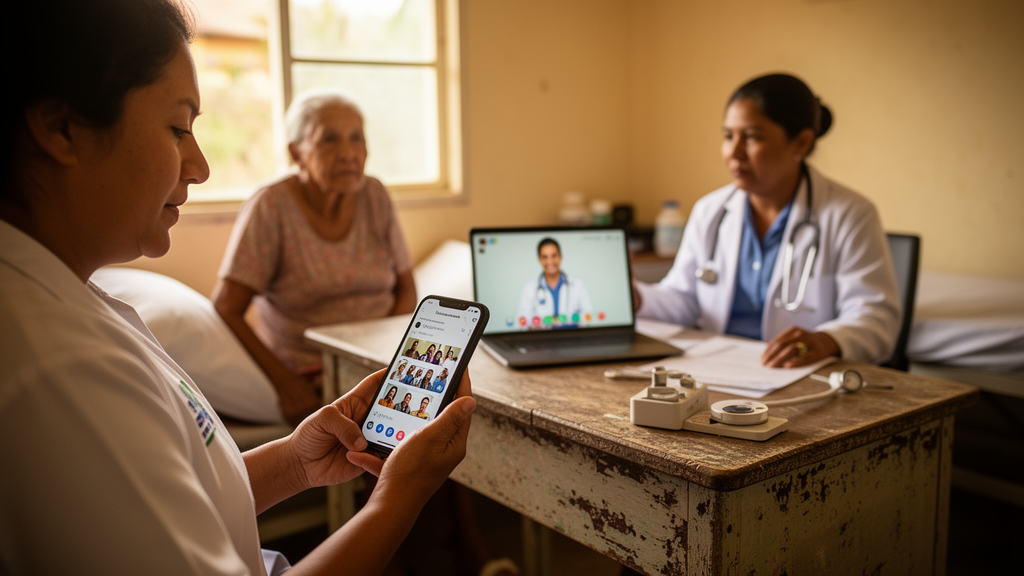
In the coffee-growing hills of central Colombia, one of the most effective tools against a leading cause of death and disability is not an expensive scanner or a new clot-dissolving drug, but a smartphone group chat. Researchers reporting in Frontiers in Stroke describe how Red ACV-Quindío, an integrated stroke care network built around a WhatsApp group, transformed access to emergency stroke treatment in a region that previously had none. Over 51 months of follow-up, the network delivered thrombolysis rates more than double the national average, kept door-to-needle times under 40 minutes, and held in-hospital mortality below 10 percent, all using resources that were already available.
The stakes could hardly be higher. Stroke is the second leading cause of death and the primary cause of acquired disability worldwide, and low- and middle-income countries bear the heaviest burden. Colombia recorded 16,946 deaths from cerebrovascular disease in 2023, with adults over 65 and women most affected. The department of Quindío, part of the so-called Coffee Triangle alongside Risaralda and Caldas, recorded a mortality rate of 32.19 stroke deaths per 100,000 inhabitants in 2025, among the highest in the nation. Yet before 2023, the region had no specialized stroke network, no reliable pathway to reperfusion therapy, and patients in low-complexity facilities often faced prolonged transfers to distant major cities, if they were transferred at all.
The solution that emerged in Armenia, the capital of Quindío, was strikingly simple. A neurologist and a handful of physicians doing their mandatory social service year created a WhatsApp group with a single purpose: routing patients with suspected acute stroke to a hospital capable of delivering thrombolysis, thrombectomy, or neurocritical care. The group quickly expanded to include the regional emergency and urgent care regulatory center, known as CRUE, pre-hospital responders, and emergency departments across neighboring departments including northern Valle del Cauca and Risaralda. Under the protocol, any clinician who encounters a suspected stroke patient posts a standardized pre-notification template to the chat, listing the time the patient was last known well, symptom onset, and medical history. Within minutes, a CRUE radio operator reviews the case and directs the patient to the most appropriate treatment center based on clinical need and insurance coverage. During transport, the accompanying physician updates the chat with clinical status and blood pressure readings every five minutes.
To evaluate whether this improvised system actually worked, the researchers conducted a pre-post quasi-experimental study at a World Stroke Organization-certified essential stroke center in Armenia, covering January 2022 through March 2026. They screened 1,381 patients with suspected stroke and included 841 confirmed acute ischemic cases with symptoms lasting less than 24 hours, excluding hemorrhagic strokes, transient ischemic attacks, intracranial tumors, and stroke mimics. Neurological severity was scored with the National Institutes of Health Stroke Scale, or NIHSS, and functional status with the modified Rankin Scale, both administered by professionals trained under World Stroke Organization guidelines. Statistical analysis in R used non-parametric methods appropriate for ordinal scales, including the Jonckheere-Terpstra test for trend and the Wilcoxon signed-rank test, with Cochran-Armitage tests applied to detect linear trends across the five study periods.
The demographic picture remained remarkably stable throughout, which strengthens the interpretation of the results. The median patient age was 72 years, just over half were women, and 91.7 percent came from urban areas. Nearly half of all patients, 47.1 percent, presented with minor strokes, and 89 percent were functionally independent before their event. Arterial hypertension dominated the risk factor profile at 73.1 percent, followed by dyslipidemia at 31.5 percent and diabetes at 25.6 percent. Trend tests confirmed no significant shift in admission severity across the years, meaning that changes in outcomes could not be explained by a changing mix of patients arriving at the door.
The most dramatic finding was the surge in reperfusion therapy. Thrombolysis rates climbed from 45.6 percent in 2022 to 64.2 percent in 2025, with an overall rate of 52.1 percent across the cohort, a statistically significant upward trend. In 2025, the odds of a patient receiving thrombolysis were more than twice those of 2022. Set against national Colombian figures from the RES-Q stroke quality registry, where thrombolysis rates hovered between 16 and 23 percent, the Quindío center exceeded the national average by 22 to 44 percentage points every single year, corresponding to rate ratios between 2.33 and 3.21. Door-to-needle times, the interval between hospital arrival and administration of the clot-dissolving bolus, rose from a mean of 20 minutes in 2022 to 38 minutes in 2026 as volume grew, but never breached the recommended 60-minute threshold and remained well below the national median of roughly 50 minutes.
Safety data supported the aggressive expansion of treatment. Hemorrhagic transformation, the most feared complication of thrombolysis, occurred in just 4.5 percent of the entire cohort and in 7.3 percent of thrombolyzed patients, and only four of those 38 transformations were symptomatic, amounting to less than 1 percent of all patients. Malignant brain edema was similarly rare at 3.9 percent. Neither complication showed a significant trend over time, and the figures compare favorably with the margins reported in large international registries such as SITS-MOST. Most strikingly, patients who received thrombolysis had significantly lower mortality than those who did not, 7.8 percent versus 12.2 percent, an odds ratio of 0.61. The authors are careful to note this unadjusted comparison is vulnerable to confounding by indication, since more severe strokes are both more likely to be treated and more likely to be fatal, but it aligns with adjusted findings from a Peruvian RES-Q cohort where thrombolysis independently predicted favorable outcomes.
Functional outcomes told a more nuanced story. At discharge, 55 percent of evaluable patients were functionally independent on the modified Rankin Scale, a figure that again substantially exceeds the national RES-Q benchmark of 33.4 percent. Yet this also means roughly one in three patients who had been independent before their stroke left the hospital with a new dependency, a sobering reminder of how destructive ischemic injury remains even with rapid treatment. On the NIHSS, surviving patients improved markedly between admission and discharge in every year, with median scores falling from 4 or 5 to 2, a within-patient change that was highly significant across the entire cohort. Sensitivity analyses varying the handling of missing data confirmed these patterns were not artifacts of incomplete documentation.
The study also captured the growing pains of a network that scaled faster than its design anticipated. Patient volume exploded from 68 ischemic cases in 2022 to a historic peak of 496 in 2024, then fell 45 percent in 2025 for identifiable operational reasons: new stroke-treating centers opened in the region, equipment maintenance forced temporary diversions, and a referral agreement with insurers was terminated. Intriguingly, pre-notification through the WhatsApp group declined from a peak of 57.1 percent in 2024 to 29.7 percent by early 2026, while walk-in patients arriving under their own power came to account for more than 70 percent of admissions. The apparent advantage of pre-notification for securing thrombolysis, clearly visible in 2023, disappeared as regional stroke awareness grew and in-hospital processes matured, suggesting the network had succeeded in teaching an entire region that stroke is a time-critical emergency.
Perhaps the most consequential message of the Quindío experiment is economic. The model runs on a WhatsApp group that costs almost nothing, a CRUE radio operator already staffed around the clock, and rotating physicians whose response burden is distributed across a wide network. The recurring cost is periodic training, essential because social service physicians rotate constantly, and even that is modest compared with the infrastructure a formal telestroke platform would demand. The authors acknowledge that consumer messaging raises data protection questions and that a dedicated application could automate case registration and referral coding, and they caution that their findings require prospective multicenter confirmation. But the core demonstration stands: organized regional stroke networks are achievable in middle-income settings without capital investment, and they can more than double access to clot-busting therapy while keeping mortality under 10 percent. For the millions living in stroke underserved regions across Latin America, Africa, and Asia, a group chat may be the most replicable stroke intervention yet devised.
Subject of Research: Impact of an integrated regional stroke care network on thrombolysis, mortality, and functional outcomes in Colombia
Article Title: The Quindío stroke network: impact of an integrated care model on mortality and functional outcomes in a middle-income country
Article References: García-Espinosa, L. S., Corredor-Quintero, Á. B., Lineros-Franco, R. A., Hernández-Cardona, A., Loaiza-Giraldo, I. N., Torres-Gómez, F., & Igirio-Gamero, J. L. (2026). The Quindío stroke network: impact of an integrated care model on mortality and functional outcomes in a middle-income country. Frontiers in Stroke, 5, Article 1916617. https://doi.org/10.3389/fstro.2026.1916617
Image Credits: AI Generated
DOI: 10.3389/fstro.2026.1916617
Keywords: stroke, thrombolysis, stroke network, Colombia, middle-income countries, reperfusion, mortality, functional outcomes, WhatsApp, telemedicine, public health, RES-Q registry
Cite Scienmag News
Cassandra Pierce. (October 17, 2026). A WhatsApp Group Is Saving Stroke Patients in Rural Colombia. Scienmag. https://scienmag.com/a-whatsapp-group-is-saving-stroke-patients-in-rural-colombia/
Cassandra Pierce. "A WhatsApp Group Is Saving Stroke Patients in Rural Colombia." Scienmag, 17 October 2026, https://scienmag.com/a-whatsapp-group-is-saving-stroke-patients-in-rural-colombia/. Accessed 17 October 2026.
Cassandra Pierce. "A WhatsApp Group Is Saving Stroke Patients in Rural Colombia." Scienmag. October 17, 2026. https://scienmag.com/a-whatsapp-group-is-saving-stroke-patients-in-rural-colombia/


