


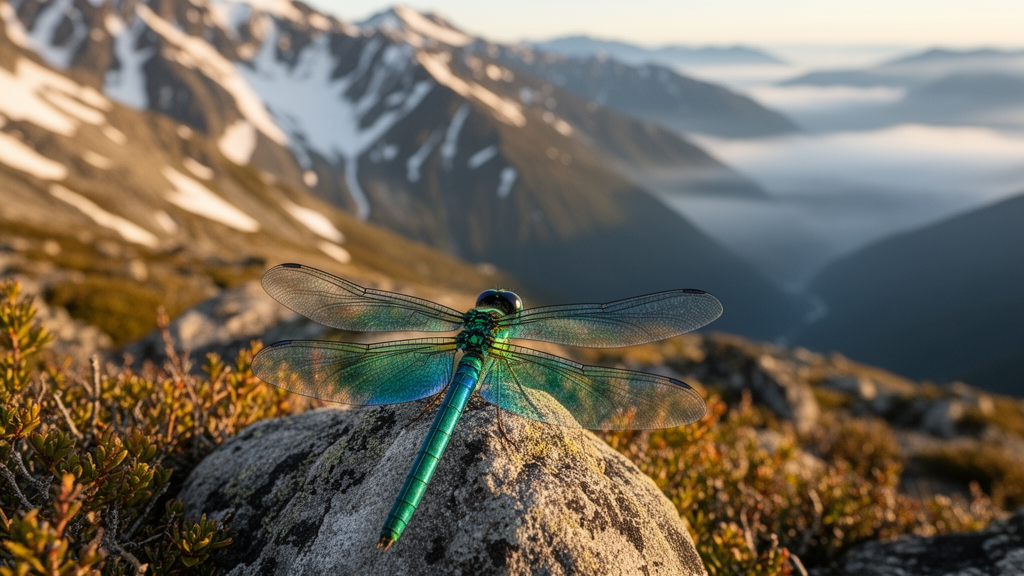
Deep in the mountains of Aotearoa New Zealand, two species of Kapokapowai dragonflies have become the unlikely protagonists of a fierce scientific dispute. One species, Uropetala chiltoni, lives in the high elevations of Kā Tiritiri-o-te-Moana, the Southern Alps. The other, Uropetala carovei, occupies lowland habitats. How did their ancestors come to inhabit such different worlds? The answer, according to a new commentary published in Frontiers of Biogeography, is active colonization: the dragonflies flew, dispersed, and shifted between elevations repeatedly over millions of years. The alternative hypothesis, that the insects passively rode tectonic uplift to their alpine homes, is not supported by the available genetic data, the authors argue.
The commentary, led by researchers including E. R. Tolman and colleagues, responds to two recent publications that cited their Kapokapowai work as evidence for passive uplift. This dispute is not merely academic. It touches on one of the longest-running controversies in biogeography: panbiogeography, a framework proposed by Leon Croizat in the mid twentieth century that treats vicariance, the splitting of ancestral populations by geographic barriers, as the primary means of speciation. Panbiogeography has generally rejected active dispersal as a direct route to speciation and downplayed the role of natural selection in evolution. For alpine taxa, a key assumption is that species reached high elevations by passively being carried upward with tectonic uplift, a process called passive uplift.
Aotearoa New Zealand is an ideal natural laboratory for testing these competing hypotheses. The flora and fauna of the Southern Alps have long served as a system for evaluating whether alpine species arrived by active colonization or by passive uplift. Thorough investigation has uncovered compelling evidence that active colonization brought numerous plants and animals to the Southern Alps. The Kapokapowai dragonflies, belonging to the genus Uropetala in the ancient family Petaluridae, offered an excellent test case, with one species at high elevation and a close relative at lowland elevations.
The original research, published in the journal Evolution, employed demographic modelling from a reference genome assembly and assessed population structure with sampling across the full range of the Kapokapowai dragonflies. The results strongly supported active colonization over passive uplift, revealing a dynamic dispersal history with multiple active shifts between high and low elevations. The montane species appears to have colonized the alpine habitat after the mountains formed, and then radiated back down to the lowlands, where the lowland species lost much of the genetic diversity still present in the alpine populations.
So how did two subsequent publications come to cite this work as supporting passive uplift? The commentary traces the confusion to a single typographical error in the first version of the preprint, posted on bioRxiv in November 2024. That early draft stated that the data offered support for the former hypothesis, meaning passive uplift, when the analyses actually supported the latter, meaning active colonization. The error was corrected in an updated preprint posted six days later, and the sentence was replaced entirely in the published version. The commentary argues that appealing to and quoting from an older preprint version, when the peer-reviewed published article is available, does not follow standard scientific practice. The published article supersedes all previously archived versions of the manuscript.
Beyond the typographical issue, the two critical publications focused their argument for passive uplift on the pattern of higher genetic diversity found in montane populations. They suggested that the montane species reflects the ancestral elevation and distribution, and that a simpler explanation is that lowland and montane species differentiated by vicariance, with the montane species surviving uplift passively. The commentary authors respond that these statements fail to address why lowland populations appear to have lost much of the genetic diversity present in the alpine populations. More importantly, they do not posit active colonization based on this pattern alone.
Two additional lines of evidence were not considered by the critics. First, a demographic model of the lowland species, built with the Pairwise Sequentially Markovian Coalescent, showed a decrease in effective population size after the uplift of the Southern Alps. Under passive uplift, this bottleneck would be expected to coincide closely with tectonic uplift, which it does not. Second, the researchers conducted an ancestral state reconstruction of the maximum elevation inhabited by species within the Petaluridae family. From simulating 1,000 discrete character trait histories, they found that these dragonflies have transitioned between high elevations above 900 meters, intermediate elevations between 400 and 900 meters, and low elevations below 400 meters every 2.9 million years on average. This offers support for widespread active colonization across the entire family, of which Uropetala is one of five genera.
The glaciation history of the Southern Alps adds further weight to the case for active colonization. In the last two million years, there have been approximately 20 glaciation events, during which the alpine habitat was repeatedly disrupted. The nunataks protruding above the ice were unlikely to have provided suitable habitat for Kapokapowai or other dragonfly species. Under passive uplift, the alpine species would have had to persist on the Southern Alps through all of these periods of glaciation, requiring persistence in a habitat in which, to the authors’ knowledge, no Petaluridae larvae have yet been observed. Glaciation events could have driven the dragonflies into lower elevations and may even have been part of the speciation process. The critics also appealed to behavioral notes from a field guide, observing that female Kapokapowai barely leave the habitat of their future offspring. The commentary authors counter that these observations do not represent peer-reviewed work demonstrating that long-distance dispersal has not occurred, and their own work found evidence of gene flow between high elevation and lower elevation populations on the South Island, which would likely require at least some long-distance dispersal.
The dispute also raises a deeper evolutionary question: can movement create species? The critical publications asserted that movement allows species to persist but does not create species. The commentary authors argue that this reasoning is fundamentally flawed. It is exceedingly difficult, if not impossible, to demonstrate that a phenomenon such as active colonization has never played a critical role in species formation. Given the biological diversity of life, it is scientifically unsound to posit that active colonization, at any geographic scale, has never contributed to speciation. Empirical and theoretical study has repeatedly demonstrated that movement and active colonization can lead to speciation across a variety of geographic scales and systems. The authors are careful to note that vicariance can certainly result in speciation, and that passive uplift does not lead to speciation would be equally inappropriate to claim.
The authors acknowledge that more data are needed to refine the demographic models of Kapokapowai dragonflies. Genome-wide re-sequencing of the sampled specimens, and a historical demographic model of dispersal and gene flow between populations using the site-frequency-spectrum, could robustly test the competing hypotheses. Based on their work, they consider it highly unlikely that follow-up study would support passive uplift over active colonization, but they cannot fully falsify the hypothesis until such data are acquired. Evolutionary and ecological processes are notoriously messy, and while simple explanations may be appealing, researchers are often forced to confront complexity. Until further evidence is uncovered, the authors assert that the quagmire of active colonization remains the best explanation for the biogeography of the Kapokapowai dragonflies, and that the failure to consider dispersal can lead to an incomplete understanding of evolutionary histories.
Subject of Research: Active colonization versus passive uplift in the biogeographic history of New Zealand's Uropetala dragonflies
Article Title: Dynamic dispersal histories: evidence for active colonization in Kapokapowai ( Uropetala ) dragonflies in Aotearoa New Zealand
Article References: Tolman, E. R., Goodman, A., Abbott, J. C., Bybee, S., Frandsen, P. B., Guralnick, R., Kohli, M. K., McAllister, T., Ware, J. L., & Beatty, C. D. (2026). Dynamic dispersal histories: evidence for active colonization in Kapokapowai (Uropetala) dragonflies in Aotearoa New Zealand. Frontiers of Biogeography, 19, Article e189098. https://doi.org/10.21425/fob.19.189098
Image Credits: AI Generated
Keywords: biogeography, dragonflies, Uropetala, New Zealand, Southern Alps, active colonization, passive uplift, panbiogeography, genomics, demographic modelling, speciation, Petaluridae
Cite Scienmag News
Gavin Prescott. (October 17, 2026). Dragonfly Genomes Reveal Alpine Colonization, Not Tectonic Hitchhiking, in New Zealand. Scienmag. https://scienmag.com/dragonfly-genomes-reveal-alpine-colonization-not-tectonic-hitchhiking-in-new-zealand/
Gavin Prescott. "Dragonfly Genomes Reveal Alpine Colonization, Not Tectonic Hitchhiking, in New Zealand." Scienmag, 17 October 2026, https://scienmag.com/dragonfly-genomes-reveal-alpine-colonization-not-tectonic-hitchhiking-in-new-zealand/. Accessed 17 October 2026.
Gavin Prescott. "Dragonfly Genomes Reveal Alpine Colonization, Not Tectonic Hitchhiking, in New Zealand." Scienmag. October 17, 2026. https://scienmag.com/dragonfly-genomes-reveal-alpine-colonization-not-tectonic-hitchhiking-in-new-zealand/


