


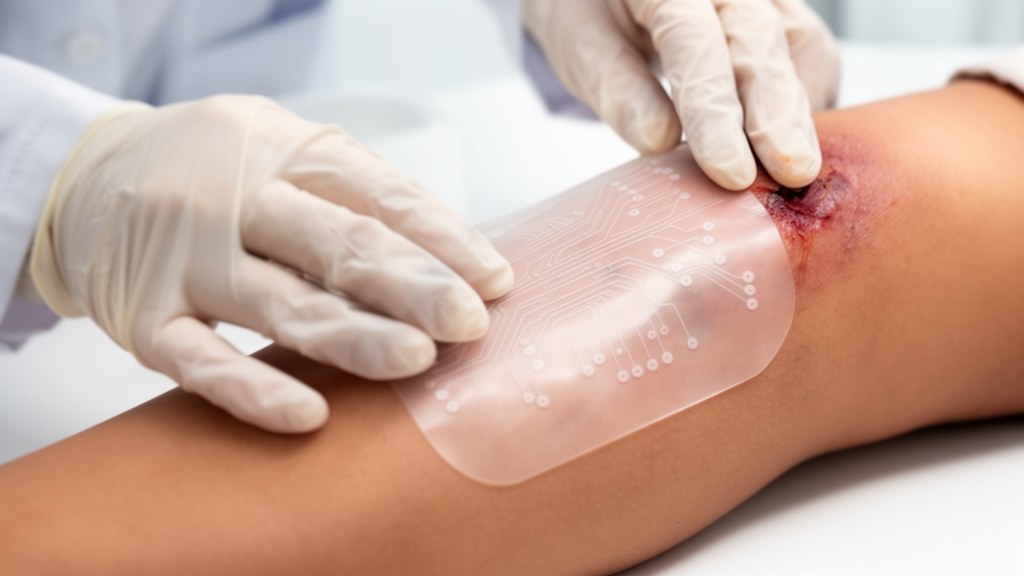
Chronic wounds that refuse to close are one of medicine’s most stubborn problems, and a new review from researchers at Xinqiao Hospital of Army Medical University argues that the solution may lie in an overlooked force already present in the wound bed: electricity. Writing in Frontiers in Medical Technology, the team led by Haihong Ge, Xi Ren and Zeyuan Lei surveys a rapidly expanding field of electroactive materials—conductive hydrogels, self-powered dressings, and multifunctional composites—that can generate, transmit, or amplify electrical signals to restart stalled healing. Their analysis arrives at a moment when the clinical burden of non-healing wounds has become enormous: more than six million people in the United States live with wounds that fail to close, prevalence approaches three percent among the elderly, and annual medical costs exceed fifty billion dollars.
The biological rationale for electrical stimulation rests on a phenomenon that has fascinated scientists since the nineteenth century. The German physiologist Emil Du Bois-Reymond first recorded faint bioelectric currents at injured skin in the 1800s, and in the 1980s researchers Barker and colleagues measured voltage differences of thirty to one hundred millivolts across hairless guinea pig skin, proposing what became known as the skin battery hypothesis. The modern explanation involves the transepithelial potential, a voltage generated by the polarized distribution of ion channels and pumps in epithelial cell membranes, together with active ion transport by Na+/K+-ATPase. Intact skin typically sits ten to sixty millivolts negative relative to underlying tissue. When the epithelial barrier is broken, this potential is locally short-circuited, and ions flow from surrounding healthy tissue toward the wound center, creating a lateral direct-current electric field of roughly forty to two hundred millivolts per millimeter directed from the wound periphery to its core.
That endogenous field is not a passive curiosity; it is an active steering mechanism for repair. In vivo imaging by Nuccitelli and colleagues confirmed that a mouse skin wound edge carries a field of about 177 millivolts per millimeter, sustained at peak intensity for roughly three days before declining as re-epithelialization proceeds. Different cell types respond with striking specificity: neutrophils and keratinocytes migrate toward the cathode, while fibroblasts and macrophages move toward the anode. Even endothelial cells split by origin, with microvascular cells migrating cathodally and macrovascular cells anodally. Gene knockout experiments identified phosphatidylinositol-3-OH kinase-gamma and PTEN as master regulators of this electrotactic behavior, with loss of the kinase abolishing directional migration and loss of the phosphatase amplifying it. Crucially, in three independent diabetic animal models, researchers found that wounds in diabetic tissue generate significantly weaker electric signals than healthy tissue, offering a concrete biophysical explanation for why chronic wounds stall in the inflammatory phase.
The clinical evidence for harnessing this biology has grown steadily. A recent meta-analysis of ten randomized controlled trials covering 451 patients with diabetic ulcers found that electrical stimulation with electrodes placed on or around the wound significantly improved healing rates compared with standard care alone, with a relative risk of 1.45. Yet conventional electrotherapy equipment remains tethered to external power supplies, demands complicated procedures, and restricts patient mobility—limitations that have kept electroceutical wound care from widespread adoption. The review’s central argument is that a new generation of materials can dissolve these barriers by embedding the electrical function directly into the dressing itself.
The first of the three material categories, conductive hydrogels, exploits the fact that hydrogels already make ideal wound dressings: they hold large amounts of moisture, are highly biocompatible, and mechanically mimic soft tissue. By weaving electroactive components into the hydrogel network—conductive polymers such as polyaniline, polypyrrole and PEDOT:PSS, carbon nanomaterials including graphene, carbon nanotubes and the two-dimensional MXenes, or metal nanoparticles—researchers create flexible electrodes that conform closely to irregular wound surfaces. This conformal contact lowers the impedance at the tissue interface, allowing safe stimulation at comparatively low voltages and avoiding the localized current densities that poor contact with rigid metal electrodes can produce. Most current designs target conductivity between ten to the minus three and ten to the minus one siemens per centimeter, a range chosen to approximate the electrical properties of hydrated dermal tissue. In animal studies, a three-dimensional conductive hydrogel scaffold seeded with dermal fibroblasts and paired with external stimulation produced the fastest wound contraction in full-thickness rat wounds, with higher vessel density and collagen accumulation than either component alone. A MXene-based nanocomposite hydrogel combined with antimicrobial peptides and suitable stimulation accelerated healing and improved final closure relative to both untreated controls and MXene-free hydrogels.
The review is candid, however, about a fundamental weakness in the most fashionable of these additives. MXenes, particularly the archetype Ti3C2Tx, oxidize readily in aqueous, oxygen-rich environments: within days, the transition metal surface converts to oxides such as TiO2 and conductivity deteriorates sharply. Surface passivation coatings, antioxidant agents, and protective hydrogel matrices are under investigation, but these strategies have been validated mostly in vitro, and the retention of MXene conductivity under the enzymatic and oxidative conditions of a real wound over the full healing period has not been systematically demonstrated. Hydrogels also swell and degrade in the moist wound bed, steadily eroding both conductivity and structure, and the long-term toxicology of conductive fillers and their degradation byproducts remains incomplete.
The second category, self-powered materials, tackles the power problem head-on by converting ambient mechanical energy into therapeutic fields. Piezoelectric polymers such as polyvinylidene fluoride and its copolymers generate charge in response to deformation, while triboelectric nanogenerators harvest electricity from contact and separation between surfaces—so ordinary movements like joint bending, muscle stretching, and the expansion of the chest during breathing become the power source. One team fabricated a flexible piezoelectric film from a P(VDF-TrFE) copolymer modified with tetrabutylammonium chloride, which boosted output voltage roughly 5.3-fold; placed on rat skin wounds, the film generated fields spontaneously from body motion and achieved near-complete closure by day seven. An ionic triboelectric nanogenerator patch converted movement into power for demand-coupled delivery of therapeutic zinc ions in diabetic mice, showing antibacterial effects, enhanced angiogenesis, and accelerated healing. But the review highlights a sobering quantitative mismatch: triboelectric devices typically produce open-circuit voltages in the tens to hundreds of volts, while the fields that optimally guide cell migration correspond to only 0.04 to 1 volt across a typical wound distance. Raw outputs are fifty to one thousand times higher than the biological sweet spot, pulsatile rather than steady, and randomly timed—meaning that power management circuits capable of conditioning harvested energy into a therapeutically relevant waveform are not an optional extra but an essential design element.
The third category, integrated multifunctional systems, reflects the recognition that chronic wounds present multiple simultaneous pathologies—infection, excess exudate, persistent inflammation, hypoxia, and growth factor depletion—that no single function can address. One 2023 study coupled negative pressure wound therapy with a triboelectric generator, converting the rhythmic mechanical deformations of the therapy itself into a safe supplementary electric field while simultaneously providing drainage and swelling relief. A biomimetic neuro-immuno-regulatory platform assembled from MXene nanosheets, decellularized adipose tissue and basic fibroblast growth factor integrated exudate control, conductivity, antioxidant activity, controlled delivery and immunomodulation in one structure, driving macrophages from the pro-inflammatory M1 state toward the reparative M2 phenotype in diabetic wounds. An asymmetric nanofibrous scaffold with hydrophilic and hydrophobic layers moved exudate directionally while activating copper-zinc galvanic pairs to generate a continuous microcurrent of about 465 millivolts that triggered curcumin release. The frontier now visible is the closed-loop smart bandage: a 2025 Nature Communications paper described a self-powered, breathable electronic bandage providing continuous wound monitoring with responsive drug delivery, tested clinically in patients aged eighteen to ninety-five, while a separate wireless system called a-Heal uses wearable imaging and machine learning to assess healing stage and deliver electrical stimulation or medication accordingly.
Underlying all three categories is a mechanistic story that the review assembles with unusual quantitative care. Electric fields establish directional signals through the PI3K-gamma/PTEN polarity pathway, with calcium influx and the mechanosensitive channel Piezo1 feeding into PI3K/Akt and MAPK/ERK cascades. In the inflammatory phase, fields as weak as five millivolts per millimeter direct macrophage migration and enhance phagocytosis; continuous three-day exposure reduced the local M1-to-M2 ratio by 30.6 percent in a murine model, accompanied by falling TNF-alpha and IL-1beta and rising IL-10. In the proliferative phase, keratinocytes migrate cathodally in coordinated sheets above roughly fifty millivolts per millimeter, fibroblasts differentiate into contractile myofibroblasts through TGF-beta1/ERK/NF-kappaB signaling at fifty to one hundred millivolts per millimeter, and endothelial cells form tubular structures through VEGF receptor signaling at seventy-five to one hundred millivolts per millimeter. In remodeling, pulsed fields activate matrix metalloproteinases while suppressing TGF-beta1, limiting excessive collagen accumulation and scar formation—one wearable electret patch suppressed type I collagen expression by ninety percent in vitro. Electric fields also disrupt bacterial biofilms directly: in an ex vivo human skin model, stimulation reduced viable Pseudomonas aeruginosa by more than sixty percent, and a wireless electroceutical dressing using a silver-zinc redox couple prevented and disrupted mixed-species biofilms over fifty-six days in a porcine model.
The review closes with a clear-eyed assessment of what stands between these laboratory successes and routine clinical use. There is no single optimal stimulation parameter set: field strengths in the literature span forty to three hundred millivolts per millimeter, durations range from minutes to days, and waveforms span direct current, pulsed, and alternating current, with each cell type showing distinct sensitivity thresholds. Long-term durability in the moist wound environment, comprehensive biosafety evaluation of degradation products, manufacturing scalability, sterilization compatibility, and regulatory pathways remain largely unexplored. The authors’ proposed destination is a closed-loop intelligent repair system that senses wound conditions, decides on a therapeutic response, and adjusts stimulation in real time—beginning with simple pH- or temperature-triggered feedback and evolving toward machine-learning-driven, multi-modal platforms that coordinate electric fields with mechanical forces and spatiotemporally controlled biochemical cues. If that vision matures, the humble wound dressing could evolve from a passive covering into an adaptive bioelectronic interface that reads the wound’s own electrical language and speaks back to it.
Subject of Research: Electroactive materials for electrical stimulation of skin wound healing
Article Title: Advances in electroactive materials-based strategies for promoting skin wound healing
Article References: Ge, H., Ren, X., & Lei, Z. (2026). Advances in electroactive materials-based strategies for promoting skin wound healing. Frontiers in Medical Technology, 8, Article 1919503. https://doi.org/10.3389/fmedt.2026.1919503
Image Credits: AI Generated
DOI: 10.3389/fmedt.2026.1919503
Keywords: wound healing, electrical stimulation, conductive hydrogels, self-powered materials, triboelectric nanogenerators, piezoelectric materials, MXene, endogenous electric fields, chronic wounds, smart dressings, macrophage polarization, closed-loop systems
Cite Scienmag News
Renee Hurst. (October 17, 2026). Electric Fields Meet Smart Materials: New Dressings Aim to Heal Chronic Wounds. Scienmag. https://scienmag.com/electric-fields-meet-smart-materials-new-dressings-aim-to-heal-chronic-wounds/
Renee Hurst. "Electric Fields Meet Smart Materials: New Dressings Aim to Heal Chronic Wounds." Scienmag, 17 October 2026, https://scienmag.com/electric-fields-meet-smart-materials-new-dressings-aim-to-heal-chronic-wounds/. Accessed 17 October 2026.
Renee Hurst. "Electric Fields Meet Smart Materials: New Dressings Aim to Heal Chronic Wounds." Scienmag. October 17, 2026. https://scienmag.com/electric-fields-meet-smart-materials-new-dressings-aim-to-heal-chronic-wounds/


