


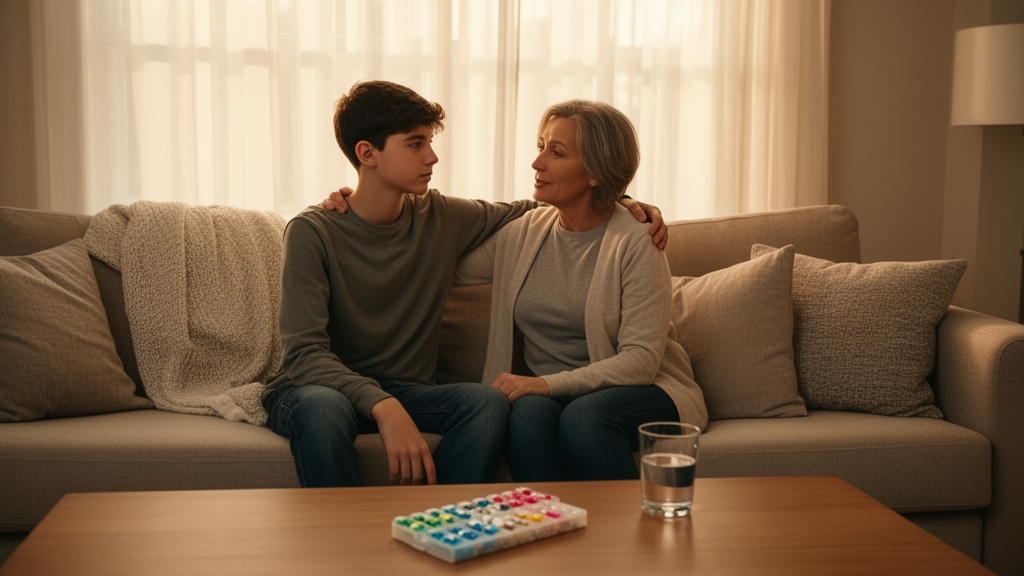
Adolescents with opioid use disorder are among the most endangered and least studied patients in American medicine. Fatal overdoses among teenagers aged 14 to 18 more than doubled between 2019 and 2020, and by 2022 the United States recorded 5.2 overdose deaths per 100,000 adolescents. The synthetic opioid fentanyl, now involved in at least 75 percent of adolescent overdose deaths, has transformed a devastating epidemic into a lethal one for this age group. Yet the clinical response has lagged far behind the mortality curve. Medications for opioid use disorder, chiefly buprenorphine and extended-release naltrexone, are the accepted standard of care for adolescents, but uptake is dismal: in one large multistate Medicaid claims analysis, only 5 percent of adolescents diagnosed with opioid use disorder received any medication at all, and only one in four adolescent residential treatment facilities offers buprenorphine. Even among youth who do start medication, retention is remarkably poor, with one study finding that just two of 82 adolescents on extended-release naltrexone remained in continuous treatment for six months.
Against this backdrop, a research team at Maryland Treatment Centers in Baltimore, working with colleagues at Johns Hopkins University School of Medicine, has adapted a behavioral intervention called Youth Opioid Recovery Support, or YORS, for adolescents aged 13 to 17. The intervention had already shown large effects on medication adherence in young adults aged 18 to 28 across multiple pilot trials since 2018, but it had never been tested in younger adolescents, nor in patients taking sublingual buprenorphine, the dissolvable tablet under the tongue that is by far the most common medication choice among youth. The new pilot, published in Frontiers in Adolescent Medicine, also took a broader view of success than previous work. Rather than measuring only medication adherence and opioid use, the researchers explored recovery capital, a framework describing the accumulated resources across financial, human, social, and community dimensions that support a person’s recovery. For adolescents, these resources include stable housing, school engagement, sober friendships, supportive family, and access to peer recovery groups.
The study enrolled 11 adolescents seeking treatment for opioid use disorder from inpatient or outpatient addiction programs in central Maryland between April 2024 and January 2025. Each participant nominated a family member or support person to serve as a treatment significant other, and 10 such adults, all parents, joined the trial. The design was a 16-week uncontrolled feasibility pilot, meaning there was no comparison group and the goal was to establish whether the adapted intervention could be delivered successfully and whether adolescents and families found it acceptable. The sample was diverse and clinically severe: participants were primarily African American and Hispanic, mostly male, with a mean age of 15.8 years, smoking fentanyl as their primary route of opioid use, and relying on public insurance. Their first opioid use occurred at a mean age of 14.3 years, and more than a quarter reported a lifetime overdose.
YORS is built on four core components, each designed to strip away the barriers that typically cause adolescents to fall out of medication treatment. The first is low-barrier access to medication: there was no requirement to attend counseling sessions in order to receive prescriptions, medications were prescribed in flexible supplies of one to four weeks, and free rideshare transportation was offered for injection visits or pharmacy pickups. Research staff monitored refills, coordinated medication visits, and offered same-day appointments outside regular business hours. The second component is motivational incentives, in which participants earned cash gift cards verified for taking their medication, with schedules totaling up to 200 dollars for injectable adherence or 208 dollars for daily sublingual buprenorphine over the 16 weeks. Incentives were dispensed only when adherence was confirmed through medical records, direct observation, or a trained support person.
The third component is assertive outreach and therapy. Every adolescent was assigned a YORS therapist for individual sessions, family sessions, and frequent contact by text and phone. Staff contacted patients weekly and support persons at least biweekly, with sessions flexible enough to accommodate school schedules, and maintaining engagement treated as the top priority even when patients declined formal sessions. The fourth component is family involvement: each adolescent and their designated support person created a written treatment agreement with the therapist to set goals and expectations, revisited in monthly family sessions, supplemented by education and coaching on opioid use disorder, coping skills, peer support, and weekly family support groups. The intervention was layered on top of usual care, which consisted of completing an acute inpatient stay where applicable and referral to continuing outpatient services.
The primary outcome was self-reported days of medication adherence, assessed biweekly with the timeline follow-back interview method. Participants averaged 78.7 days of adherence, or 70.3 percent of the 112-day intervention period, with missing days conservatively imputed as non-adherent. When calculated only across days with available self-report data, adherence reached 92.4 percent. Six of the 11 participants reported adherence above 90 percent, well over the 80 percent threshold conventionally considered good medication adherence, while the remaining participants ranged from 25 to 53 percent, producing a strikingly bimodal distribution. On the secondary outcome of opioid use, participants reported use on only 4.8 percent of days with available data, and nine of the 11 participants, or 81.8 percent, reported complete opioid abstinence across the intervention. Urine drug screen data collected as a validity check flagged only one discordance, in which a participant self-reported two abstinent weeks contradicted by a positive screen in the first month.
Feasibility signals were strong. The trial exceeded its enrollment target of eight adolescents with 11 enrollments, and reached 90.9 percent of its goal for enrolling a support person for each participant. All intervention components were implemented with variable uptake: 72.7 percent of adolescents completed at least one individual therapy session, averaging 3.3 sessions, while 72.7 percent of patient-family dyads completed at least one family session, averaging 1.2. Staff averaged 47.9 days of outreach per dyad across the intervention, and the average incentive dispensed was 93.64 dollars, roughly 46 percent of the total possible, on par with dispensation rates commonly reported in the contingency management literature. Session attendance was low, which the authors attribute to the model’s flexible principle of accommodating whatever level of care patients will accept while persistently reengaging them, and to the high volume of shorter impromptu contacts through calls, texts, and check-ins that supplemented scheduled care.
Acceptability ratings were uniformly high among the seven adolescents and five support persons who completed satisfaction surveys. Every participant with prior treatment experience rated YORS as better than previous treatment, and all adolescents described the outreach level as the right amount. Adolescents rated the helpfulness of components on a 10-point scale: having a support person involved scored a perfect 10, low-barrier access to medication 9.7, cash incentives 9.4, relapse prevention medication 8.4, individual therapy 8.3, frequent calls and texts 8.3, and family sessions 7.3. Support persons rated components similarly, with low-barrier access and support person involvement both at 10, and frequent calls and texts at 9.6. Adolescents reported mean satisfaction of 8.9 out of 10 with their family member’s involvement in recovery, while support persons reported 9.0 satisfaction with their loved one’s recovery.
The exploratory recovery capital indicators showed promising pre-to-post signals, though the authors caution these were not validated measures and missing data reached 36 percent for adolescents and 50 percent for support persons. Among the seven participants with complete data, two reported homelessness in the past year at baseline, but only one reported homelessness during the intervention. Five of seven were in school or employed at baseline; all seven were in school or employed at week 14. None attended self-help groups at intake, but four, or 57.1 percent, attended at least one group by follow-up, with two attending regularly. Five of seven reported at least one lifetime arrest at baseline, yet only one arrest occurred during the intervention and no participant was charged with a new offense. Both adolescents and support persons rated family involvement in recovery above 9 on a 10-point scale. Three psychiatric hospitalizations occurred during the trial, classified as unrelated to the intervention by the principal investigator and an independent data safety monitoring board.
The authors emphasize that this small, uncontrolled pilot cannot establish efficacy, and its limitations are substantial: no randomization, no validated adolescent recovery capital measure, reliance on self-report with 20 percent missing opioid use data suggesting the use rate may be underestimated, exclusion of non-English speakers despite a largely Hispanic sample, and a fixed rather than escalating incentive schedule for daily medication. The trial was also not pre-registered. Still, the bimodal adherence pattern offers a concrete research question for future work, since understanding what distinguishes adolescents who thrive under the model from those who struggle could guide targeted improvements. The team calls for adequately powered randomized trials, cultural adaptations for Spanish-speaking families, longer intervention durations, and the development of validated recovery capital measures for adolescents, a gap experts in the field have highlighted. If confirmed, the findings would suggest that a family-centered, low-barrier, persistently assertive treatment model can help a critically underserved population not only stay on medication but begin building the resources that make recovery durable.
Subject of Research: Behavioral treatment and recovery capital in adolescents with opioid use disorder
Article Title: Targeting recovery capital for adolescents through treatment for opioid use disorder: a pilot expansion of the Youth Opioid Recovery Support intervention
Article References: Taylor, L., Wenzel, K., Mallik-Kane, K., Pfeltz, C., Massie, E., Davis, K., Lavorato, L., & Fishman, M. (2026). Targeting recovery capital for adolescents through treatment for opioid use disorder: a pilot expansion of the Youth Opioid Recovery Support intervention. Frontiers in Adolescent Medicine, 4, Article 1720332. https://doi.org/10.3389/fradm.2026.1720332
Image Credits: AI Generated
DOI: 10.3389/fradm.2026.1720332
Keywords: adolescents, opioid use disorder, Youth Opioid Recovery Support, medication adherence, buprenorphine, recovery capital, family involvement, motivational incentives, assertive outreach, pilot trial, Frontiers in Adolescent Medicine, addiction treatment
Cite Scienmag News
Ophelia Keating. (October 17, 2026). Family-Powered Treatment Helps Teens Stay on Opioid Medication in Pilot Trial. Scienmag. https://scienmag.com/family-powered-treatment-helps-teens-stay-on-opioid-medication-in-pilot-trial/
Ophelia Keating. "Family-Powered Treatment Helps Teens Stay on Opioid Medication in Pilot Trial." Scienmag, 17 October 2026, https://scienmag.com/family-powered-treatment-helps-teens-stay-on-opioid-medication-in-pilot-trial/. Accessed 17 October 2026.
Ophelia Keating. "Family-Powered Treatment Helps Teens Stay on Opioid Medication in Pilot Trial." Scienmag. October 17, 2026. https://scienmag.com/family-powered-treatment-helps-teens-stay-on-opioid-medication-in-pilot-trial/


