


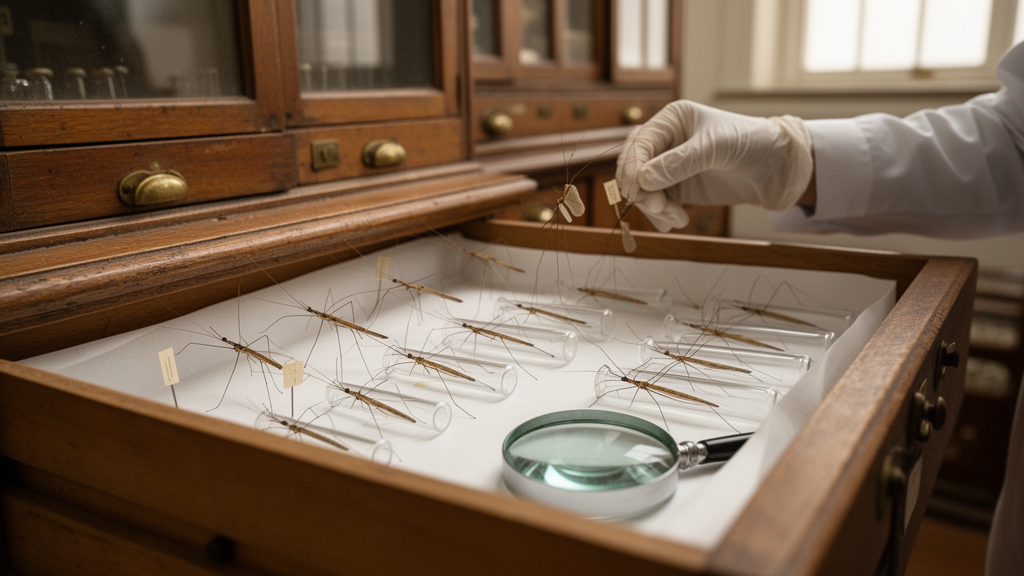
Deep in the entomological collections of the Natural History Museum Vienna, a small but scientifically significant assembly of insects has been brought into sharp focus. A newly published catalogue documents every type specimen of the family Hydrometridae, the water measurers, held by the museum. These slender, stilt-like bugs, which walk with deliberate, measured steps across the surfaces of ponds and streams, belong to the infraorder Gerromorpha, the semiaquatic true bugs. The catalogue, appearing in the Annals of the Natural History Museum Vienna, records 92 type specimens representing ten nominal taxa of species and subspecies, including three holotypes and 89 paratypes, two of which are designated allotypes. Photographs of the three holotypes accompany the work, providing researchers worldwide with a permanent visual record of the primary types.
Type specimens are the bedrock of zoological nomenclature. When a scientist describes a new species, a single specimen, the holotype, becomes the name-bearing reference against which all future identifications of that species must be checked. Paratypes, the additional specimens cited in the original description, and allotypes, paratypes of the opposite sex from the holotype, reinforce this foundation. Catalogues such as this one are therefore not mere bookkeeping exercises. They anchor the identity of species, prevent misidentification, and allow taxonomists to trace exactly where the physical evidence for each name resides. The Vienna inventory continues a series of type catalogues covering the Gerromorpha families Gerridae and Hebridae previously documented by the same research team.
In contrast to the museum’s substantial holdings of water striders and velvet water bugs, the Hydrometridae collection in Vienna is comparatively small, consisting chiefly of material from the Oriental Region. Some specimens are historical acquisitions, some were described in cooperation with the current curator, and others arrived by exchange with fellow taxonomists. All type specimens are dry mounted and registered in the museum’s collection database, which served as the source of the inventory. The authors list species alphabetically, and in most cases, with only two exceptions, the original combination of genus and species name remains taxonomically valid today.
Each catalogue entry follows a rigorous format. The original citation is given together with the type locality and the depository of the holotype. Where the original description failed to name a depository, the authors consulted an unpublished catalogue by the late Danish specialist Nils Møller Andersen or investigated the material themselves. When paratypes originate from more than one locality, a type region summarizes the distribution of all type material. Locality labels are cited verbatim in quotation marks, with line breaks indicated and occasional translations from German added in square brackets, a practice that preserves the historical evidence embedded in each specimen’s labels.
The oldest material in the catalogue dates to 1934, when Hungerford and Evans described Hydrometra insularis and Hydrometra maidli from specimens collected in West Sumatra by the collector Fruhstorfer. Both holotypes, brachypterous males, are housed in Vienna, together with allotypes and paratype series. Subsequent research revealed that Hydrometra insularis is a junior synonym of Hydrometra orientalis Lundblad, 1933, an outcome documented in the catalogue’s current status notes. Such synonymies illustrate why type catalogues matter: the physical specimens allow later researchers to test whether names proposed in different papers actually refer to the same biological entity.
Vienna’s holdings also include paratypes of taxa whose holotypes reside elsewhere. Hydrometra akekawati, described by Sites and J. Polhemus in 2003 from Thailand, has its holotype at the University of Missouri, while Vienna holds two brachypterous paratypes. The catalogue records a notable discrepancy between the published type locality and the label text of these paratypes. When the first author inquired about the accurate locality, Robert W. Sites explained that the collection predates the routine use of GPS coordinates, and that locality L-228 must have lain in the western part of Amphur Khon Sarn, the northernmost district of Chaiyaphum Province, close to the border with Phetchabun Province. The published name of the village could not be matched on modern maps, a reminder of how much interpretive work underlies historical type localities.
A substantial share of the Vienna types stems from the research of Herbert Zettel and Ching Yang, who described several Oriental Hydrometra in 2004. Hydrometra borneensis, with its holotype at the Museum Borneensis in Malaysia, is represented in Vienna by 25 paratypes from Sarawak, Sabah, and beyond, collected in the Kelabit Highlands from ponds on pastures and paddy fields. Hydrometra brevitarsus, whose holotype is in the Zoological Reference Collection in Singapore, is documented by four apterous paratypes from Sumatra’s Darkie Water Reserve. The subspecies Hydrometra heoki heoki and Hydrometra heoki paya, both described with holotypes in Singapore, contribute further paratype series from Malaysia and Indonesian Kalimantan, including material from the Danum Valley in Sabah.
More recent additions include Hydrometra balkei, described by Zettel in 2013 from a swamp near Nabire in Central Papua Province, Indonesia. Its holotype, an apterous male, and two apterous female paratypes were collected by Michael Balke in 1998 and are held in Vienna. The catalogue provides stacked photographs of this holotype, taken with a Leica DFC490 camera on a Leica Z16APO optics carrier, processed with ZereneStacker and Adobe Photoshop. The authors note that dorsal habitus views of Hydrometridae are of very limited diagnostic use, which is why new imaging was restricted to the holotypes, focusing instead on details such as the clypeus and genital capsule that carry the decisive taxonomic characters.
Beyond the Oriental Region, the catalogue records paratypes of two New World taxa. Hydrometra wileyi, described by Hungerford in 1923 from Colorado County, Texas, is represented by 15 paratypes collected by Mrs. Grace Wiley in July 1922, with the holotype at the University of Kansas Biodiversity Institute. The catalogue notes that an unjustified emendation of the name, Hydrometra wileyae, proposed in 1992, is not accepted under the rules of the International Commission on Zoological Nomenclature. Hydrometra zeteki, described by Drake in 1952 from the Panama Canal Zone, contributes a single macropterous male paratype collected by Drake himself, with the holotype in the National Museum of Natural History in Washington.
The catalogue also performs a valuable act of nomenclatural housekeeping. Two macropterous female specimens from Soochow, China, labelled as paratypes of Hydrometra greeni var. suensoni, are excluded from the type material. The authors show that Hungerford and Evans originally proposed the variation name in 1934 but ultimately considered these specimens to belong to Hydrometra albolineata Scott, 1874, and never intended to establish the name. By sorting such ambiguities with documented evidence, the Vienna catalogue strengthens the stability of water measurer taxonomy and demonstrates how careful curation of historical collections continues to serve modern biodiversity science.
Subject of Research: Type catalogue of Hydrometridae specimens at the Natural History Museum Vienna
Article Title: Catalogue of the type specimens of the family Hydrometridae ( Insecta , Hemiptera , Heteroptera ) in the Natural History Museum Vienna
Article References: Zettel, H., & Bruckner, H. (2025). Catalogue of the type specimens of the family Hydrometridae (Insecta, Hemiptera, Heteroptera) in the Natural History Museum Vienna. Annals of the Natural History Museum Vienna, 126, 65-70. https://doi.org/10.3897/anhmw.169056
Image Credits: AI Generated
DOI: 10.3897/anhmw.169056
Keywords: Hydrometridae, type specimens, Natural History Museum Vienna, Hemiptera, taxonomy, Gerromorpha, Catalogue, type, specimens, family, Insecta, Heteroptera
Cite Scienmag News
Gavin Prescott. (October 17, 2026). Vienna Museum Catalogue Reveals Hidden Type Specimens of Water Measurers. Scienmag. https://scienmag.com/vienna-museum-catalogue-reveals-hidden-type-specimens-of-water-measurers/
Gavin Prescott. "Vienna Museum Catalogue Reveals Hidden Type Specimens of Water Measurers." Scienmag, 17 October 2026, https://scienmag.com/vienna-museum-catalogue-reveals-hidden-type-specimens-of-water-measurers/. Accessed 17 October 2026.
Gavin Prescott. "Vienna Museum Catalogue Reveals Hidden Type Specimens of Water Measurers." Scienmag. October 17, 2026. https://scienmag.com/vienna-museum-catalogue-reveals-hidden-type-specimens-of-water-measurers/


