


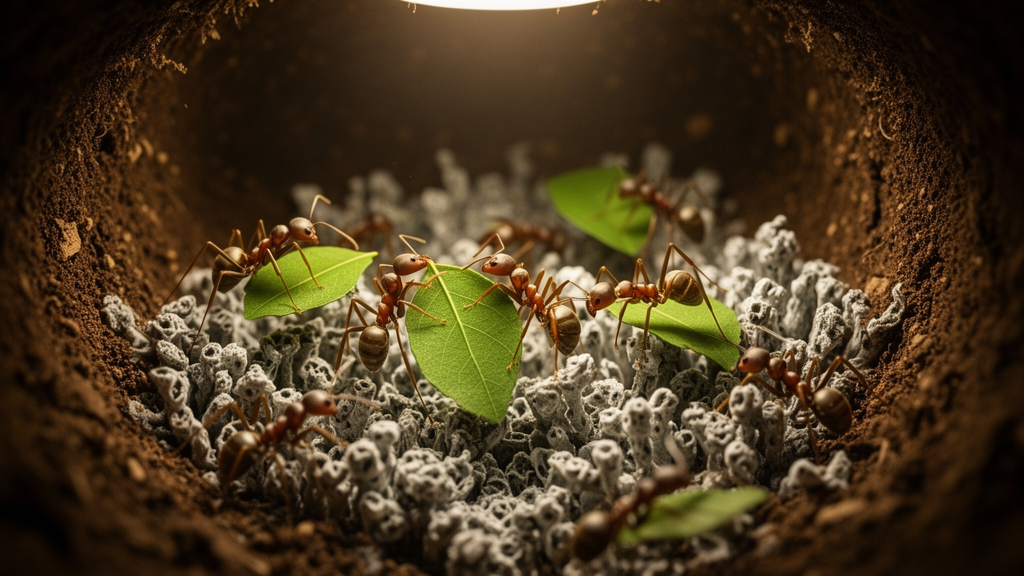
Deep underground, a leafcutter ant colony is a fortress built around a fragile partnership. The ants cultivate a basidiomycete fungus that serves as the exclusive food for their larvae and a major part of the workers’ diet, while the ants supply fresh plant substrate and defend the garden against intruders. This obligate mutualism, roughly 66 million years old, now faces a new kind of scrutiny: a team of researchers has combined laboratory experiments with mathematical modelling to ask exactly how grooming behaviour and multi-chambered nest architecture regulate the biomass growth of both partners when pathogenic fungi invade. The study, published in the journal BioRisk, focused on Atta sexdens, the leafcutting ant whose sprawling subterranean nests make it one of Latin America’s most formidable agricultural pests.
The research team, working with incipient colonies collected at the Federal University of São Carlos and experimented on at the Luiz de Queiroz College of Agriculture in Piracicaba, São Paulo, set out to quantify a behaviour that is easy to observe but hard to weigh. They housed miniaturised colonies in plaster-lined Petri dishes, each containing half a gram of symbiotic fungal garden, one larva, one pupa, and ten medium-sized ants, and let them acclimate for 48 hours. Three treatments followed: a Tween 80 control, a suspension of the entomopathogenic fungus Metarhizium anisopliae, and a suspension of Escovopsis phialicopiosa, the notorious garden parasite. Suspensions were adjusted to 10^8 conidia per millilitre and applied with an airbrush spray. Cameras recorded four hours of behaviour per replicate at 30-minute intervals, with five-minute focal sampling analysed in BORIS software, allowing the researchers to measure, in seconds, how much time workers spent on self-grooming versus allogrooming.
The behavioural data revealed a striking asymmetry. Under the control treatment, maximum allogrooming reached 1701 seconds, with a mean of 330 seconds. When Metarhizium anisopliae was present, those figures collapsed to a maximum of 169 seconds and a mean of just 54 seconds, suggesting that workers facing a virulent pathogen pull back from social contact, likely to avoid horizontal spore transmission between nestmates. Escovopsis phialicopiosa, by contrast, produced allogrooming values close to the control, with a maximum of 1639 seconds and a mean of 82 seconds. Self-grooming, meanwhile, remained relatively stable across treatments, with means hovering between 12 and 14.4 seconds. The largest difference among treatments appeared between the maximum and mean allogrooming values, hinting that social hygiene is the more behaviourally plastic of the two defences.
To translate these seconds into colony-scale consequences, the team built on a mathematical framework originally developed by Kang and colleagues in 2011 to describe biomass dynamics in Acromyrmex ants, a genus that typically cultivates its fungus in a single chamber. Two coupled differential equations track ant biomass and fungal biomass over time: ant growth depends on fungal biomass consumed through a Holling Type I functional response, while fungal growth depends on the labour ants allocate to harvesting and processing leaves, modelled with a Type III numerical response and a half-saturation constant. Mortality rates for both partners, plus a conversion rate of fungus into ant biomass, close the loop. The new study extended this single-chamber model into a two-chamber system, because Atta sexdens cultivates its symbiotic fungus across multiple underground chambers rather than one.
The extension introduced two crucial innovations. First, grooming was written directly into the mortality terms: pathogen-induced mortality for ants and fungus is scaled by the factor one minus the grooming time divided by its maximum, so the longer workers spend grooming, the lower the pathogen’s lethal intensity. The same structure was applied to allogrooming by substituting the allogrooming time. Second, a one-way transfer rule was added between chambers: when fungal biomass in chamber A exceeds its carrying capacity, a density-dependent flux moves ants and fungus to chamber B, mimicking how real Atta workers relocate brood and fungal biomass to newly excavated chambers as the colony expands. This directional flow reflects the colony’s developmental trajectory, in which older chambers act as sources of biomass for new compartments, and it embodies the organisational immunity that compartmentalised nests provide by limiting pathogen dissemination.
Simulations solved with the deSolve package in R, using the lsoda numerical method, produced sigmoidal growth curves for both partners, consistent with classical models of obligate mutualism. When the one-way transfer parameter was set to 0.1 per day, biomass decreased in the source chamber while increasing in the receiving chamber, and inflection points in the growth curves, identified from the second derivative of the biomass trajectories, were delayed. Those delayed inflection points mark a critical growth shift: the moment when accelerating growth gives way to deceleration. Under pathogen pressure, the timing of these shifts became diagnostic. In the Metarhizium treatment, ant and fungal biomasses dropped significantly compared with the control, and inflection points moved to higher values, producing a time-delayed effect. In the Escovopsis treatment, curves closely resembled the control, with only minor shifts in inflection values.
The most sobering result concerned Metarhizium anisopliae’s resilience to grooming. Even when the model was fed the maximum measured self-grooming and allogrooming durations, the pathogen still significantly reduced the biomasses of both ants and symbiotic fungus. The reason lies in the pathogen’s direct virulence to workers: Metarhizium infects insects through conidia that adhere to the cuticle, germinate, and penetrate the integument, so self-grooming alone may be insufficient to prevent infection even though it reduces spore quantity and viability. Infection may also impair worker activity, and empirical studies have shown that Metarhizium can disrupt essential tasks such as foraging, destabilising the social homeostasis that keeps a colony functioning. Escovopsis phialicopiosa, an opportunistic pathogen that attacks the cultivated fungus rather than the ants themselves, had minimal impact unless fungal mortality exceeded a critical threshold, roughly above 0.5 per day in the simulations, suggesting the strain’s lower virulence fails to trigger strong defensive responses.
Bifurcation diagrams, which map how equilibrium states change as parameters vary, exposed the system’s stability landscape. The proportion of workers allocated to fungus cultivation, denoted q, proved decisive: when q approached zero, too few workers tended the garden and biomass collapsed; when q approached one, workers neglected other essential tasks to the detriment of colony function. Intermediate values between 0.4 and 0.6 maximised stability by balancing competing demands. Ant and fungal mortality rates produced non-linear declines in most simulations, with a pronounced threshold near 0.5 per day for ant mortality, beyond which worker losses exceeded the colony’s replacement capacity and fungal biomass accelerated its decline. Self-grooming proved more effective than allogrooming in mitigating Metarhizium’s effects, likely reflecting the prioritisation of individual defences under high pathogen pressure, and ant biomass associated with self-grooming was significantly higher than biomass associated with allogrooming, although fungal biomass did not follow this pattern.
These findings carry practical weight well beyond ecology. Atta species are dominant herbivores in Neotropical biomes, capable of consuming up to 17 percent of available foliar biomass, and they inflict substantial damage on Eucalyptus and Pinus plantations as well as crops such as cassava and coffee. Biological control with entomopathogenic fungi has long struggled against these ants precisely because their multi-chambered nests and layered behavioural defences hinder uniform application of control agents. By identifying the behavioural and structural factors that limit or enhance pathogen effectiveness, the model suggests that targeted interventions could exploit critical mortality thresholds and worker allocation dynamics, minimising environmental impacts while optimising population control. The framework also provides a useful tool for understanding epidemiological dynamics in natural nests, integrating behavioural defences and spatial strategies to safeguard a mutualism that has persisted for 66 million years, and pointing toward future studies that could extend the two-chamber model into interconnected multi-chamber networks to reveal how full nest topology shapes ecological stability.
Subject of Research: Grooming behaviour and nest architecture regulating biomass growth of leafcutter ants and their symbiotic fungus under entomopathogenic fungal infection
Article Title: The role of grooming in regulating biomass growth of ants and symbiotic fungi under entomopathogenic fungal infection: experiments and mathematical modelling
Article References: Bueno, I., Toledo, J. V. M. F. D., Canuto, L. S., & Godoy, W. A. C. (2025). The role of grooming in regulating biomass growth of ants and symbiotic fungi under entomopathogenic fungal infection: experiments and mathematical modelling. BioRisk, 23, 17-43. https://doi.org/10.3897/biorisk.23.151538
Image Credits: AI Generated
DOI: 10.3897/biorisk.23.151538
Keywords: leafcutter ants, Atta sexdens, symbiotic fungus, grooming, Metarhizium anisopliae, Escovopsis phialicopiosa, entomopathogenic fungi, mathematical modelling, bifurcation analysis, mutualism, social immunity, biological control
Cite Scienmag News
Roger Howard. (October 17, 2026). Grooming and nest architecture decide how fungal pathogens strike leafcutter ant colonies. Scienmag. https://scienmag.com/grooming-and-nest-architecture-decide-how-fungal-pathogens-strike-leafcutter-ant-colonies/
Roger Howard. "Grooming and nest architecture decide how fungal pathogens strike leafcutter ant colonies." Scienmag, 17 October 2026, https://scienmag.com/grooming-and-nest-architecture-decide-how-fungal-pathogens-strike-leafcutter-ant-colonies/. Accessed 17 October 2026.
Roger Howard. "Grooming and nest architecture decide how fungal pathogens strike leafcutter ant colonies." Scienmag. October 17, 2026. https://scienmag.com/grooming-and-nest-architecture-decide-how-fungal-pathogens-strike-leafcutter-ant-colonies/


