


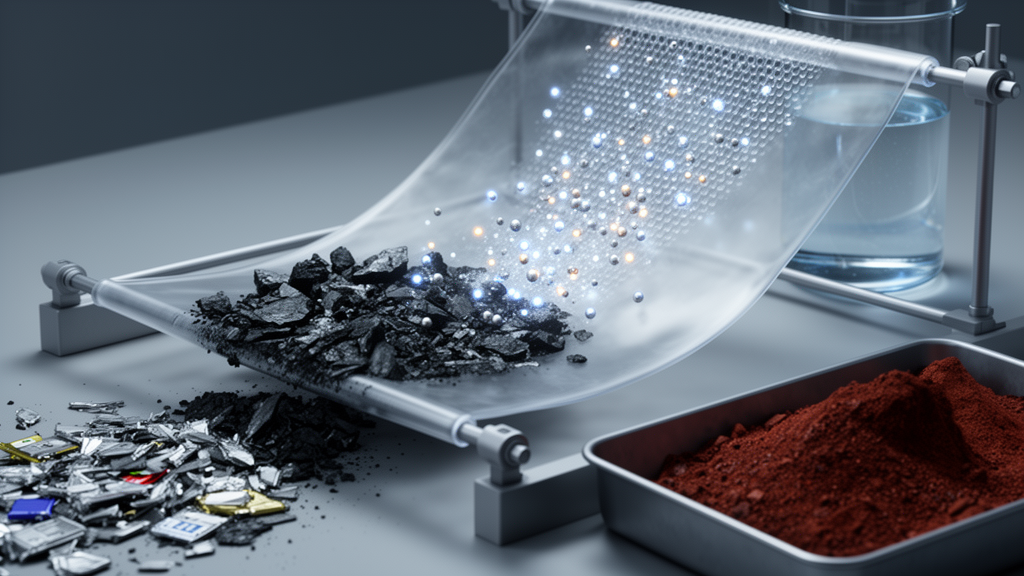
The electric vehicle revolution has an uncomfortable secret: every battery that powers a car, stores solar energy, or runs a smartphone depends on lithium, cobalt, nickel, and manganese — metals that are mined at enormous environmental cost and are increasingly scarce. Now, a comprehensive review published in Frontiers in Membrane Science and Technology argues that the solution to this supply crunch may already be sitting in our landfills and mine tailings, and that a technology borrowed from water treatment — thin, selectively permeable membranes — could unlock it. The review, led by Funeka Matebese, Mabore J. Raseala, and Richard M. Moutloali of the University of South Africa’s Institute for Nanotechnology and Water Sustainability, systematically evaluates how membrane-based separation could transform spent lithium-ion batteries, acid mine drainage, industrial effluents, and salt-lake brines into viable secondary sources of critical metals.
The scale of the challenge is staggering. China alone consumes roughly half of the world’s lithium, driven largely by its dominant position in the electric vehicle market, and has pledged to cut greenhouse gas emissions by 60 to 65 percent by 2030. Meanwhile, mining these metals generates vast quantities of tailings laden with heavy metals and chemicals. When improperly disposed of, these wastes contaminate water supplies, destroy biodiversity, and degrade soil — with acid mine drainage, in which sulfide minerals oxidize to produce extremely acidic runoff, posing the single greatest threat to water quality across large regions. Conventional recycling routes offer little relief: pyrometallurgical smelting is energy-hungry, while hydrometallurgical leaching demands aggressive acids and generates sludge and saline effluents of its own.
Membranes work on an entirely different principle. Instead of burning or dissolving entire waste streams, they act as molecular gatekeepers — semi-permeable barriers that allow some ions to pass while blocking others based on size, electrical charge, or specific chemical interactions. Pressure-driven systems such as ultrafiltration, nanofiltration, and reverse osmosis push liquid through these barriers, while electro-driven systems like electrodialysis use an applied voltage to steer ions toward oppositely charged electrodes. The review categorizes four main feed streams — battery leachates, acid mine drainage, salt-lake brines, and industrial effluents — each with distinct chemistries that demand tailored membrane approaches rather than one-size-fits-all solutions.
The most striking results come from lithium recovery. In acidic sulfate leachates from spent batteries, lithium exists largely as free Li+ ions while cobalt, nickel, and manganese form sulfate complexes. Negatively charged nanofiltration membranes exploit this difference: they repel the multivalent transition metal cations through electrostatic repulsion and size exclusion while allowing the smaller, singly charged lithium ions to permeate. One study cited in the review achieved 99.5 percent pure lithium carbonate after just two nanofiltration passes — approaching battery-grade material without harmful chemical additives. Another research group using polymer inclusion membrane electrodialysis, where selective carriers embedded in a PVDF-HFP polymer matrix bind lithium and cobalt ions, reported recoveries of 99.1 percent for lithium and 99.9 percent for cobalt, with a carbon footprint of just 3.1 kilograms of CO2-equivalent per kilogram of lithium recovered.
Separating lithium from magnesium in brines presents an even tougher puzzle because the two ions have similar ionic radii. Here, the review explains that the key lies in hydration energy: magnesium ions hold water molecules far more tightly than lithium does, giving Mg2+ a bulkier, more strongly bound hydration shell. Negatively charged nanofiltration membranes exploit this by electrostatically repelling the divalent magnesium while the monovalent lithium slips through more easily. Separating cobalt from nickel is harder still — both are divalent with nearly identical hydrated radii — so simple charge exclusion fails. Supported liquid membranes, which impregnate a porous support with a tailored organic extractant that reversibly binds one metal preferentially, offer a way forward, achieving extraction and stripping efficiencies of 85.7 and 83.2 percent for nickel in one reported case.
But the review is refreshingly honest about where membranes struggle. Real battery leachates are not clean laboratory solutions: they are acidic (often below pH 2), highly saline, loaded with organic residues from binders and electrolytes, and contain a shifting cast of competing ions. Under these conditions, membranes fail in chemistry-specific ways. Precipitation is the most common culprit — as pH, temperature, or ionic strength shifts, salts like calcium carbonate, magnesium hydroxide, and gypsum (calcium sulfate dihydrate) become supersaturated and crystallize on membrane surfaces, blocking pores and causing irreversible flux decline. Iron and aluminum hydrolyze into gelatinous hydroxides that clog membranes, while oxidants such as hydrogen peroxide and hypochlorite — often added during leaching — attack polyamide membranes chemically, degrading the polymer itself.
Long-term durability emerges as the review’s central concern. In one particularly revealing study, commercial NF270 and DK nanofiltration membranes were exposed to hydrochloric acid at pH 1 for up to 30 days. Both initially retained divalent ions at 96.5 percent or better, but NF270’s rejection dropped from 99.1 to 84.3 percent over the exposure period — a systematic decline the authors attribute to acid hydrolysis of the polyamide active layer. Another group incorporated sulfonated covalent organic framework nanosheets into a nanofiltration membrane to boost acid resistance; initial lithium rejection was moderate at 43.7 percent while divalent metals exceeded 90 percent, but even this engineered membrane lost significant performance after 7 to 14 days in acid. The lesson, the review argues, is that short-term laboratory tests cannot predict months-long industrial performance.
On economics, the numbers are encouraging but conditional. Membrane processes like electrodialysis and nanofiltration typically consume 0.5 to 5 kWh per cubic meter of treated water — substantially less than conventional thermal or precipitation-based routes, which can exceed 10 kWh per cubic meter when the full water-intensive mining chain is accounted for. Membrane-hybrid systems have demonstrated 50 to 84 percent reductions in total energy demand compared to conventional solvent extraction. Lithium recovered from salt-lake brines costs roughly USD 2 to 3 per kilogram, compared with around USD 80 per kilogram from seawater, while lithium carbonate commands a market price near USD 24 per kilogram — making brine-based membrane recovery economically attractive. Polymeric membranes last 5 to 8 years and ceramic membranes 15 to 20, offering long-term savings through reduced replacement frequency.
Yet the review is careful to position membranes as complementary rather than replacement technology. Nanofiltration achieves lithium selectivity in the 70 to 90 percent range with transition metal rejections typically above 90 percent, but separating chemically similar divalent cations like nickel from cobalt remains limited. Fluxes in concentrated leachates are often constrained to below 10 liters per square meter per hour due to osmotic pressure and fouling. Membranes excel at lithium concentration and acid recovery, but solvent extraction or precipitation is still needed for full transition metal separation. The realistic industrial pathway, the authors suggest, is a hybrid flowsheet: membranes as selective concentration and acid-recycling steps, followed by conventional precipitation to deliver battery-grade products.
The review’s conclusion is both a warning and a roadmap. The principal bottleneck in membrane-based critical material recovery is not initial separation performance — many studies already report 90 to 99 percent recovery — but sustained stability, fouling control, and honest accounting of energy per kilogram of product, membrane lifetime, and cleaning frequency under realistic leachate conditions. Few studies report these parameters, and most rely on simulated rather than real battery-derived streams. Future progress, the authors argue, depends on targeted material innovations such as acid-resistant thin-film composites and crown ether-functionalized ion-exchange membranes, thorough long-term stability testing, and integration into holistic pretreatment and recovery trains. If those gaps close, membranes could shift from promising laboratory curiosities to indispensable components of a circular economy that treats yesterday’s batteries and mine waste as tomorrow’s ore bodies.
Subject of Research: Membrane-based separation technologies for recovering critical metals from spent batteries and mineral wastes
Article Title: Membrane-based extraction of critical materials from spent batteries and other mineral wastes
Article References: Matebese, F., Raseala, M. J., & Moutloali, R. M. (2026). Membrane-based extraction of critical materials from spent batteries and other mineral wastes. Frontiers in Membrane Science and Technology, 5, Article 1766669. https://doi.org/10.3389/frmst.2026.1766669
Image Credits: AI Generated
DOI: 10.3389/frmst.2026.1766669
Keywords: membrane technology, lithium recovery, battery recycling, nanofiltration, electrodialysis, acid mine drainage, critical materials, circular economy, cobalt, nickel, fouling, hydrometallurgy
Cite Scienmag News
Sloane Callahan. (October 17, 2026). Membranes Could Turn Spent Batteries and Mine Waste Into Tomorrow’s Metal Mines. Scienmag. https://scienmag.com/membranes-could-turn-spent-batteries-and-mine-waste-into-tomorrows-metal-mines/
Sloane Callahan. "Membranes Could Turn Spent Batteries and Mine Waste Into Tomorrow’s Metal Mines." Scienmag, 17 October 2026, https://scienmag.com/membranes-could-turn-spent-batteries-and-mine-waste-into-tomorrows-metal-mines/. Accessed 17 October 2026.
Sloane Callahan. "Membranes Could Turn Spent Batteries and Mine Waste Into Tomorrow’s Metal Mines." Scienmag. October 17, 2026. https://scienmag.com/membranes-could-turn-spent-batteries-and-mine-waste-into-tomorrows-metal-mines/


