


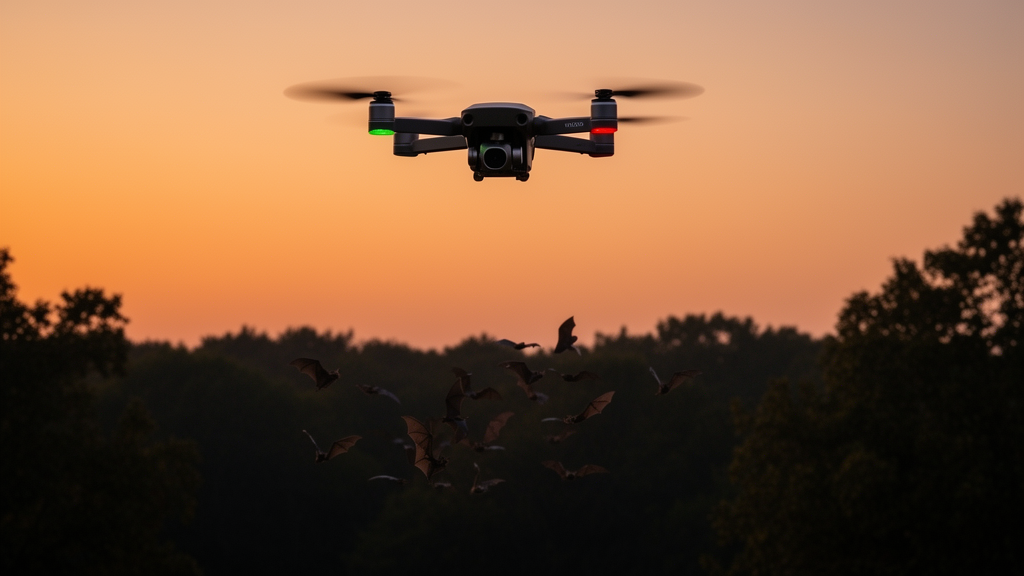
The findings carry practical weight for anyone planning acoustic surveys around wind farms, because they translate an abstract behavioral observation into concrete placement distances. Rather than leaving survey designers to guess how far a drone must hover from a microphone before its noise becomes irrelevant, the study offers frequency-specific thresholds that can be applied to any multicopter whose noise profile has been measured. This matters because multicopter noise is not uniform across the spectrum: rotor and motor emissions concentrate in particular frequency bands, and the frequencies that overlap most strongly with bat echolocation calls are precisely those where disturbance is most likely to alter recorded activity. By modeling how sound attenuates with distance at each frequency, the researchers could estimate where the multicopter’s noise falls below the level at which any echolocation group shows a detectable behavioral response.
The echolocation grouping approach deserves particular attention. Bats do not respond to disturbance as a single homogeneous class; species differ in call frequency, call structure, foraging strategy, and tolerance of anthropogenic noise. By assigning species to groups such as Pipistrelloid and Nyctaloid, the study acknowledges that a noise level harmless to one group may suppress the activity of another. The observation that the larger ConVecDro hexacopter deterred both Pipistrelloid and Nyctaloid bats, while the smaller DJI Mavic 2 Pro affected only Nyctaloid groups, suggests that heavier aircraft with more powerful rotors produce noise profiles that overlap more broadly with the hearing and call ranges of multiple species. This has implications for UAS selection in ecological monitoring: a lighter, quieter platform may be preferable not only for flight stability reasons but because it minimizes the behavioral footprint of the survey itself.
The threshold value identified, 4.5 dB at 23 kHz, is notable because it represents the point below which no echolocation group showed any detectable impact relative to a control condition. In practical terms, this means that once the multicopter’s noise at 23 kHz falls below this level at the recording location, the survey can proceed with reasonable confidence that bat activity in the sampled volume is not being suppressed by the aircraft itself. The frequency of 23 kHz is significant because it falls within the range used by many bat species for echolocation, particularly those in the Nyctaloid group, which tend to call at lower frequencies than some other groups. The fact that this single threshold sufficed across all groups tested suggests that the most noise-sensitive species in the study set the limit for everyone else, a conservative approach that errs on the side of protecting the most vulnerable species.
The directional properties of the recording device add another layer of complexity to the placement question. Ultrasonic microphones are not omnidirectional in practice; their sensitivity varies with the angle of incoming sound, and orienting the microphone toward or away from a noise source changes how much of that noise enters the recording. The study tested both orientations, and the placement distances recommended assume the microphone faces the multicopter, which is the orientation that maximizes noise pickup. This is a conservative choice: if the microphone were oriented away from the aircraft, the effective noise level would be lower, and the required placement distance could potentially be shorter. However, survey designers rarely have full control over microphone orientation relative to where bats actually fly, so the conservative recommendation provides a margin of safety across varied field conditions.
The broader context of wind energy development frames why this methodological refinement is timely. Bat mortality at wind turbines is estimated at roughly 12 bats per turbine per year in North America and 14 in Europe, and these figures are expected to rise as turbine numbers grow and rotors sweep larger volumes of airspace. Current mitigation relies heavily on curtailment, shutting down turbines during periods of expected bat activity, which reduces energy production and is based on incomplete information about when and where bats actually fly within the rotor’s risk area. Acoustic monitoring from the ground or from the nacelle after construction covers only a fraction of the risk area, and acoustic shadowing from the tower and nacelle further limits coverage. A mobile platform capable of sampling the entire risk volume, both before construction for planning purposes and during operation for refining curtailment strategies, would address a significant gap in current practice.
The study’s approach of using a sound attenuation model to predict placement distances is methodologically elegant because it separates the physical problem from the behavioral one. The physical component, how multicopter noise diminishes with distance at each frequency, can be measured once for a given aircraft and then applied repeatedly. The behavioral component, at what noise level each echolocation group stops responding, requires field observation but yields thresholds that can be generalized across similar conditions. By combining these two components, the researchers created a framework that can be updated as new multicopters are tested or as new behavioral data become available, without needing to repeat the full experimental protocol for every aircraft and every species combination.
It is worth noting that the study found no evidence of attraction to multicopter noise across any of the conditions tested. All observed effects were deterrent, which aligns with previous research showing that bats generally avoid anthropogenic sound sources rather than investigating them. This consistency matters for survey interpretation: if multicopter noise were attracting bats, recorded activity near the aircraft would be inflated, leading to overestimates of bat presence in the risk area. Deterrent effects, by contrast, risk underestimating activity, which could lead planners to conclude that an area is less important to bats than it actually is. The placement distances recommended by the study are therefore designed to ensure that recorded activity reflects genuine bat presence rather than a behavioral artifact of the survey method itself.
The distinction between the two multicopters tested also highlights how aircraft design choices propagate into ecological outcomes. The ConVecDro hexacopter, being larger and heavier, requires more rotor power to maintain flight, producing higher sound pressure levels across the frequency spectrum. The DJI Mavic 2 Pro, a compact quadcoopter, generates less noise overall and its noise profile overlaps less with the call frequencies of Pipistrelloid species. The result is that the Mavic 2 Pro requires only 20 meters of separation from the recording device, while the ConVecDro requires 36 meters. For survey teams operating in constrained environments, where hovering at 36 meters may be impractical due to airspace regulations, obstacles, or wind conditions, the choice of aircraft can determine whether a compliant survey is feasible at all.
Looking ahead, the framework established by this study could be extended to other UAS platforms and other taxa sensitive to noise disturbance. The principle that a measured noise profile combined with a sound attenuation model can predict safe operating distances is not specific to bats; it could apply to birds, marine mammals, or any wildlife whose behavior is altered by anthropogenic sound. As UAS become increasingly central to ecological monitoring, studies like this one provide the evidence base needed to ensure that the tools used to observe wildlife do not themselves distort the phenomena being observed.
Subject of Research: Science
Article Title: Determining recorder distances from multicopters to avoid bat disturbance
Article References: Huamán Roswag, M., Fietz, J., Roswag, A., Kunz, V. D., & Taefi, T. T. (2026). Determining recorder distances from multicopters to avoid bat disturbance. Frontiers in Ethology, 5, Article 1868324. https://doi.org/10.3389/fetho.2026.1868324
Image Credits: AI Generated
DOI: 10.3389/fetho.2026.1868324
Keywords: drones, bats, echolocation, multicopter, noise, wind energy, acoustic monitoring, sound pressure level, wildlife conservation, UAS, Determining, recorder
Cite Scienmag News
Margaret Porter. (October 17, 2026). How Far Must a Drone Fly to Keep Bats Undisturbed? New Study Calculates the Answer. Scienmag. https://scienmag.com/how-far-must-a-drone-fly-to-keep-bats-undisturbed-new-study-calculates-the-answer/
Margaret Porter. "How Far Must a Drone Fly to Keep Bats Undisturbed? New Study Calculates the Answer." Scienmag, 17 October 2026, https://scienmag.com/how-far-must-a-drone-fly-to-keep-bats-undisturbed-new-study-calculates-the-answer/. Accessed 17 October 2026.
Margaret Porter. "How Far Must a Drone Fly to Keep Bats Undisturbed? New Study Calculates the Answer." Scienmag. October 17, 2026. https://scienmag.com/how-far-must-a-drone-fly-to-keep-bats-undisturbed-new-study-calculates-the-answer/


