


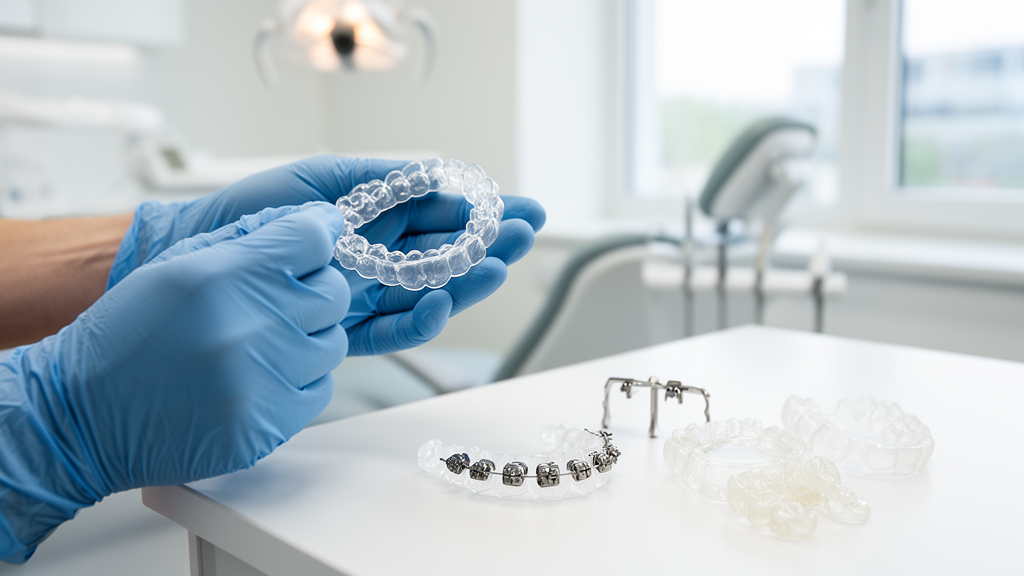
Orthodontics has quietly become one of dentistry’s most material-intensive specialties. Every treatment course consumes metals and polymers, single-use barriers, packaging, sterilization energy, transport, and repeated clinical visits, and then ends with appliances that must be disposed of somewhere. A new systematic review published in Frontiers in Oral Health has now taken the unusual step of asking how much direct scientific evidence actually exists on the environmental consequences of orthodontic care—and the answer is strikingly small. Out of 680 records screened, only five primary studies met the review’s deliberately strict criteria for directly measuring an environmental outcome or explicitly examining sustainability-related behavior.
The review, led by Mohammad Khursheed Alam of Jouf University in Saudi Arabia and Suliman Alsaeed of King Saud bin Abdulaziz University for Health Sciences, was conducted according to the PRISMA 2020 reporting standard and registered in PROSPERO. The team searched PubMed/MEDLINE, Scopus, Web of Science Core Collection, EMBASE, and the Cochrane Library from January 2010 through October 2025, supplementing the search with Google Scholar screening and reference-list checks. Crucially, the search strategy used two reproducible concept blocks—orthodontics and environmental sustainability—without a human-subject filter, so that laboratory studies and life-cycle assessments remained eligible alongside surveys of practitioners.
That strictness was intentional. The authors note that much of the existing orthodontic sustainability literature mixes direct environmental measurements with indirect clinical, microbiological, or material outcomes, allowing clinical novelty to be mislabeled as evidence of ecological benefit. By restricting eligibility to primary studies with a direct environmental link, the review produced a highly selected evidence base: two laboratory or material studies, one comparative life-cycle assessment, and two cross-sectional surveys. The small number itself is an important finding, revealing how sparse direct evidence remains despite extensive discussion of sustainable orthodontics.
The most eye-catching result concerns the end-of-life fate of clear aligners, the transparent thermoplastic appliances that have transformed orthodontic treatment. In a laboratory study from India, researchers used gas chromatography-mass spectrometry to analyze the smoke generated by incinerating used PET-G and polyurethane aligners. The analysis detected measurable hazardous volatile compounds, providing direct evidence that routine incineration of aligner waste cannot be assumed to be environmentally benign. However, the experiment assessed only selected materials and disposal conditions and did not compare a complete set of recycling or recovery pathways, so its conclusions are necessarily bounded.
The comparative life-cycle assessment, conducted by researchers in Ireland and the UK, examined Hawley and Essix retainers—the wire-and-acrylic appliances versus the vacuum-formed plastic ones—across 16 impact categories. On production alone, Hawley retainers carried a higher burden in 12 of the 16 categories. But the picture changed once product lifespan and replacement frequency were modeled: over the specified period, under the stated assumptions, Hawley retention emerged as having the lower environmental burden. The finding demonstrates why functional unit, durability, replacement, and system boundaries are central to any orthodontic sustainability decision, and why simple labels such as recyclable, digital, or plastic-free can mislead without specifying end-of-life scenarios.
Life-cycle assessment evidence requires particular caution because results are conditional on modeling choices. Geographic electricity generation, transportation distance and mode, manufacturing location, inventory-database selection, waste-treatment pathways, and expected replacement frequency can all materially alter comparative estimates. The review’s authors emphasize that even apparently similar appliance comparisons performed in different settings may not be directly comparable, and that an environmentally preferable result in one modeled scenario should not be treated as a universal property of the appliance.
The third domain concerned material innovation. An Italian in vitro study evaluated a shape-memory, 4D-printed aligner material through morphological, optical, thermomechanical, and cyclic testing. Heat-triggered shape recovery was reversible without loss of usability, supporting the concept that a single appliance might deliver more than one programmed stage of treatment and thereby reduce material consumption. Yet the study did not perform a cradle-to-grave life-cycle assessment. The review treats this finding strictly as evidence of material-function potential: fewer appliances do not automatically guarantee a lower total footprint, because printing energy, resin synthesis, activation steps, failed prints, transport, device life, and disposal must all be quantified before any net environmental benefit can be claimed.
The two surveys provide complementary implementation evidence. In India, a cross-sectional survey of 760 orthodontists and general dentists found that orthodontists reported safer clear-aligner disposal more often than general dentists, but both groups showed gaps in knowledge of biodegradation and disposal regulation. Regular garbage disposal and transfer of disposal responsibility to patients remained common. In the UK, a survey of 146 British Orthodontic Society members—yielding a 10 percent response rate—found that environmental sustainability was widely regarded as important, with respondents prioritizing reduction of plastics, recycling of consumables, and rethinking waste management. Cost, regulation, organizational policy, and feasibility were prominent barriers. The review cautions that these are self-reported attitudes and practices, vulnerable to self-selection and social-desirability bias, and that the identified barriers should be read as perceived constraints rather than demonstrated causes of environmental outcomes.
Methodological appraisal, matched to study design rather than applying a single tool, found that all five studies had some concerns overall, concentrated in sample or functional-unit selection, modeling assumptions, confounding, response bias, and limited sensitivity analysis. None was considered unusable for a cautious narrative synthesis, but the review did not apply formal certainty grading because the evidence spans fundamentally different designs and non-comparable outcomes—chemical emissions, multiple life-cycle impact categories, thermomechanical material behavior, disposal knowledge, and implementation attitudes. Meta-analysis was inappropriate for the same reason: a pooled effect estimate would have no coherent interpretation.
Geographic generalizability is also limited. The included evidence originated from only a few countries and healthcare systems, and the review does not adequately characterize lower-resource settings or the diversity of waste-management and regulatory contexts worldwide. Local energy generation, transport logistics, procurement structures, recycling access, infection-control requirements, and waste regulation may materially alter both life-cycle estimates and the feasibility of implementation. The search was restricted to English-language reports, which may have missed locally published evidence from settings where energy mixes, regulation, and recycling infrastructure differ substantially.
For clinicians, the review supports cautious, intervention-specific actions: clear-aligner incineration should not be assumed to be environmentally benign; retainer longevity and replacement should be considered alongside production burden; and material-saving technologies should remain described as promising until full life-cycle evidence is available. For institutions and policymakers, the survey findings support clearer disposal guidance and greater attention to procurement, recycling pathways, and manufacturer instructions. Take-back schemes and standardized procurement criteria remain proposals for future evaluation rather than established evidence-based interventions.
Looking ahead, the authors call for prospective comparative life-cycle assessments with explicit functional units, system boundaries, local energy and transport data, uncertainty analysis, and clinically realistic replacement rates. Clear aligners, fixed appliances, retainers, packaging, remote monitoring, digital models, and reusable alternatives should be compared across manufacturing, clinical use, travel, and end-of-life stages. Material innovations should report both clinical performance and environmental inventory data, and implementation studies should test whether manufacturer instructions, take-back schemes, procurement standards, staff training, and policy changes measurably reduce waste or emissions rather than only improving attitudes. The direct evidence for sustainable orthodontics is limited but clinically relevant, and firm recommendations will require standardized environmental outcomes and orthodontic-specific life-cycle assessment before any technology, material, or appliance category can be credibly labeled sustainable.
Subject of Research: Sustainable orthodontics: direct environmental, material, and implementation evidence from a systematic review
Article Title: Sustainable orthodontics: direct environmental, material, and implementation evidence from a systematic review
Article References: Alam, M. K., Alsaeed, S., Hajeer, M. Y., Abutayyem, H., Alayyash, A., & Alhajeri, K. (2026). Sustainable orthodontics: direct environmental, material, and implementation evidence from a systematic review. Frontiers in Oral Health, 7, Article 1772579. https://doi.org/10.3389/froh.2026.1772579
Image Credits: AI Generated
DOI: 10.3389/froh.2026.1772579
Keywords: orthodontics, environmental sustainability, life-cycle assessment, clear aligners, systematic review, waste disposal, dental materials, healthcare carbon footprint, Sustainable, direct, environmental, material
Cite Scienmag News
Ophelia Keating. (October 17, 2026). Sustainable orthodontics: what a systematic review of five studies really found. Scienmag. https://scienmag.com/sustainable-orthodontics-what-a-systematic-review-of-five-studies-really-found/
Ophelia Keating. "Sustainable orthodontics: what a systematic review of five studies really found." Scienmag, 17 October 2026, https://scienmag.com/sustainable-orthodontics-what-a-systematic-review-of-five-studies-really-found/. Accessed 17 October 2026.
Ophelia Keating. "Sustainable orthodontics: what a systematic review of five studies really found." Scienmag. October 17, 2026. https://scienmag.com/sustainable-orthodontics-what-a-systematic-review-of-five-studies-really-found/


