


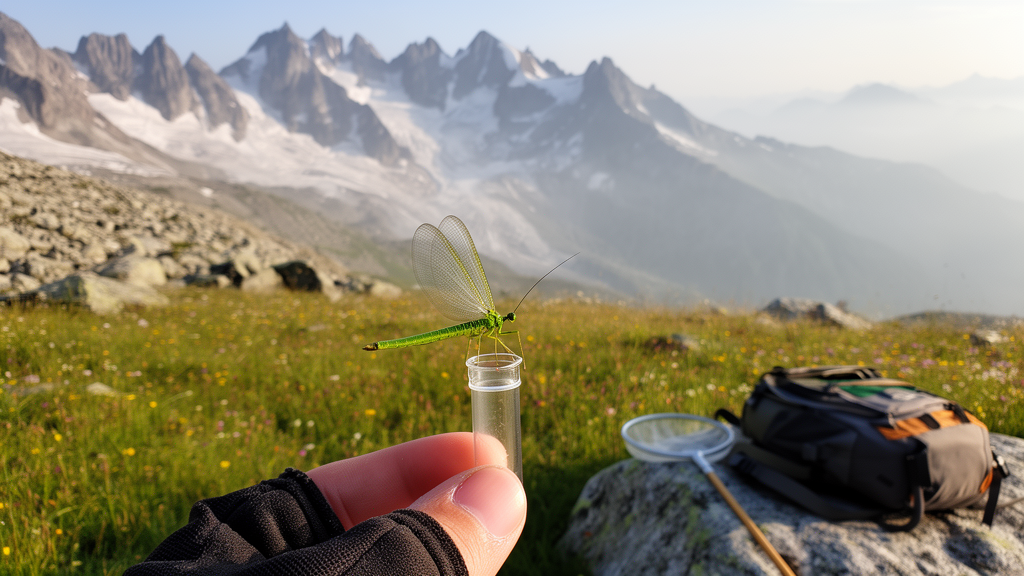
Deep in the Swiss Alps, a small brown insect has been quietly evading detection for almost a hundred years. The alpine brown lacewing Hemerobius schedli, described only in 1970 and known from scattered mountain ranges across Europe, has now been officially confirmed as part of Switzerland’s fauna, thanks to a combination of museum detective work and fresh field surveys. The finding, published in the journal Alpine Entomology, resolves a long-standing uncertainty about whether this elusive predator ever lived in the country at all.
Brown lacewings of the genus Hemerobius are delicate, predatory insects whose larvae feed on aphids, scale insects and other soft-bodied arthropods, making them quiet allies of mountain forest health. Within the Palearctic, four recognized species belong to the so-called Hemerobius nitidulus group: H. handschini, H. nitidulus, H. schedli and the recently renamed H. sucinus. All four share uniformly coloured wings with dotted veins but without spots, a resemblance so close that even specialists have struggled to tell them apart. While H. handschini and H. nitidulus are rather common in Central Europe, H. schedli has been recorded only rarely, with a distribution stretching from the French Pyrenees to the Rila Mountains in Bulgaria and the Baba Mountains in North Macedonia.
What sets H. schedli apart ecologically is its apparent dependence on a single tree. Whereas its two common relatives live on a variety of pine species, H. schedli seems restricted to the Swiss stone pine, Pinus cembra, in the Alps and to the Macedonian pine, Pinus peuce, in Eastern Europe. Its larvae and adults prey on homopteran insects, with the first instars feeding on eriophyid mites and insect eggs. The fourth member of the group, H. sucinus, remains so poorly known, with only a handful of specimens from France, that its status as a valid species distinct from H. nitidulus is still uncertain.
For Switzerland, the only published record of H. schedli dated back to 1991, when the specialist Victor Monserrat reported three male and three female specimens collected in 1927 in the Upper Engadine by M.E. Mosely and stored in the Natural History Museum in London. Because that report had been overlooked, the species was never included in the Swiss national species list or the national database of Neuropterida, and its presence in the country remained officially uncertain. The nearest confirmed populations lay elsewhere in the Alps: in Austria’s Vorarlberg about 45 kilometres from the nearest Swiss site, in Liechtenstein about 70 kilometres away, and in southern Germany roughly 110 kilometres distant.
The new confirmation grew out of a comprehensive revision launched in 2020, in which researchers set out to examine all Neuropterida specimens, the orders comprising lacewings, alderflies and snakeflies, held in Swiss museums. The goal was to identify unclassified material, update names to reflect current taxonomy, and refresh the distribution maps in the Swiss National Database. Fourteen institutional collections were processed, from the Natural History Museum Basel to the Museo cantonale di storia naturale in Lugano. None of the visited museums held specimens labelled as H. schedli, but at the Naturhistorisches Museum Basel, several males previously identified as H. handschini turned out, on closer inspection, to be something else entirely.
Those Basel specimens had been collected by the entomologist Willy Eglin and colleagues during scientific studies in and around the Swiss National Park between 1938 and 1978. All the newly recognized H. schedli males had been caught by Eglin between 1950 and 1963, at localities such as Trupchun, Buffalora and Süsom Givè at altitudes between 2000 and 2200 metres, always on stone pine. At the time, H. schedli had not yet been described, so Eglin had no way of recognizing it as a distinct species. Meanwhile, a visit to the Natural History Museum in London located the historical Swiss specimens reported by Monserrat, including a Pontresina male originally identified by the Victorian-era entomologist R. McLachlan as H. nitidulus, and four Upper Engadine males from 1927 that Monserrat had reidentified without leaving labels behind.
Armed with precise locality data from the old labels, the team returned to the field. In the summers of 2023 and 2024 they searched the Engadin region in the Canton of Grisons using beating nets and light traps, and in 2025 they visited the Visper Valley in the Canton of Valais. The effort paid off quickly. In July 2024, two male H. schedli were taken at light at Buffalora in Val Müstair at 1995 metres, alongside a single male of the similar H. handschini, and at Munt Baselgia near Zernez at 2215 metres only H. schedli appeared, together with three females provisionally assigned to the species. In July 2025, one more male was beaten from a stone pine at Visperterminen in Valais at 1945 metres. Together with the museum material, these captures confirmed both the historical and the current presence of H. schedli in Switzerland.
Identifying these insects is far from trivial, and the technical details reveal why the species has been so widely overlooked. Like all members of the group, H. schedli has brownish, spotless forewings with dotted veins, and like H. handschini it generally shows a dark frons, the front of the head, whereas H. nitidulus tends to be paler there. But frons colour is not always reliable, particularly in old or damaged specimens. The decisive characters lie in the male genitalia. Most identification keys separate H. handschini from H. schedli by comparing the lengths of the ectoproct’s distal lobes, the katoprocessus and anoprocessus, yet some authors warn that these lengths partially overlap. The researchers therefore prepared the genitalia of every male in 10 percent potassium hydroxide solution, softening the abdominal apex to expose the internal structures mounted on slides in Euparal. The internal genital architecture proved decisive: in H. schedli the two arms of the gonarcus, the entoprocessus, are clearly divergent, whereas in both H. handschini and H. nitidulus they converge. The team never observed the katoprocessus significantly longer than the anoprocessus in any H. schedli male, as would be expected in H. handschini, and found the divergent entoprocessus arms more dependable than the gonarcus shape suggested in existing keys.
Females present a stubborn problem. Despite earlier descriptions, female genital structures do not appear sufficiently reliable for species identification, and they are often missing from published keys altogether. As a result, females of H. schedli and H. handschini remain mostly indistinguishable, as do those of H. nitidulus when the frons is not clearly pale. Without dependable criteria, female identifications can only be inferred when no males of other group members occur in the area, or when genetic analysis is available. That genetic angle matters for another reason: the strong morphological similarity among the three species once led some specialists to doubt they were distinct at all, suggesting they might be morphs of a single species. But a 2022 study reported a clear genetic distinction between H. schedli and the other two, which themselves proved harder to separate genetically, echoing an earlier analysis that had failed to distinguish H. handschini from H. nitidulus by DNA while not including H. schedli at all.
The ecological story behind the lacewing’s rarity may hinge on its prey. The authors suggest that H. schedli could be specialized on the aphid Cinara cembrae, a monophagous species living only on stone pine at altitudes of 1800 to 2100 metres, almost exactly the band where the lacewing occurs. Its two common relatives feed on a broader range of homopteran prey and are therefore not tied to particular conifers or elevations. That specialization carries a warning for the future. Stone pine is a postglacial relict with a fragmented distribution, already threatened by climate change, and its populations may be forced upslope into ever scarcer habitat. Any shift in the pine’s fate would ripple through the aphid and then the lacewing, a species already considered rare and listed on various European Red Lists. The new Swiss records, at sites between 1945 and 2215 metres, fit the known altitudinal range, though the species has been recorded as high as 2740 metres in Bulgaria’s Rila Mountains and 3090 metres in the Zillertal Alps, likely as wind-blown strays above the treeline. For now, the message for alpine entomologists is clear: any lacewing of the nitidulus group collected in stone pine stands deserves a close look at its male genitalia, because H. schedli may be hiding in plain sight.
Subject of Research: Rediscovery and confirmation of the rare alpine brown lacewing Hemerobius schedli in Switzerland
Article Title: The alpine brown lacewing insect Hemerobius schedli ( Neuroptera , Hemerobiidae ) in Switzerland
Article References: Koch, B., & Duelli, P. (2025). The alpine brown lacewing insect Hemerobius schedli (Neuroptera, Hemerobiidae) in Switzerland. Alpine Entomology, 9, 65-71. https://doi.org/10.3897/alpento.9.162964
Image Credits: AI Generated
Keywords: Hemerobius schedli, brown lacewings, Neuroptera, Swiss National Park, Pinus cembra, Swiss stone pine, alpine entomology, museum specimens, male genitalia, Cinara cembrae, climate change, species distribution
Cite Scienmag News
Gavin Prescott. (October 17, 2026). Hidden alpine lacewing rediscovered in Switzerland after nearly a century. Scienmag. https://scienmag.com/hidden-alpine-lacewing-rediscovered-in-switzerland-after-nearly-a-century/
Gavin Prescott. "Hidden alpine lacewing rediscovered in Switzerland after nearly a century." Scienmag, 17 October 2026, https://scienmag.com/hidden-alpine-lacewing-rediscovered-in-switzerland-after-nearly-a-century/. Accessed 17 October 2026.
Gavin Prescott. "Hidden alpine lacewing rediscovered in Switzerland after nearly a century." Scienmag. October 17, 2026. https://scienmag.com/hidden-alpine-lacewing-rediscovered-in-switzerland-after-nearly-a-century/


