


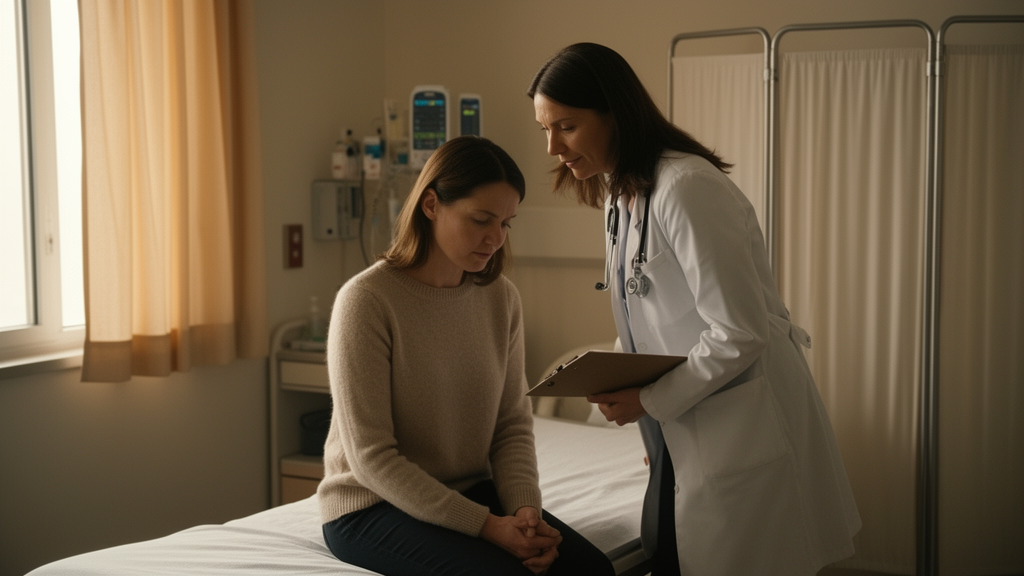
Every year, millions of women walk through hospital doors carrying injuries, anxieties, and secrets that no blood test can detect. They come for contraception, antenatal scans, mental health support, or treatment for bruises and broken bones. Behind many of these routine encounters lies domestic abuse, one of the most pervasive public health crises of our time. Yet a striking paradox persists: healthcare settings are arguably the best places for abuse to be identified, and still, most women never tell their doctor or nurse what is really happening to them. A new systematic review published in Frontiers in Global Women’s Health has now dissected this silence with unprecedented precision, revealing that disclosure is not a simple act of courage but a complex, socially mediated process that depends on trust, safety, and the structural readiness of the healthcare system itself.
The review, led by Mandu Stephen Ekpenyong at Manchester Metropolitan University alongside Khatidja Chantler and Gillian Janes at Anglia Ruskin University, synthesised evidence from twenty-one qualitative and mixed-methods studies conducted across the United Kingdom, Australia, the United States, Italy, Norway, Sweden, and Pakistan between 2000 and 2023. The researchers searched five major databases, including MEDLINE, Embase, CINAHL, PsycINFO, and Scopus, following PRISMA 2020 reporting guidelines and using the SPIDER framework to define eligibility. Methodological quality was appraised with the Critical Appraisal Skills Programme checklist, and findings were interpreted through a socio-ecological model, a public health framework that situates behaviour within nested systems spanning individual, interpersonal, institutional, and societal levels. This analytical choice proved crucial, because it allowed the team to move beyond listing barriers and facilitators towards understanding how these factors interact and reinforce one another across multiple domains.
The scale of the problem these findings address is staggering. The World Health Organization estimates that roughly one in three women aged fifteen and over have experienced physical or sexual intimate partner violence, or non-partner sexual violence, in their lifetime. In England and Wales, five percent of adults aged sixteen and over reported experiencing domestic abuse in the year ending March 2022, equating to approximately 2.4 million adults. In the United States, lifetime estimates suggest one in four women have experienced sexual violence, physical violence, or stalking by an intimate partner. The health consequences are equally severe: women who experience abuse report higher rates of depression, self-harm, suicide attempts, anxiety disorders, miscarriage, pregnancy complications, and chronic physical injuries. When abuse involves multiple forms simultaneously, such as physical violence combined with coercive control, the effects compound and intensify over time.
Against this backdrop, the review’s central finding is both elegant and sobering: disclosure emerged as a relational process, not a discrete event. Women’s willingness to share their experiences depended on trust, perceived safety, validation, confidentiality, and continuity of care. Trust, in this context, was not a singular construct but a multidimensional process comprising relational safety, perceived competence, emotional validation, and the expectation that the healthcare professional would act in the woman’s best interests. Seemingly small interpersonal behaviours, such as sitting down, maintaining eye contact, speaking calmly, and allowing time, were interpreted by women as signals of attentiveness and legitimacy. These behaviours reduced perceived risk and enabled incremental disclosure, often unfolding gradually across repeated encounters rather than emerging in a single consultation.
One of the most conceptually rich findings is the notion of borrowed trust. The review found that women’s willingness to engage with healthcare professionals was sometimes mediated through social networks, institutional legitimacy, or prior social endorsement rather than through direct personal experience. In other words, trust could be borrowed from community endorsement, professional authority, or the expectations associated with healthcare settings themselves. This extends the understanding of trust beyond an individual interpersonal bond, positioning it as both relational and socially mediated. At the same time, trust proved remarkably fragile: where women encountered impatience, disbelief, judgement, or subtle emotional distancing, it deteriorated rapidly, and women who experienced dismissal or disbelief were significantly less likely to re-disclose in future consultations.
Validation emerged as another critical mechanism, operating at multiple levels. Emotional validation acknowledged feelings; epistemic validation treated women’s accounts as truthful; and moral validation clearly named abuse as unacceptable. Failure in any of these domains undermined relational safety and frequently resulted in withdrawal from further help-seeking. The review also found that non-disclosure should not be conceptualised as a straightforward failure of courage. In some contexts, silence represented a rational and protective strategy, shaped by economic dependency, housing insecurity, childcare concerns, and fear of triggering child protection procedures. For some women, the possibility that disclosure could lead to statutory intervention acted as a deterrent, particularly where professionals did not communicate safeguarding responsibilities clearly or sensitively. Moreover, leaving or separating from an abusive partner does not necessarily restore safety; research shows that separation can intensify risk and produce further instability.
On the professional side, the review revealed that preparedness is a multidimensional construct encompassing competence, confidence, emotional readiness, and perceived role legitimacy. Competence refers to knowledge and skill, including understanding indicators of abuse, safeguarding procedures, and referral pathways. Confidence reflects the perceived capability to initiate enquiry. Readiness encompasses both cognitive preparedness and emotional willingness to engage with the complexity of abuse disclosures. Crucially, the findings showed that knowledge alone was insufficient. Even where training had improved theoretical understanding, practitioners described hesitation rooted in uncertainty about managing disclosure consequences, fear of causing harm, unclear role boundaries, and concern about lacking appropriate follow-up resources. The absence of enquiry, the authors argue, cannot be interpreted solely as lack of competence; it may reflect a rational appraisal of structural constraints.
Structural factors proved equally decisive. Limited consultation time, workload pressures, staffing shortages, unclear reporting requirements, and fragmented referral pathways repeatedly constrained effective response. Time emerged in two distinct ways: as a practical resource within individual consultations, and as relational time accumulated through continuity of care. Brief appointment windows limited the opportunity for sensitive enquiry, while fragmented care reduced opportunities to build the rapport needed for safe disclosure. Where referral systems were unclear or community resources scarce, practitioners expressed moral distress and reluctance to initiate discussions that might not be adequately supported. In such contexts, identification without intervention risked being perceived as ethically problematic. Conversely, structured training combined with specialist support roles, such as domestic abuse nurse specialists, enhanced confidence and facilitated earlier identification, demonstrating that education operates on a continuum and must be supported by organisational structures to translate into practice.
The review’s most consequential insight is that disclosure alone did not ensure improved outcomes where system readiness was inadequate. Without clear referral pathways, protected time, and institutional backing, even well-informed practitioners may be constrained in their ability to respond effectively, and disclosure may expose women to additional risks, including procedural harm, unmet expectations, or unintended consequences associated with safeguarding processes. The authors therefore caution that efforts to promote disclosure must be accompanied by parallel investment in system capacity and trauma-informed care. The absence of overt structural barriers did not automatically function as a protective condition; disclosure required the active presence of relational safety and institutional support, highlighting the asymmetrical nature of barriers and enablers.
The implications extend far beyond individual training programmes. Sustainable progress, the review concludes, depends on organisational leadership, protected time, clear referral systems, and alignment across relational and structural domains. Relationally, healthcare encounters must prioritise trust, validation, confidentiality, and shared decision-making. Organisationally, services must provide continuity of care, clear protocols, and accessible referral systems. At the system level, leadership, policy alignment, and interagency collaboration are essential to support consistent and effective responses. The socio-ecological model proved especially useful here, revealing how interpersonal failures are often symptoms of wider structural misalignment rather than simply individual professional shortcomings. Future research, the authors suggest, should examine healthcare professionals’ own lived experiences of domestic abuse, a dimension absent from the included studies but potentially significant for understanding empathic engagement, emotional burden, and response behaviours. They also call for exploring disclosure processes in diverse healthcare and socio-cultural contexts, since most included studies were conducted in high-income settings with different healthcare infrastructures, legal frameworks, and safeguarding systems. Ultimately, meaningful improvement in healthcare responses to domestic abuse will depend on moving beyond individual-level interventions towards integrated, system-wide approaches that align relational practice with organisational and structural support, ensuring that when women finally find the courage to speak, the system is ready to listen.
Subject of Research: Health
Article Title: Factors affecting women's disclosure of domestic abuse and healthcare professionals’ preparedness to identify and respond: a systematic literature review
Article References: Ekpenyong, M. S., Chantler, K., & Janes, G. (2026). Factors affecting women's disclosure of domestic abuse and healthcare professionals’ preparedness to identify and respond: a systematic literature review. Frontiers in Global Women's Health, 7, Article 1702307. https://doi.org/10.3389/fgwh.2026.1702307
Image Credits: AI Generated
DOI: 10.3389/fgwh.2026.1702307
Keywords: domestic abuse, healthcare professionals, disclosure, systematic review, women's health, preparedness, socio-ecological model, Frontiers, Factors, affecting, women's, domestic
Cite Scienmag News
Ophelia Keating. (October 17, 2026). Why Women Stay Silent About Domestic Abuse in Hospitals: New Review Reveals the Trust Equation. Scienmag. https://scienmag.com/why-women-stay-silent-about-domestic-abuse-in-hospitals-new-review-reveals-the-trust-equation/
Ophelia Keating. "Why Women Stay Silent About Domestic Abuse in Hospitals: New Review Reveals the Trust Equation." Scienmag, 17 October 2026, https://scienmag.com/why-women-stay-silent-about-domestic-abuse-in-hospitals-new-review-reveals-the-trust-equation/. Accessed 17 October 2026.
Ophelia Keating. "Why Women Stay Silent About Domestic Abuse in Hospitals: New Review Reveals the Trust Equation." Scienmag. October 17, 2026. https://scienmag.com/why-women-stay-silent-about-domestic-abuse-in-hospitals-new-review-reveals-the-trust-equation/


