


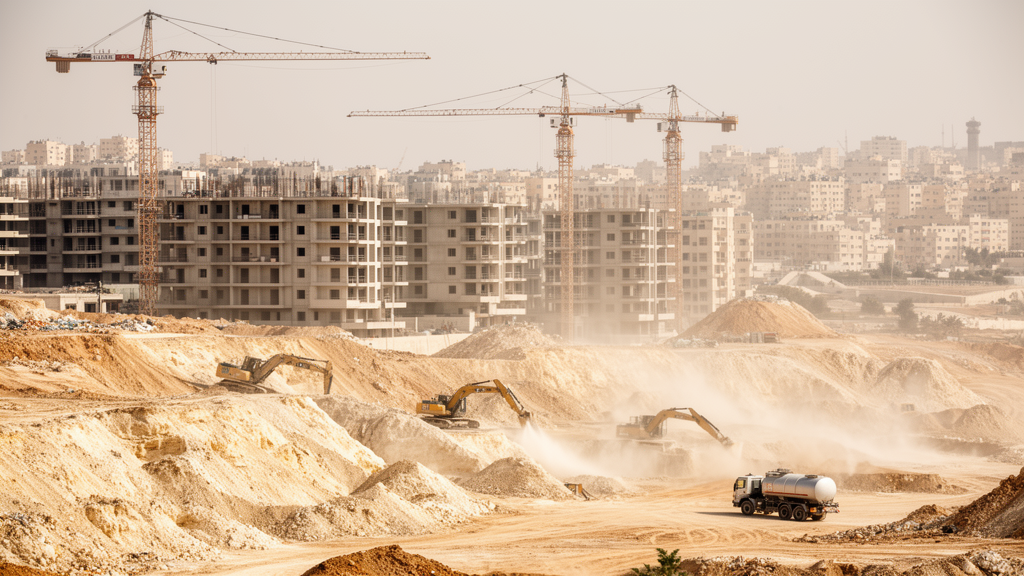
Every building site on Earth is an interface between human activity and the planet’s operating systems. Construction consumes water, reshapes land, releases dust and emissions, and cumulatively contributes to pressures on the essential Earth-system processes that scientists describe as planetary boundaries. Now, a new study from Jordan’s construction sector shows how these pressures play out in a lower-middle-income country, and proposes a governance mechanism to push back.
The research, published in Frontiers in Built Environment, examined active construction sites across Jordan and mapped their practices against the planetary boundaries framework. The findings reveal a sector operating far from any scientifically downscaled allocation of global limits, with unmetered water use, uncontrolled dust emissions, and minimal soil protection measures.
Lead author Ibrahim Al-Hamdani and colleagues conducted site audits and expert interviews across Jordan’s construction industry. Their analysis shows that construction practices in Jordan contribute to pressures on freshwater use, land-system change, and atmospheric aerosol loading, three of the nine planetary boundaries that scientists have identified as essential Earth-system processes.
The study found that construction sites in Jordan operate without any quantitative governance budgets for water, carbon, or soil. Sites use water unmetered, emit dust without monitoring, and dispose of excavated soil without documented treatment. The researchers argue that these practices cumulatively push the sector beyond any reasonable share of the global safe operating space.
To address these gaps, the team proposes a governance mechanism called the Planetary-Contractual Enforcement Mechanism (PCEM). This mechanism would link construction sector commitments to tendering, contractual, financial, monitoring, and accountability processes. The goal is to move public and private clients from generic environmental commitments to explicit, measurable governance limits informed by the planetary boundaries framework.
The researchers emphasize that clean water, clean air, and healthy soil should be treated as essential project deliverables, not optional extras. They argue that construction practices in Jordan and similar countries cumulatively contribute to pressures on the global safe operating space, and that governance mechanisms must acknowledge this reality.
The study contributes to the broader geoscience and society agenda by showing how a specific economic sector in a lower-middle-income country operates relative to planetary boundaries. The findings suggest that governance mechanisms must move beyond informative approaches to enforceable, measurable limits that acknowledge the cumulative impact of local practices on the global safe operating space.
The empirical details behind the study’s headline findings deserve closer attention, because they illustrate how small, routine site-level decisions aggregate into Earth-system pressures. Across the ten active construction projects examined, nine lacked any form of water metering, meaning that neither contractors nor regulators could quantify how much blue water was being drawn from municipal networks or tanker supplies for concrete mixing, curing, and dust suppression. Not a single site employed water-reuse systems, even though semi-arid Jordan faces a chronic water-supply deficit and over-exploited groundwater aquifers. In a country regularly ranked among the most water-stressed in the world, where municipal, agricultural, and industrial users already compete intensely for scarce supplies, treating construction water as an unmeasured operating cost effectively renders the sector invisible in national water accounting.
The soil findings are equally striking. Eight of the ten sites discharged cement wash-water directly into unprotected ground. Cement wash-water is highly alkaline and carries fine particulates and chemical admixtures, so its uncontrolled release can alter soil chemistry, impede microbial activity, and create pathways for contamination to migrate into shallow groundwater. Because Jordan’s soils are often thin, saline-prone, and dependent on limited natural regeneration, such site-level contamination pathways connect directly to the land-system integrity boundary within the planetary boundaries framework. The co-mingling of construction and demolition waste observed across the sites further compounds the problem, since mixed waste streams are far harder to recycle and typically end up in landfills, foreclosing circular-economy options that the wider construction research community has identified as central to reducing material throughput.
On the air-quality side, none of the audited sites deployed particulate sensors. Excavation, hauling, material handling, and demolition all generate aerosols, and in the absence of continuous monitoring there is no basis for adaptive site management, no early warning for neighboring communities, and no verifiable record for enforcement authorities. This monitoring gap is particularly consequential because the planetary boundaries framework identifies atmospheric aerosol loading as a boundary whose regional expression—urban particulate concentrations—can be directly harmful to human health even when global averages remain within limits. The study’s authors frame this as a misalignment between observed practice and PB-informed governance benchmarks for freshwater change, aerosol loading, and land-system integrity, rather than a formal downscaling of global thresholds to each site, a methodological choice they acknowledge remains challenging in the literature.
The interview component of the research adds a crucial socio-economic dimension that purely technical audits often miss. Analyzing sixty-eight semi-structured interviews thematically, the researchers identified three reinforcing managerial logics that explain why absolute sustainability targets fail to take hold on Jordanian sites. Economic Resourceism describes the tendency to treat water and other environmental inputs as cheap, abundant operating costs rather than finite resources tied to hydrological constraints. Spatial Externalization captures the practice of pushing environmental burdens—dust, contaminated wash-water, mixed waste—beyond the site boundary where they cease to be the contractor’s problem. Temporal Constraint Bias reflects the dominance of schedule pressure, in which short-term delivery deadlines systematically crowd out environmental measures whose benefits accrue over longer horizons. Together, these logics reinforce the traditional Iron Triangle of cost, time, and quality, within which environmental performance remains a discretionary extra rather than a binding constraint.
The proposed governance architecture responds directly to these logics. The Planetary-Contractual Enforcement Model is conceptual at this stage and explicitly requires future testing, but its logic is to embed PB-informed benchmarks into the instruments that already discipline construction behavior: tender documents, contract clauses, financing conditions, and site-level management routines. The companion Jordan Absolute Sustainability Management system would, in principle, provide the monitoring and reporting backbone, potentially leveraging the digital and IoT-based site-monitoring technologies that recent construction research has shown to be increasingly feasible. By tying disbursement milestones or contract compliance to measurable indicators—metered water consumption, particulate readings, wash-water containment, segregated waste streams—the model aims to convert what are currently voluntary aspirations into enforceable obligations.
The study’s positioning within the international literature clarifies what is genuinely novel about this contribution. Planetary boundaries research has matured from global threshold-setting toward sectoral applications, including corporate sustainability accounting, life-cycle impact assessment, and urban-scale analysis. In the built environment, PB-informed approaches have so far concentrated on design-stage and material choices through life-cycle assessment, which addresses what buildings are made of but rarely how they are built. The Jordanian study shifts attention to the construction phase itself—the active, dusty, water-consuming months when a project physically transforms land—and asks what governance levers operate at that moment. This fills what the authors describe as an implementation gap between robust assessment frameworks and the daily managerial reality of procurement, where relative improvements over a previous project are often celebrated even as absolute pressures grow.
The choice of Jordan as a study setting also carries broader significance for how planetary boundaries research reaches the Global South. Much of the existing PB operationalization work has been conducted in high-income European contexts with mature regulatory infrastructure, extensive monitoring networks, and functioning enforcement institutions. Lower-middle-income, water-scarce settings face different constraints: limited regulatory capacity, constrained municipal budgets, market pressures that reward the lowest bid, and voluntary green building guidelines that lack enforcement power. By demonstrating a methodology—PB-derived checklists, site audits, thematic interview analysis—that can be applied in such contexts, the study offers a template that researchers and regulators in other MENA countries and similarly stressed regions could adapt.
The connection to the Sustainable Development Goals gives the work additional policy traction. The pressures documented at the site level map onto SDG 6 on clean water and sanitation, SDG 11 on sustainable cities, SDG 13 on climate action, and SDG 13’s companion SDG 15 on terrestrial ecosystems. Framing construction-site practices in terms of these globally agreed targets may help advocates argue for regulatory reform in language that ministries and development banks already use, potentially opening financing channels—green bonds, conditional lending, sustainability-linked procurement—that reward measurable environmental performance rather than paper commitments.
Certain limitations and open questions remain. Ten sites and sixty-eight interviews provide depth but not statistical representativeness, and the proposed enforcement models are conceptual proposals whose practical effectiveness, cost, and political acceptability have not yet been tested. Questions about who bears the cost of metering and monitoring, how benchmarks would be calibrated for projects of different sizes, and whether Jordan’s institutional capacity can support contractual enforcement all await empirical study. Nevertheless, the study’s central insight stands: planetary boundaries become meaningful for ordinary economic activity only when they are translated into the contracts, budgets, and daily routines through which that activity is actually governed, and the construction sites of water-stressed cities are as good a place as any to begin that translation.
Subject of Research: Planetary boundaries and construction governance in Jordan
Article Title: Planetary Boundaries and construction: pressures on water, air, and soil in Jordan
Article References: Saraireh, I. M., Mustafa Rawashdeh, T., & Al-Btoush, M. A. K. A. (2026). Planetary Boundaries and construction: pressures on water, air, and soil in Jordan. Frontiers in Sustainable Cities, 8, Article 1909137. https://doi.org/10.3389/frsc.2026.1909137
Image Credits: AI Generated
DOI: 10.3389/frsc.2026.1909137
Keywords: planetary boundaries, construction, Jordan, governance, freshwater use, soil protection, aerosol loading, Planetary, Boundaries, pressures, water, soil
Cite Scienmag News
Russell Cooper. (October 17, 2026). Construction in Jordan is quietly pushing Earth past its limits, scientists warn. Scienmag. https://scienmag.com/construction-in-jordan-is-quietly-pushing-earth-past-its-limits-scientists-warn/
Russell Cooper. "Construction in Jordan is quietly pushing Earth past its limits, scientists warn." Scienmag, 17 October 2026, https://scienmag.com/construction-in-jordan-is-quietly-pushing-earth-past-its-limits-scientists-warn/. Accessed 17 October 2026.
Russell Cooper. "Construction in Jordan is quietly pushing Earth past its limits, scientists warn." Scienmag. October 17, 2026. https://scienmag.com/construction-in-jordan-is-quietly-pushing-earth-past-its-limits-scientists-warn/


