


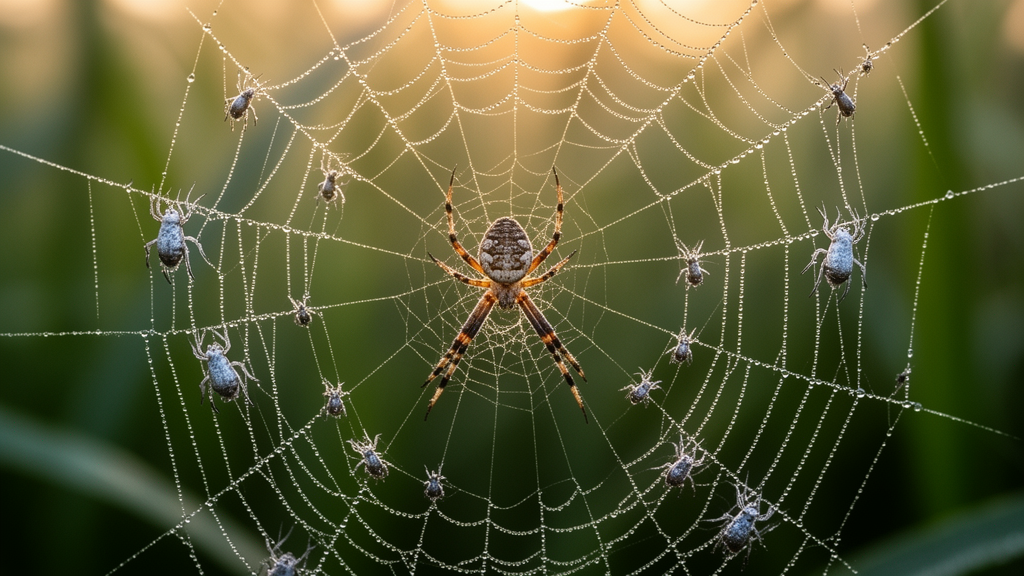
Kleptoparasitism, broadly defined, is the theft of extrinsic resources resulting in potential cost to the host. The stealing of resources, often food gathered by another, is perhaps best known in birds and mammals, but is even more common and widespread in arthropods like ants, bees, flies and spiders. Spiders are involved in myriad kleptoparasitic interactions, best studied as obligatory kleptoparasites of other spiders. However, less attention has been paid to the critical role of spiders as “superhosts” to commensal and kleptoparasitic organisms, and their variety of facultative kleptoparasitic strategies. To understand obligatory kleptoparasitism in spiders, it is first necessary to examine their role and characteristics as hosts and as facultative kleptoparasites. Most spider kleptoparasites utilize other spiders as hosts, a link that is not coincidental, and facultative resource stealing, in its many forms, is generally assumed to provide an evolutionary bridge to obligate kleptoparasitism. Here, I provide a brief review of these two roles through a summary of literature on all kleptoparasitic spiders and over 200 hosts. The phylogenetic distribution of spider hosts is distinctly non-random, involving about 200 species, in 86 genera, and 23 families. These then pertain to a few select lineages, out of total spider diversity: 23/136 families, 86/4,427 genera, and 200/52,765 known species. The vast majority of argyrodine hosts belong to four Araneoidea families (Araneidae, Nephilidae, Theridiidae, Linyphiidae), while the majority of hosts of mysmenid kleptoparasites are mygalomorphs, mostly Dipluridae and Ischnothelidae. Key spider hosts like Nephila, Trichonephila, Argiope, Cyrtophora, and Linothele, build large, often structurally complex, and persistent webs. Three-dimensionality, often in the form of auxiliary webbing, provides safe refuges for kleptoparasites, and the abundant prey and extended prey handling time of large spiders provide resources and opportunities for theft. Many of the favored hosts either interlink webs or are social. Key host traits to counter kleptoparasitism include web takedown and relocation, food concealment, and direct aggression. Facultative resource stealing in spiders includes web takeover, male kleptoparasitism of females in webs, and opportunistic prey theft. Among these, kleptotany, the facultative abandonment of own web and the invasion of a larger host web, to steal it and/or to prey on the host (araneophagy) are the most likely to link to obligatory kleptoparasitism.
The concentration of kleptoparasitic associations within a small subset of spider lineages raises questions about why certain spiders are disproportionately targeted while the vast majority of the roughly 52,765 described species are rarely or never exploited. One plausible explanation lies in the economics of web architecture. A web represents a substantial energetic investment, and spiders that construct large, three-dimensional structures with auxiliary silk layers effectively create a habitat that persists long after its original builder has finished hunting. Such webs offer microhabitats where smaller spiders can hide from predators, ambush stray prey, and intercept items already subdued by the host. In contrast, spiders that build small, ephemeral webs or hunt without webs present few opportunities for a thief to exploit, because there is little infrastructure to occupy and little time in which prey remains accessible.
Prey handling time is another critical variable. Large orb-weavers and sheet-web builders often subdue prey that requires minutes or hours to consume, during which the food item remains exposed within the web. This extended window gives kleptoparasites ample opportunity to approach, solicit, or steal. Smaller hosts that consume prey quickly, or that retreat to concealed retreats while feeding, deny thieves that window. The review’s observation that favored hosts such as Nephila, Trichonephila, Argiope, Cyrtophora, and Linothele share traits of large body size, complex webs, and long handling times is consistent with this economic logic: the host’s own adaptations for efficient prey capture inadvertently generate the very resources that attract exploiters.
The social and semi-social tendencies of many host species deserve particular attention. Colonial web builders, whose individual webs are interconnected by shared silk frameworks, effectively multiply the number of potential theft opportunities within a single site. A kleptoparasite moving through such a colony can exploit dozens of hosts without the dispersal costs that solitary living would impose. This aggregation effect may explain why social and colonial spiders appear repeatedly among documented hosts despite representing a small fraction of spider diversity. The same logic applies to the persistent, interconnected webs of some mygalomorph hosts exploited by mysmenid kleptoparasites, where the silk-lined burrows and sheet structures of Dipluridae and Ischnothelidae provide stable refuges across seasons rather than days.
The phylogenetic pattern also suggests a degree of coevolutionary specialization. Argyrodine kleptoparasites, concentrated on araneoid hosts, and mysmenid kleptoparasites, concentrated on mygalomorph hosts, each appear to have evolved morphological and behavioral adaptations matched to the web architecture and defensive capabilities of their particular host lineages. Such matching implies that the transition from facultative to obligate kleptoparasitism is not a random event but a process shaped by the availability of suitable hosts and the accumulation of traits that facilitate life within another spider’s web. The evolutionary bridge hypothesis, in which facultative stealing precedes obligate dependence, gains support from the observation that kleptotany, the abandonment of one’s own web to invade and appropriate a larger host web, combines elements of both free-living predation and parasitic dependence.
Host defenses add another dimension to these interactions. Web takedown and relocation, whereby a host dismantles and rebuilds its web elsewhere, impose costs on kleptoparasites by destroying the very resource they depend upon. Food concealment, such as wrapping prey and carrying it to a retreat before feeding, reduces the window of opportunity for theft. Direct aggression, including physical attacks on intruders, raises the potential cost of kleptoparasitism from lost meals to injury or death. The existence of these defenses suggests an ongoing arms race in which hosts evolve countermeasures and kleptoparasites evolve means of circumventing them, from stealthy movement patterns to chemical or tactile mimicry that allows thieves to approach without triggering attack.
Male kleptoparasitism of females within webs represents a particularly intriguing variant, because it occurs within a single species rather than between species. Males that steal prey from the webs of females may gain nutrition needed for mating effort while simultaneously reducing the risk of being cannibalized, since a female occupied with stolen food may be less likely to treat the male as prey. This behavior, documented in several lineages, illustrates how the same web infrastructure that enables interspecific theft can also facilitate intraspecific exploitation, and it may represent an additional pathway by which kleptoparasitic tendencies become entrenched in spider behavioral repertoires.
Web takeover, another facultative strategy, involves a spider displacing the original builder and appropriating the web itself. This behavior blurs the boundary between kleptoparasitism and predation, since the displaced owner may be eaten in the process. The combination of web theft and araneophagy in kleptotany suggests that the evolutionary pathway toward obligate kleptoparasitism may pass through stages in which the thief first exploits the web as a foraging platform, then increasingly relies on the host’s presence and resources, and eventually becomes dependent on hosts altogether. Understanding these intermediate stages is essential for reconstructing how obligate kleptoparasites, which cannot survive without their hosts, arose from ancestors that were capable of independent life.
The broader significance of spiders as superhosts extends beyond the spiders themselves. Because kleptoparasitic spiders occupy webs built by other species, they participate in food web dynamics that link the foraging success of large web builders to the survival of smaller associates. Changes in host abundance, whether from habitat loss, climate shifts, or other pressures, would propagate to their kleptoparasites, potentially making these dependent lineages especially sensitive indicators of ecological change. Similarly, the concentration of host associations within a few lineages means that declines in key host genera could eliminate the ecological foundation for entire communities of commensals and parasites. Recognizing spiders as hosts, and not merely as predators or parasites, therefore reframes their ecological role and highlights the importance of preserving the web-building lineages on which so many other organisms depend.
Future research directions suggested by this synthesis include quantitative comparisons of host traits across exploited and unexploited lineages, experimental tests of the evolutionary bridge hypothesis using species that exhibit facultative kleptoparasitism, and phylogenetic analyses that reconstruct the sequence of behavioral transitions leading to obligate dependence. Such work would clarify whether kleptotany and related facultative behaviors are truly intermediate states or alternative pathways, and would help identify which host characteristics most strongly predict susceptibility to exploitation. The review’s compilation of over 200 host species provides a foundation for these efforts, offering a dataset that spans the diversity of spider kleptoparasitic associations and inviting deeper investigation into one of the most distinctive forms of resource theft in the animal kingdom.
Subject of Research: Kleptoparasitism in spiders
Article Title: Spiders as superhosts and secondary kleptoparasites
Article References: Agnarsson, I. (2025). Spiders as superhosts and secondary kleptoparasites. Frontiers in Arachnid Science, 4, Article 1544428. https://doi.org/10.3389/frchs.2025.1544428
Image Credits: AI Generated
DOI: 10.3389/frchs.2025.1544428
Keywords: kleptoparasitism, spiders, superhosts, araneophagy, web-building, host-parasite interactions, Araneoidea, Theridiidae, Nephilidae, behavioral ecology, secondary, kleptoparasites
Cite Scienmag News
Gavin Prescott. (October 17, 2026). Spiders as superhosts and secondary kleptoparasites. Scienmag. https://scienmag.com/spiders-as-superhosts-and-secondary-kleptoparasites/
Gavin Prescott. "Spiders as superhosts and secondary kleptoparasites." Scienmag, 17 October 2026, https://scienmag.com/spiders-as-superhosts-and-secondary-kleptoparasites/. Accessed 17 October 2026.
Gavin Prescott. "Spiders as superhosts and secondary kleptoparasites." Scienmag. October 17, 2026. https://scienmag.com/spiders-as-superhosts-and-secondary-kleptoparasites/


