


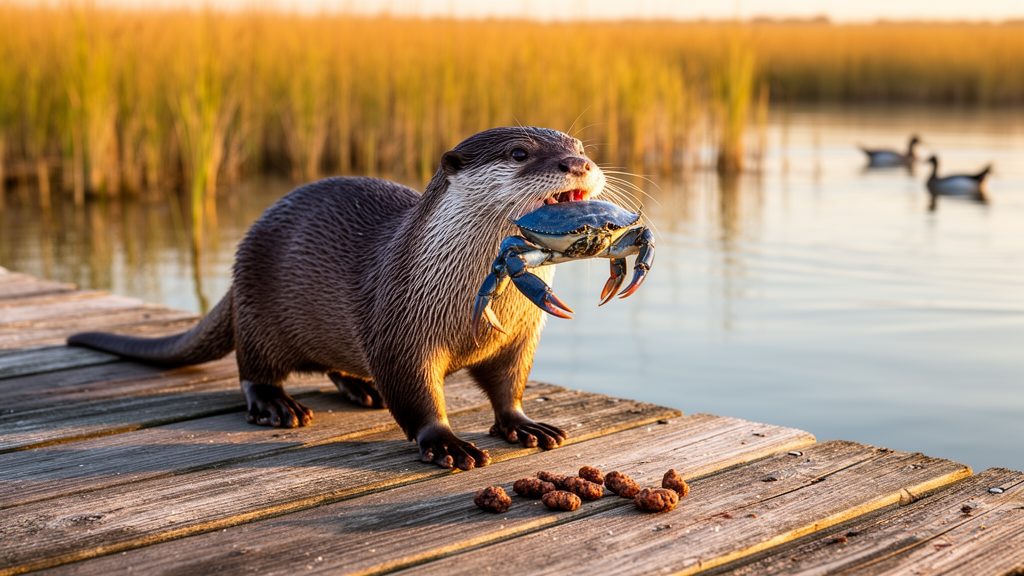
Along 12 kilometers of tidal shoreline at the Smithsonian Environmental Research Center in Maryland, researchers walked the same routes at least three times, sniffing for a telltale fishy odor and scanning the mud for tracks and scrapes. What they found was evidence of a predator that has quietly colonized the largest estuary in the United States: the North American river otter, an apex semi-aquatic mammal whose biology in the Chesapeake Bay had, until now, never been systematically studied. The new research, published in Frontiers in Mammal Science, is the first to characterize river otter latrines and diet in a tidally influenced subestuary of the Chesapeake Bay, and it reveals a generalist predator consuming everything from blue crabs to ducks, along with a surprising diversity of parasites riding along inside their prey.
River otters are notoriously elusive, largely nocturnal, and difficult to observe directly. But they congregate at specific sites known as latrines, which they use primarily for scent-marking through defecation, urination, and anal gland secretions, though they also eat, play, socialize, and rest there. These latrines are persistent landscape features that can remain active for decades, littered with scat and identifiable by their fishy smell, tracks, and signs of habitat manipulation. That makes them ideal for non-invasive monitoring. The research team surveyed three transects along the Rhode River, a low-salinity subestuary on a 1,072-hectare SERC property with 22 kilometers of shoreline, and identified 36 areas of otter activity between October 2020 and August 2021. Of those, 25 qualified as active latrines under strict criteria requiring at least two scats deposited over multiple visits and concentrated in a focal area. Eighteen latrines ultimately had measurable habitat characteristics and were included in statistical analysis.
The habitat findings were striking in their consistency with prior models from inland riverine systems. Active latrines were significantly more often characterized by permanent beaches, an open water interface, drop-offs, and undercut banks than randomized control points. Focal point clearings averaged about 19 square meters, roughly 4 meters long and 4.5 meters deep, and were significantly more likely to have soil-based sediment and woody debris. Overstory and understory vegetation heights were significantly lower at latrines than at control sites, suggesting otters concentrate their marking activity under low-hanging branches, possibly for protection from predators or to shield scat from degradation and extend the longevity of scent signals. Slope incline and burrows were seldom present. The researchers note that while marshes comprise much of the SERC shoreline, otters instead chose areas with woody debris and open water access, characteristics broadly associated with latrines across riverine, lacustrine, and coastal systems.
Perhaps the most unexpected habitat finding was the otters’ ready adoption of manmade structures. Five latrines were found on floating and fixed docks, elevated boardwalks, and a shoreline staircase. Dock and boardwalk latrines showed some of the highest otter activity in the study area and were used for scat collection, despite boat traffic and proximity to actively used walking trails. The researchers suggest that developed shorelines may be a significant component of river otter habitat in increasingly urban landscapes, a finding with implications as otter populations expand into degraded and urbanized estuaries across North America, including highly urbanized areas of the Chesapeake Bay where otters have been spotted in Baltimore’s Inner Harbor and even on the National Mall in Washington, D.C.
To examine diet, the team collected 90 scats and deployed a dual approach: microscopic examination of prey remains and DNA metabarcoding of dietary DNA. For the genetic analysis, they amplified a roughly 133-base-pair fragment of the mitochondrial cytochrome oxidase I gene for prey identification and a roughly 130-base-pair fragment of the V9 region of the 18S ribosomal gene for parasite detection. The COI gene was chosen because it has a curated local database from the Chesapeake Bay Barcode Initiative with high taxonomic coverage, providing the highest resolution for species-level assignments. Sequencing generated nearly 9 million raw reads for COI, which after filtering, merging, chimera removal, and exclusion of otter sequences and negative controls, yielded 27 potential primary prey taxa detected 333 times across all scats. On average, metabarcoding detected 3.7 prey items per scat, with 57 percent identified as finfish and 36.6 percent as crustaceans.
The diet results confirm that Chesapeake Bay otters are opportunistic generalists consuming both aquatic and terrestrial fauna. The most abundant crustacean by sequence number, and the prey item found in the greatest number of scats, was the American blue crab, a commercially important and widespread species in the Bay. Finfish prey included species in the Cyprinodontidae and Clupeidae as most frequently consumed, along with anadromous species such as striped bass, gizzard shad, and American eel. Otters also opportunistically consumed freshwater devil crayfish, amphibians, and ducks. Two non-native species already established in Maryland waters, common carp and white river crayfish, appeared in scats as well. Microscopic examination of 89 scats identified 199 individual prey items across 18 taxa, with ray-finned fish remains occurring in 92.1 percent of scats and crustaceans in 52.8 percent.
The comparison between methods revealed the technical power of metabarcoding. Of 20 orders detected, 45 percent were found with both methods, 35 percent only with metabarcoding, and 20 percent only with microscopy. Soft-bodied organisms such as polychaete worms, finely scaled fish like American eel, and scaleless fish including catfish and gobies were identified only genetically, since they leave no recognizable scales behind. Metabarcoding also detected pickerel, silversides, herring, frogs, and crabs more frequently than microscopy, while killifish and flatfish were identified more often microscopically. The researchers note that prior studies relying solely on microscopic methods may have underestimated the variability of summer diets, when otter diet diversity tends to peak. However, microscopy retains advantages: it can provide information on prey size and volume consumed, which genetics cannot, and it allowed the researchers to distinguish true prey items, such as cicadas likely consumed during the summer 2021 Brood X emergence, from decomposers that colonized scat after deposition. The authors conclude that a combined morphological and genetic approach is required for a holistic assessment of prey consumed.
Beyond prey, the 18S metabarcoding opened a window into the parasite community within the food web. The analysis yielded 591,412 sequences across 138 amplicon sequence variants from 10 parasitic taxa in six classes. Trematodes, parasitic flatworms requiring multiple hosts throughout their life cycles, were the most frequently detected and dominated relative abundance at 99.5 percent of parasite sequences, with 81.3 percent belonging to the order Plagiorchiida. Diplostomid trematodes typically use fish as second intermediate hosts before reaching birds or mammals as definitive hosts, while Plagiorchiid trematodes typically use arthropods as second intermediate hosts and fish as final hosts. The team also recovered monogeneans, including Gyrodactylidea, which commonly infect fish gills, and multiple myxozoan taxa, many of which parasitize fish. Most parasites identified do not infect mammals, meaning they most likely infected the otters’ prey and were consumed along with it, a phenomenon ecologists call concomitant predation.
Some parasites, however, likely infected the otters themselves. Nematodes in the order Strongylida, primarily known to infect terrestrial vertebrates and marine mammals, were detected, a finding supported by observations of large red nematodes visible in fresh scat. Multiple apicomplexans were also recovered, including parasites in the Sarcocystidae, which infect a wide range of mammalian species. As river otters increasingly reside in urban areas, they face greater exposure to zoonotic parasites such as Cryptosporidium and Giardia, making non-invasive parasite surveillance through scat a potentially valuable public health tool. The researchers caution that metabarcoding cannot determine parasite life stages and that the short amplified fragment limits taxonomic resolution, suggesting future studies combine genetics with traditional fecal flotation or sedimentation methods to identify parasite eggs.
This study marks a critical first step in expanding ecological research on river otters across the increasingly urbanized Chesapeake Bay watershed. The latrine characteristics identified here can be used to locate latrines from which non-invasive scat studies can examine otter ecology and health across land- and seascapes. Because otters are generalist predators, examining their diet across seasons and years would reveal how their food consumption shifts with seasonal migrations of prey, particularly anadromous species like striped bass and American eel. The researchers expect that teleost fish may become more important prey during fall and winter months, consistent with prior studies, and call for future work across additional subestuaries to provide broader regional representation of river otter ecology. As apex aquatic predators whose diet reflects the diversity of available prey and parasites within aquatic habitats, river otters may prove to be sentinels of ecosystem condition in one of America’s most studied and most pressured estuaries.
Subject of Research: Ecology
Article Title: North American river otters consume diverse prey and parasites in a subestuary of the Chesapeake Bay
Article References: Wise, C. M., Serfass, T. L., Palmer, E. M., Yisrael, L., Burton-Reeder, K., & Pagenkopp Lohan, K. M. (2025). North American river otters consume diverse prey and parasites in a subestuary of the Chesapeake Bay. Frontiers in Mammal Science, 4, Article 1620318. https://doi.org/10.3389/fmamm.2025.1620318
Image Credits: AI Generated
DOI: 10.3389/fmamm.2025.1620318
Keywords: river otter, Chesapeake Bay, metabarcoding, parasites, diet, latrines, apex predator, DNA barcoding, North, American, river, otters
Cite Scienmag News
Gavin Prescott. (October 17, 2026). River otters in the Chesapeake Bay eat everything from blue crabs to ducks, and their poop reveals a hidden parasite world. Scienmag. https://scienmag.com/river-otters-in-the-chesapeake-bay-eat-everything-from-blue-crabs-to-ducks-and-their-poop-reveals-a-hidden-parasite-world/
Gavin Prescott. "River otters in the Chesapeake Bay eat everything from blue crabs to ducks, and their poop reveals a hidden parasite world." Scienmag, 17 October 2026, https://scienmag.com/river-otters-in-the-chesapeake-bay-eat-everything-from-blue-crabs-to-ducks-and-their-poop-reveals-a-hidden-parasite-world/. Accessed 17 October 2026.
Gavin Prescott. "River otters in the Chesapeake Bay eat everything from blue crabs to ducks, and their poop reveals a hidden parasite world." Scienmag. October 17, 2026. https://scienmag.com/river-otters-in-the-chesapeake-bay-eat-everything-from-blue-crabs-to-ducks-and-their-poop-reveals-a-hidden-parasite-world/


