


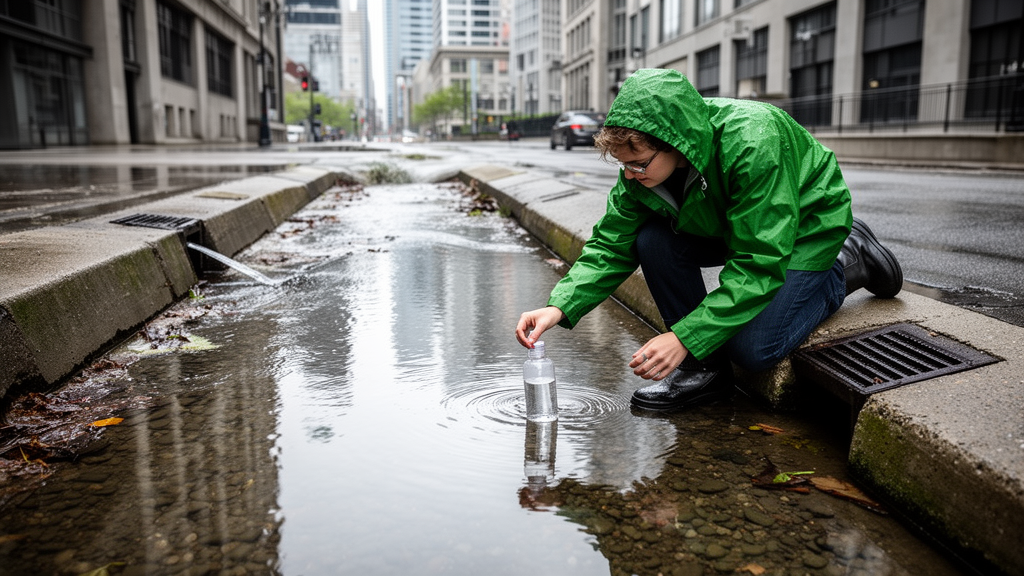
Beneath the streets of Columbus, Ohio, an invisible river flows. Every time rain falls on the campus of The Ohio State University, stormwater vanishes into a dense web of subterranean pipes, only to re-emerge minutes, hours, or days later through two outfalls that discharge directly into the Olentangy River. A team of geochemists from the university’s School of Earth Sciences and Byrd Polar and Climate Research Center spent twelve months tracking that hidden water, and what they found is a striking portrait of how cities chemically rewrite the rivers that drain them. Their study, published in Frontiers in Geochemistry, reveals that the water surging out of urban pipes carries dramatically elevated concentrations of nearly every major ion, quietly pushing the Olentangy toward a syndrome that is now salinizing fresh waters across North America and Europe.
The Olentangy River is an ideal natural laboratory for this kind of work because it performs a complete land-use transformation within a single watershed. Covering 1,370 square kilometers of central Ohio, the river begins in row-crop farmland to the north, passes through a 35-kilometer stretch designated a Scenic River for its undisturbed riparian buffer, and then plunges into metropolitan Columbus, the fourteenth-largest city in the United States with a population density of roughly 1,400 people per square kilometer. The researchers sampled the river and two outfalls on the university campus between November 2021 and November 2022, collecting water weekly or biweekly. The Big Outfall drains a broad network extending into Columbus’ combined sewer system, fed by campus runoff, sanitary sewer overflows, and combined sewer overflows. The Small Outfall, just thirty meters downstream, drains a smaller campus network centered on parking lots around Ohio Stadium, a parking garage, and academic buildings.
The analytical results were unambiguous. Chloride concentrations in the outfalls ranged from less than 150 to more than 3,400 micromolar, and in the Small Outfall, 69 percent of samples exceeded the Environmental Protection Agency’s chronic threshold for aquatic life of 6,488 micromolar. The outfall waters also carried elevated sodium, potassium, magnesium, calcium, sulfate, and dissolved silica compared with the river itself. Mean calcium concentrations in the two outfalls were around 2,238 and 2,294 micromolar, well above the river’s mean of 1,432 micromolar. Sulfate means were similarly elevated, at 1,220 and 1,475 micromolar in the outfalls versus 548 micromolar in the river, while dissolved silica averaged 148 and 134 micromolar in the outfalls against just 88 micromolar in the river. Interestingly, the pattern reversed for nutrients: the Olentangy typically carried greater nitrate and soluble reactive phosphorus concentrations than the outfalls, a fingerprint of the agricultural headwaters upstream.
To trace where all those ions were coming from, the team deployed a geochemical detective kit. Chloride-to-bromide ratios, which ranged from roughly 1,100 to 7,000 in the outfalls, pointed squarely at road salt, since halite formed by evaporation preferentially excludes bromide and carries a characteristically high ratio. Winter samples showed the greatest ratios, matching the deicing season. The Small Outfall’s chloride dominance persisted well beyond the typical November-to-March application window, evidence that salt stored in soils and shallow groundwater continues to leach for months. Previous research has shown road salt signatures in storm drain effluent up to seven months after the last application, and the Columbus data reinforce that persistence. Sodium-to-chloride ratios in the outfalls were enriched in chloride, consistent with sodium undergoing cation exchange with potassium, calcium, and magnesium on soils and sediments as chloride moves conservatively through the environment.
But road salt is only one ingredient in what urban geochemists have come to call chemical cocktails. The potassium story led the researchers to municipal water treatment. The mean potassium concentration in the Small Outfall, 123 micromolar, sat squarely within the range measured in Columbus’ three municipal water plants, where potassium is added as a water softener. Sodium carbonate is dosed to soften water naturally high in calcium and magnesium from limestone weathering, alum serves as a coagulant, and fluoride is added for dental health. Mean fluoride concentrations were greater in the outfalls than in the river, a telltale sign that treated municipal water leaks into the storm system. Notably, the Big Outfall and the urban river showed potassium patterns driven more by seasonal baseflow and by weathering of Devonian-age shale and carbonate bedrock than by sewage, since the three ions lacked the correlations that a sewage source would produce.
Perhaps the most surprising source was the infrastructure itself. Concrete pipes, through which nearly all this water flows, are actively dissolving. Concrete paste is composed of roughly 60 percent calcium silicate hydrates, 25 percent portlandite, and 15 percent ettringite, with gypsum frequently added to slow hydration. As urban water percolates through these networks, it weathers the pipe walls, releasing calcium, potassium, bicarbonate, sulfate, and silica into the dissolved load. The statistical fingerprints were compelling: in both outfalls, calcium showed robust, significant correlations with sulfate, dissolved silica, magnesium, and potassium, with coefficients reaching 0.97 between calcium and sulfate in the Small Outfall. Those same correlations were weak or absent in the Olentangy River, indicating that pipe weathering exerts its strongest control inside the subsurface system before the water reaches the river. The researchers argue that concrete drainage infrastructure should be viewed as an impervious surface in its own right, one that interacts chemically with every drop it conveys.
Stable water isotopes added a temporal dimension to the picture. The mean δ18O and δ2H values of the Olentangy River, Big Outfall, and Small Outfall were −6.66, −7.20, and −7.35 per mil, and −42.3, −46.5, and −47.4 per mil, respectively, closely matching the mean weighted annual precipitation composition of −7.40 and −48.2 per mil. Yet 74 percent of Big Outfall samples and 84 percent of Small Outfall samples fell outside instrument uncertainty when compared with the river, showing that the pipe water is more responsive to recent precipitation than the river itself. After a large, isotopically depleted storm on May 27, the outfalls displayed depleted signatures within hours, indicating rapid flushing of event water through the urban karst. During most of the study period, however, the consistent isotope values suggested that water in the subsurface network was well mixed, a blend of multiple precipitation events with residence times ranging from hours after major storms to days or weeks during dry periods.
All of these inputs converge on a single worrying outcome: freshwater salinization syndrome. The mean cation abundance in the urban corridor of the Olentangy shifted to calcium, sodium, magnesium, potassium, compared with calcium, magnesium, sodium, potassium in the upstream agricultural corridor, while chloride became overwhelmingly dominant among anions, averaging roughly 1,500 micromolar in the river versus 3,800 to 8,300 micromolar in the outfalls. Ternary diagrams plotting mean water compositions revealed a clear mixing line running from the agricultural river and precipitation toward urban highway runoff, with the urban Olentangy and both outfalls falling along it. This progressive enrichment in sodium and chloride, accompanied by rising calcium, magnesium, sulfate, and bicarbonate, mirrors patterns documented from Baltimore to Philadelphia and beyond, and it has consequences that reach all the way to the tap: chloride concentrations in Columbus drinking water have been observed to rise each January as road salt accumulates in the reservoirs supplying the city.
The agricultural headwaters, meanwhile, still control the river’s nutrient chemistry. Nitrate in the urban Olentangy climbed to roughly 400 micromolar in late spring and early summer, more than half of the EPA maximum contaminant level for nitrate-nitrogen in drinking water, as fertilizer applied to fields upstream was flushed into the river system. Outfall nitrate concentrations, averaging just 51 to 65 micromolar, were overwhelmed by this agricultural signal, though episodic spikes in the Small Outfall during April and August, alongside elevated soluble reactive phosphorus, hinted at campus fertilizer sources, animal waste, lawn runoff, and vehicle-related atmospheric deposition. The contrast with phosphorus is instructive: while nitrate stays dissolved, most phosphorus in urban stormwater adsorbs onto particles and iron oxyhydroxides, meaning different management strategies are needed to rein in nitrogen and phosphorus separately.
By 2050, the United Nations projects that 68 percent of the global population will live in cities, and within the United States that figure will reach 89 percent. Urban land, currently 3 percent of the American landscape, is expected to more than double by 2060. Every one of those expanding cities will build its own version of the urban karst, the fracture-like network of pipes, leaks, and conduits that turns shallow groundwater into a chemically engineered fluid. The Olentangy study demonstrates that rivers flowing from farm to city undergo a predictable geochemical evolution, their dissolved loads rewritten by road salt, water treatment chemicals, and dissolving concrete, while their nutrients remain hostage to decisions made upstream. Understanding that transformation, the authors argue, is essential for designing green infrastructure that can intercept these chemical cocktails before they reach the rivers that cities depend on for drinking water, recreation, and life itself.
Subject of Research: Geochemistry of urban waters and their evolution within the urban landscape
Article Title: Geochemistry of urban waters and their evolution within the urban landscape
Article References: Smith, D. F., Welch, S. A., Rankin, A., Carey, A. E., & Lyons, W. B. (2024). Geochemistry of urban waters and their evolution within the urban landscape. Frontiers in Geochemistry, 2, Article 1475109. https://doi.org/10.3389/fgeoc.2024.1475109
Image Credits: AI Generated
DOI: 10.3389/fgeoc.2024.1475109
Keywords: Geochemistry, urban, waters, evolution, within, landscape, scientific research
Cite Scienmag News
Gavin Prescott. (October 17, 2026). Geochemistry of urban waters and their evolution within the urban landscape. Scienmag. https://scienmag.com/geochemistry-of-urban-waters-and-their-evolution-within-the-urban-landscape/
Gavin Prescott. "Geochemistry of urban waters and their evolution within the urban landscape." Scienmag, 17 October 2026, https://scienmag.com/geochemistry-of-urban-waters-and-their-evolution-within-the-urban-landscape/. Accessed 17 October 2026.
Gavin Prescott. "Geochemistry of urban waters and their evolution within the urban landscape." Scienmag. October 17, 2026. https://scienmag.com/geochemistry-of-urban-waters-and-their-evolution-within-the-urban-landscape/


