


For women undergoing chemotherapy for breast cancer, hair loss is often ranked among the most distressing side effects of treatment, sometimes outweighing even the psychological burden of mastectomy. A new prospective clinical study from the University of Szeged in Hungary now offers one of the most detailed pictures yet of how well scalp cooling actually works in daily oncology practice, and the results carry a clear technical message: the cooling cap can preserve hair, but its success is strongly dictated by the chemotherapy regimen, with anthracycline-free protocols faring markedly better than anthracycline-based ones.
The research, published in Pathology and Oncology Research, evaluated the Orbis PAXMAN scalp cooling system in fifty women with early-stage breast cancer receiving neoadjuvant or adjuvant chemotherapy between June 2023 and March 2025. The mean age of participants was 52 years, ranging from 31 to 77, with 27 premenopausal and 23 postmenopausal patients. Forty-two women received anthracycline-containing regimens, while eight received anthracycline-free chemotherapy. The investigators assessed hair loss at the time each patient discontinued scalp cooling, using the CTCAE v5 scale, in which Grade 1 alopecia means less than 50 percent hair loss that is concealable without a wig, and Grade 2 alopecia means at least 50 percent hair loss that is readily noticeable and requires a hair replacement.
The overall success rate was 36 percent, with 18 of the 50 patients maintaining less than 50 percent hair loss by the end of chemotherapy. But the headline finding lay in the split between drug classes. Among patients receiving anthracycline-free regimens, the cooling cap combined with a 60-minute post-infusion cooling period achieved a promising success rate of 69 percent, whereas efficacy dropped to 37.5 percent in anthracycline-based protocols. Thirty-one patients, or 62 percent, discontinued scalp cooling before completing their planned therapy, most after only one or two cycles, because of Grade 2 hair loss; one additional patient withdrew because of intolerable scalp pain.
The biology behind scalp cooling is elegant in its simplicity. The technique, in use since the 1970s, exploits two principal mechanisms. First, local temperature reduction induces vasoconstriction, narrowing the blood vessels that deliver cytotoxic drugs to the scalp and thereby limiting the local concentration of chemotherapy reaching the hair follicles. Second, cooling suppresses follicular metabolism, rendering hair follicle cells less susceptible to the antimitotic and antimetabolic effects of systemic therapy. Additional mechanisms have been described, including cell cycle arrest in the G0/G1 phase, increased accumulation of the stress-protective heat shock protein HSP70, and attenuation of apoptosis, all of which contribute to follicular preservation during treatment.
The vulnerability of hair follicles to chemotherapy stems from the hair growth cycle itself. Approximately 85 to 90 percent of follicles are in the anagen, or active growth, phase at any given time, making them particularly susceptible to cytotoxic damage. Hair loss generally manifests within days to weeks after chemotherapy begins and may persist for one to three months after treatment completion. Regrown hair frequently differs in color or texture from baseline, and in certain cases alopecia can be permanent or only partially reversible, even years after therapy ends. Antimicrotubule agents such as paclitaxel, topoisomerase inhibitors including doxorubicin and epirubicin, and alkylating agents such as cyclophosphamide carry the highest alopecia rates, at 80 percent, 60 to 100 percent, and 60 percent respectively.
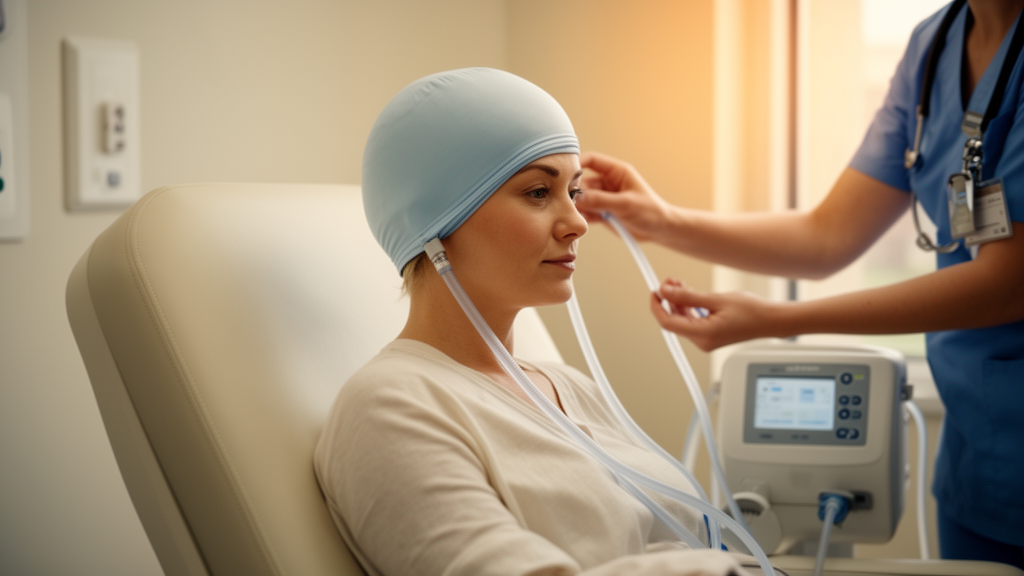
In the Szeged protocol, the Orbis PAXMAN device was pre-cooled to operating temperature with circulating fluid maintained at minus 4 degrees Celsius. Thirty minutes before chemotherapy, a suitably sized cap was fitted, and the circulating coolant reduced scalp temperature to 18 to 22 degrees Celsius, maintaining it throughout the infusion. Cooling was then continued for 60 minutes after chemotherapy, a post-infusion cooling time chosen to mitigate peak drug exposure. Notably, most trials reporting more favorable results with anthracycline-based regimens used longer post-infusion cooling of 90 to 120 minutes, and the authors acknowledge that the shorter 60-minute protocol may have contributed to the lower efficacy observed with anthracyclines in their cohort.
Treatment sequencing also emerged as a relevant factor. Prior evidence indicates that alopecia is markedly greater when anthracyclines precede taxanes compared with the reverse order, with hair loss rates of 69 percent versus 40 percent reported in a prospective study. The proposed biological explanation is that in taxane-first regimens, weekly administration and repeated cooling induce prolonged hypothermia, reducing follicular metabolism and thereby mitigating the subsequent cytotoxic effect of anthracyclines. In the Hungarian cohort, all patients receiving anthracyclines subsequently underwent taxane therapy with or without carboplatin, consistent with the pattern of poorer hair preservation when therapy begins with an anthracycline-based regimen.
Among the many patient characteristics examined, only one showed a significant association with alopecia severity: the presence of comorbidities. Twenty-one of 27 patients with systemic comorbidities developed Grade 2 alopecia, compared with 11 of 23 patients without comorbidities. When stratified, the proportion of Grade 2 hair loss was highest in the metabolic syndrome-related group, at 84.2 percent among patients with hypertension, diabetes, or dyslipidemia, compared with 62.5 percent in the other comorbidity group and 47.8 percent in patients without comorbidities. Notably, among the 19 patients with hypertension, 16 experienced Grade 2 alopecia while only 3 developed Grade 1 hair loss. The authors suggest that hypertension-related pathophysiological alterations, such as microvascular impairment and endothelial dysfunction, may adversely affect hair follicle integrity and reduce the likelihood of successful hair preservation during chemotherapy.
The connection between metabolic and cardiovascular disorders and androgenetic alopecia has been increasingly supported by the literature. Proposed mechanisms include hormonal effects, as androgens, particularly dihydrotestosterone, play a key role in the miniaturization of androgen-sensitive hair follicles. Through their effects on vascular smooth muscle cells, androgens may also induce vascular alterations leading to microcirculatory impairment and endothelial dysfunction, compromising blood flow to the follicles and reducing oxygen and nutrient supply. Inflammation-related mechanisms associated with metabolic syndrome may contribute as well, with perifollicular microinflammation and inflammatory mediators such as prostaglandin D2 and pro-inflammatory cytokines implicated in hair follicle dysfunction. Insulin resistance and hyperinsulinemia may further enhance local androgen production and increase the conversion of testosterone to dihydrotestosterone, thereby exacerbating hair loss.
On tolerability, the findings were reassuring. Most patients found the cooling system comfortable, with a mean scalp pain score of 2.17 and a mean cold sensation score of 3.9 on the visual analogue scale. Pain scores showed a declining trend over the course of treatment, decreasing from 2.54 at baseline to 1.77 by week 24, while cold sensation decreased from 4.50 to 3.69 over the same period. Cold sensation was reported by nearly all patients, with about half describing it as intense, but only one individual discontinued scalp cooling due to severe headache. Overall, 74 percent of participants described the device as comfortable, quite comfortable, or very comfortable, and no patient withdrew consent because of discomfort. The authors conclude that the Orbis PAXMAN system is an effective and well-tolerated method for preventing chemotherapy-induced alopecia, particularly in patients receiving anthracycline-free regimens, and call for further research, including randomized evaluations of 90- and 120-minute post-infusion cooling with anthracycline-based chemotherapy, to optimize patient selection and improve outcomes.
Subject of Research: Oncology
Article Title: Efficacy and tolerability of scalp cooling in preventing alopecia during (neo)adjuvant chemotherapy for breast cancer
Article References: Sántha, D., Dobi, Á., Iványi, M., Válóczi, D., Varga, Z., Oláh, J., & Nikolényi, A. (2026). Efficacy and tolerability of scalp cooling in preventing alopecia during (neo)adjuvant chemotherapy for breast cancer. Pathology & Oncology Research, 32, Article 1612403. https://doi.org/10.3389/pore.2026.1612403
Image Credits: AI Generated
DOI: 10.3389/pore.2026.1612403
Keywords: breast cancer, chemotherapy, alopecia, scalp cooling, anthracycline, taxane, hypertension, hair follicles, oncology, PAXMAN, Efficacy, tolerability
Cite Scienmag News
Nathaniel Bowman. (October 17, 2026). Scalp Cooling Caps Can Spare Hair During Breast Cancer Chemotherapy, But Success Depends on the Drug Regimen. Scienmag. https://scienmag.com/scalp-cooling-caps-can-spare-hair-during-breast-cancer-chemotherapy-but-success-depends-on-the-drug-regimen/
Nathaniel Bowman. "Scalp Cooling Caps Can Spare Hair During Breast Cancer Chemotherapy, But Success Depends on the Drug Regimen." Scienmag, 17 October 2026, https://scienmag.com/scalp-cooling-caps-can-spare-hair-during-breast-cancer-chemotherapy-but-success-depends-on-the-drug-regimen/. Accessed 17 October 2026.
Nathaniel Bowman. "Scalp Cooling Caps Can Spare Hair During Breast Cancer Chemotherapy, But Success Depends on the Drug Regimen." Scienmag. October 17, 2026. https://scienmag.com/scalp-cooling-caps-can-spare-hair-during-breast-cancer-chemotherapy-but-success-depends-on-the-drug-regimen/


