


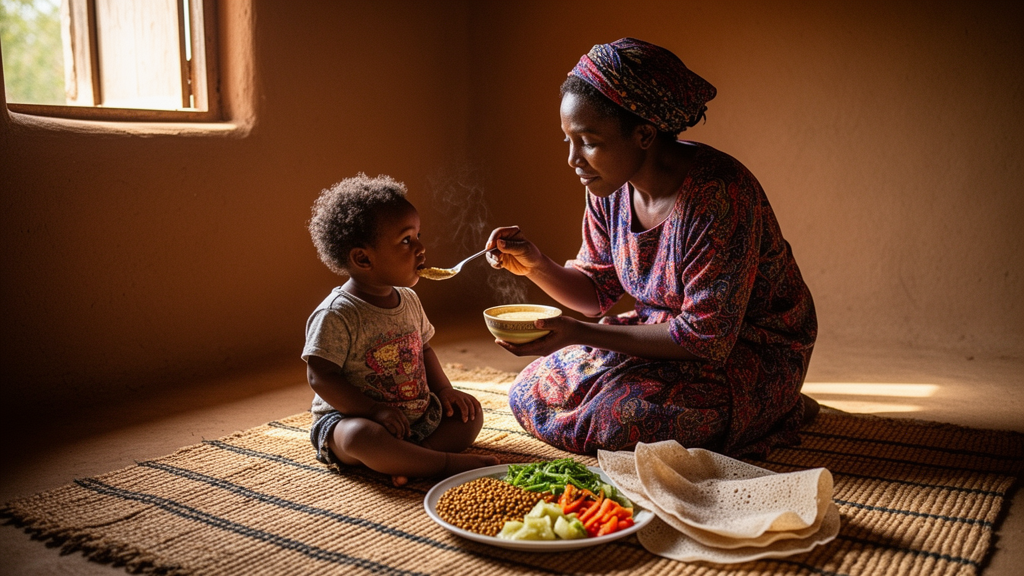
More than seven in ten young children in Ethiopia are not eating the variety of foods their growing bodies and brains require, according to a sweeping new systematic review and meta-analysis published in Food Science & Nutrition. The study, which pooled data from 13 community-based surveys covering 7,194 children aged 6 to 23 months, found that only about 27 percent of Ethiopian toddlers met the World Health Organization’s minimum dietary diversity standard — a benchmark that requires a child to have consumed foods from at least four of seven defined food groups in the previous 24 hours. The finding falls far short of the WHO’s target of 40 percent coverage by 2030, and it underscores how deeply entrenched feeding gaps remain during the most nutritionally vulnerable window of human development.
The minimum dietary diversity score, or MDD, is one of eight infant and young child feeding indicators developed by the WHO to provide simple, valid, and reliable metrics for evaluating feeding practices at the population level. Under the original 2008 definition, a child aged 6 to 23 months achieves MDD if he or she consumed foods from at least four of seven groups in the past day: grains, roots, and tubers; legumes and nuts; dairy products; flesh foods such as meat, fish, poultry, and organ meats; eggs; provitamin A-rich fruits and vegetables; and other fruits and vegetables. A revised 2021 definition adds breastmilk as an eighth group and raises the threshold to five of eight. Both versions serve as proxies for adequate intake of essential micronutrients, and the proportion of children meeting the criteria is a core process indicator in the WHO’s Global Nutrition Monitoring Framework.
Why does this single metric matter so much? The first 1,000 days of life — from conception through roughly a child’s second birthday — represent a period of extraordinary biological investment. During this window, the brain undergoes rapid synapse formation, linear growth accelerates, and the immune system calibrates itself against the environment. Malnutrition during this period is strongly linked to long-term adverse health outcomes, including stunted physical capacity, impaired cognitive development, and diminished social well-being. Low dietary diversity has been significantly associated with linear growth faltering and developmental delays, with consequences that can persist across generations. Globally, approximately 22.2 percent of children under five are stunted, 50.5 million suffer from wasting, and 16 million experience both conditions simultaneously, according to UNICEF estimates cited in the review.
The research team, led by Melkamu Senbeta Jimma of Jimma University and colleagues, followed the Preferred Reporting Items for Systematic Review and Meta-Analysis (PRISMA) guidelines and registered their protocol with PROSPERO. They searched six databases — PubMed, Embase, Web of Science Core Collection, HINARI, the Cochrane Library, and Google Scholar — with searches updated through April 25, 2026. From 997 initial records, the team screened out duplicates and irrelevant titles, ultimately including 13 peer-reviewed community-based cross-sectional studies published between 2018 and 2026. Sample sizes ranged from 335 to 807 children per study, with response rates between 96 and 100 percent. All included studies were assessed using the Newcastle-Ottawa Scale and found to be at low risk of bias.
The pooled prevalence of 27 percent, calculated using a random-effects model, masks enormous geographic variation. The highest reported prevalence — 47.6 percent — came from the Awi Zone in the Amhara region, while the lowest, just 12 percent, was recorded in Aleta Wondo Town in the Southern Nations, Nationalities, and People’s Region. Studies in Oromia reported prevalences ranging from roughly 17 to 26 percent, while a survey in Dire Dawa city found 24.4 percent and one in the agro-pastoral Afar region reported 21.8 percent. This regional spread reflects the complex interplay of local food systems, agricultural practices, market access, cultural feeding behaviors, and socioeconomic conditions that shape what actually ends up on a toddler’s plate.
Statistically, the meta-analysis revealed substantial heterogeneity across studies — an I² value of 97.58 percent, far exceeding the 75 percent threshold that typically signals meaningful inconsistency. Subgroup analyses by publication year, sample size, region, and WHO definition all failed to resolve this variation, suggesting that differences in population characteristics, cultural contexts, seasonal food availability, and local health and nutrition programs likely drove the spread. Only two of the 13 included studies applied the updated 2021 WHO definition, further complicating direct comparisons. The authors caution that the pooled estimate should be viewed as an average rather than a reflection of a consistent situation across settings. Notably, funnel plot symmetry and Egger’s test (p = 0.088) indicated no evidence of publication bias among the included studies.
Beyond the headline prevalence figure, the review synthesized which factors were most consistently associated with whether a child achieved adequate dietary diversity. Because the included studies varied too widely in variable categorization, outcome definitions, and effect measure reporting to permit a pooled meta-analysis of determinants, the team conducted a narrative synthesis. Child age emerged as the most frequently reported factor, identified as statistically significant in seven of the 13 studies — 53.8 percent of the total. Older children generally had better odds of consuming diverse diets, likely reflecting the gradual introduction of family foods as infants mature. Maternal education was the second most common factor, significant in six studies, with effect estimates suggesting that children of mothers with secondary or higher education had roughly two to three times the odds of achieving MDD compared with those whose mothers had no formal schooling.
Maternal healthcare utilization also emerged as a recurring theme. Antenatal care attendance was significantly associated with MDD in three studies, with adjusted odds ratios ranging from about 2.2 to 6.4. Postnatal care utilization showed similar patterns across three studies. Maternal knowledge of food diversification, household wealth index, and father’s occupation were each significant in three studies as well. Family size was reported as significant in two studies. These findings collectively point to a constellation of maternal empowerment, healthcare engagement, and socioeconomic resources that shape feeding decisions — factors that operate well beyond the kitchen and into the domains of education policy, health system design, and economic opportunity.
How does Ethiopia’s 27 percent compare with the rest of the world? The pooled figure is higher than several previous Ethiopian meta-analyses, which reported 26, 23.25, and 22 percent, and substantially higher than older national survey estimates that ranged from 4 to 12.5 percent. It also exceeds findings from sub-Saharan Africa-wide analyses using Demographic and Health Survey data, which reported 23.2 and 11 percent, and from East African multilevel analyses reporting 10.47 percent. Individual country estimates tell a similar story: Burkina Faso reported just 5.6 percent, Liberia and Burundi fell below 20 percent, and Uganda and South Africa recorded 15.2 and 14.4 percent respectively. Yet Ethiopia’s figure remains lower than Rwanda’s 34.4 percent, Ghana’s 47.7 percent, Nepal’s 30.4 percent, Zambia’s 37 percent, Bangladesh’s 48.4 percent, Indonesia’s 63.15 percent, Vietnam’s 83.2 percent, and Sri Lanka’s 71 percent. These cross-country differences reflect variations in food systems, cultural practices, nutrition education, religious and dietary customs, climate change impacts on agricultural productivity, and the strength of national infant and young child feeding programs.
The authors argue that addressing Ethiopia’s persistently low dietary diversity will require a multisectoral approach rather than isolated interventions. Proposed strategies include improving complementary feeding practices and nutrition counseling, strengthening nutrition education, implementing nutrition-sensitive agricultural interventions, expanding social protection and food access programs, promoting backyard gardening and cooking demonstrations, improving irrigation and market access, and leveraging mass media to disseminate infant feeding information. Strengthening maternal education and improving maternal healthcare utilization may contribute to improvements in child dietary diversity. Given that more than two-thirds of malnutrition-related child deaths are attributed to inappropriate feeding practices during the first two years of life, the stakes could hardly be higher. The findings are intended to inform national policy, improve child nutrition practices, and support progress toward Sustainable Development Goal 2.2, which aims to end all forms of malnutrition by 2030.
Subject of Research: Child Nutrition
Article Title: Minimum Dietary Diversity and Associated Factors Among 6–23 Months Children in Ethiopia: A Systematic Review and Meta‐Analysis
Article References: Jimma, M. S., Assefa, D. G., Zelka, M. A., Amaya, A. A., Begawo, M. B., Chanie, E. S., Gebreeyesus, F. A., & Lim, D. (2026). Minimum Dietary Diversity and Associated Factors Among 6–23 Months Children in Ethiopia: A Systematic Review and Meta‐Analysis. Food Science & Nutrition, 14(10), Article e72481. https://doi.org/10.1002/fsn3.72481
Image Credits: AI Generated
DOI: 10.1002/fsn3.72481
Keywords: minimum dietary diversity, Ethiopia, child nutrition, complementary feeding, WHO, meta-analysis, stunting, maternal education, infant feeding, public health, Minimum, Dietary
Cite Scienmag News
Daisy Hatcher. (October 17, 2026). Only 27% of Ethiopian Toddlers Get a Minimally Diverse Diet, Major Meta-Analysis Finds. Scienmag. https://scienmag.com/only-27-of-ethiopian-toddlers-get-a-minimally-diverse-diet-major-meta-analysis-finds/
Daisy Hatcher. "Only 27% of Ethiopian Toddlers Get a Minimally Diverse Diet, Major Meta-Analysis Finds." Scienmag, 17 October 2026, https://scienmag.com/only-27-of-ethiopian-toddlers-get-a-minimally-diverse-diet-major-meta-analysis-finds/. Accessed 17 October 2026.
Daisy Hatcher. "Only 27% of Ethiopian Toddlers Get a Minimally Diverse Diet, Major Meta-Analysis Finds." Scienmag. October 17, 2026. https://scienmag.com/only-27-of-ethiopian-toddlers-get-a-minimally-diverse-diet-major-meta-analysis-finds/


