


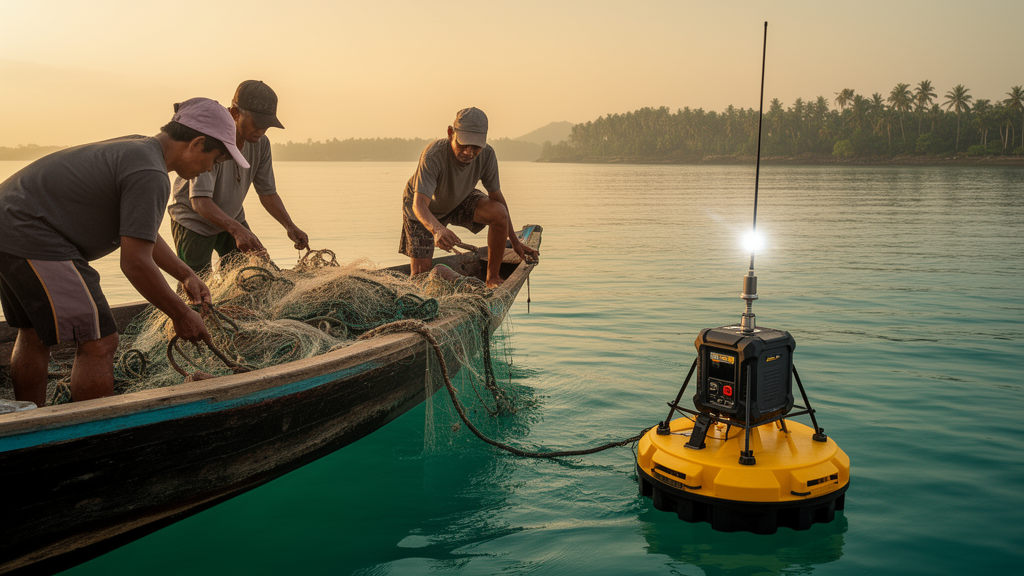
Off the coast of Belawan, a bustling port city on the Indonesian island of Sumatra, the sea has turned against the people who depend on it. Shallow coastal waters, rarely deeper than seven meters, are turbid and polluted, and the fish that once sustained local communities have grown scarce. To find anything worth catching, fishermen now push their boats up to ten kilometers offshore, where clearer waters hold richer resources. That journey comes at a punishing price: an eight-person boat burns between ten and twenty liters of diesel for a single round trip, translating to roughly IDR 68,000 to IDR 136,000 in fuel alone at IDR 6,800 per liter, before food and supplies are even counted. Many fishermen have simply given up, trading their boats for other professions. A new study published in Frontiers in the Internet of Things argues that a network of connected underwater sensors could change that calculus, cutting fuel costs and putting actionable fish-location data directly into the hands of small-scale fishermen.
The research, led by Suherman of Universitas Sumatera Utara in Medan, Indonesia, together with Marwan Al-Akaidi of Wigwe University in Nigeria, introduces the fish sensor network, or FSN, a wireless sensor network application designed to detect fish underwater and share their locations efficiently across a fishing community. The concept builds on the fish aggregating device, or FAD, a structure that fishermen have long used to attract fish. FADs range from permanent installations such as old tires marked with floating buoys and foliage to simpler variations relying only on GPS coordinates. The FSN proposal takes these structures a step further by equipping them with network-connected fish sensors, transforming passive fish houses into active data beacons that can tell fishermen where fish populations are high before a single liter of fuel is spent.
The socioeconomic stakes are considerable. Approximately ninety percent of the Indonesian population engaged in fishing livelihoods grapples with widespread poverty, largely attributed to the unpredictable nature of their occupation. In Belawan, the challenge is compounded by shallow coastal contours spanning depths of two to seven meters and extending up to seven kilometers offshore, alongside government regulations governing port traffic that restrict access to nearby deeper waters. Fish populations have declined significantly, with some species dropping by up to thirty-three percent and others showing a three percent decrease from normal levels, driven in part by indiscriminate practices such as trawling. Over the past decade, the number of active fishermen has fallen by a staggering twenty-five percent, with many falling below the poverty line. The FSN researchers argue that modernizing fishing methods could uplift marginalized traditional fishermen while potentially bolstering catch volumes and raising awareness of sustainable maritime resource management.
The technical foundation of the FSN draws on the fish finder, a device that operates within a frequency range of fifteen kilohertz to four hundred fifty-five kilohertz. These devices emit low-frequency sound impulses directed toward the seabed, and the returning echoes are visualized in various forms, including object size, composition, symbols, and seabed depth. The accuracy and reliability of fish detection hinge on a comprehensive understanding of the echo signal’s components, encompassing frequency shift, bandwidth, amplitude, emission, and processing speed. Fish finders equipped with GPS have emerged as a game-changer in the fishing industry, with research indicating potential fuel cost savings of up to sixteen point six seven percent and a substantial increase in annual income amounting to IDR 160,536,000. Yet the technology remains prohibitively expensive for many fishermen, and its standalone nature hampers seamless information sharing among fishing communities.
What distinguishes the FSN from prior work is its networked architecture. The system comprises an array of fish sensors strategically dispersed across fishing domains, positioned to surveil both fish targets and the seabed surface. These sensors capture acoustic signals, subject them to rigorous analysis, and render them into actionable visualizations. Under optimal conditions, sensors can be deployed both above and below the sea surface. Each node is equipped with GPS modules, communication links, energy harvesters such as solar cells and wind turbines, energy storage solutions such as robust batteries, radio transceivers, and antennas, all engineered to withstand the corrosive properties of marine environments, strong currents, and maritime traffic. The network architecture encompasses various operational modes, including centralized configurations where radio signal transmitters such as WiFi, WiMAX, or cellular networks serve as conduits bridging sensors with centralized servers that act as repositories and distributors of data to the wider community.
In scenarios where the FSN operates in a multihop mode, sensors are endowed with functionalities to collect, forward, route, and transmit data, enabling seamless relay of information from disparate sensors to a designated sink node. While prior research predominantly focused on deep-water deployments and estuarine environments leaned heavily on bathymetric data, the FSN proposal blazes a trail by seamlessly integrating fish finders into a cohesive network, extending tangible benefits to fishermen at large. Given the efficacy of fish aggregating devices and artificial lights in enhancing fish capture, future sensor node designs may amalgamate elements from both components, further augmenting the efficacy and versatility of the network.
Yet the path from concept to deployment is littered with natural obstacles. Belawan port, which serves as a vital link between Sumatra and Malacca through a twelve-kilometer sailing line with a width of one hundred meters, is subject to the dynamic interplay of two influential rivers, the Belawan and Deli rivers. During the wet season, current velocities fluctuate within a range of zero point zero four three six seven to zero point four six zero eight meters per second, whereas in the dry season these speeds approximately halve to values ranging from zero point zero two two nine to zero point two seven four four meters per second. The inherent instability of wave currents presents a significant challenge for sensor installation and maintenance, and without robust anchoring mechanisms, sensor displacement becomes a distinct possibility, compromising data integrity and operational efficacy.
Corrosion poses an equally formidable threat. Prevailing wind patterns originating from the northwest of Medan and flowing toward the north exhibit velocities ranging from three to fifteen knots, while tidal levels oscillate within a range of zero point five to zero point eight meters, accompanied by ambient temperatures peaking between twenty-four and thirty-two point two degrees Celsius. Atmospheric humidity hovers between sixty-eight and ninety-one percent, fostering conditions conducive to the proliferation of humid and moisture-laden air masses. This meteorological milieu engenders a corrosive environment, particularly pronounced in beach areas surrounding the port and within the port itself, which sprawls across an expanse of one hundred twenty-seven thousand five hundred eighteen square meters. Corrosive rates range from zero point one one four to one point three seven zero millimeters per year, exhibiting notable spatial variability. To mitigate these effects, the researchers advocate integrating predictive models such as the ASTM G-1 and ASTM G-50 standards into sensor development, offering invaluable insights into the anticipated lifespan of installed materials.
Radio propagation over the sea introduces its own set of engineering headaches. The saline-laden air prevalent in maritime environments exerts a pronounced attenuation effect on radio signals, precipitating rapid signal degradation. Furthermore, the water surface serves as a potent medium for the reflection and diffraction of radio signals, exacerbating losses and impairing transmission reliability. During the rainy season, precipitation acts as a potent impediment to signal propagation, worsening attenuation. The researchers emphasize that meticulous consideration must be afforded to the radio link budget for FSN deployments, with a keen awareness of the variable atmospheric conditions prevailing throughout the operational environment.
Man-made obstacles compound the natural ones. Over the first six months of 2020, a staggering total of four hundred thirty-five sizable vessels traversed Belawan port, accompanied by a cargo payload comprising five hundred thirty-one thousand five hundred fifty-one TEUs of containers, marking a notable five percent increase from the previous year’s record. The average international traffic density soared to fifty-four point nine two Box per Ship per Hour, while the domestic terminal recorded a throughput rate of forty-seven point six six B/S/H, and these figures do not account for the hundreds of fishing vessels plying the port waters. Such prodigious maritime traffic poses a formidable challenge in identifying safe and strategically viable positions for sensor deployment. Physical security adds another layer of complexity: statistics from the Indonesia Statistics Body reveal that theft accounts for forty-four to fifty-six percent of total reported criminal incidents, and given the remote locales often inhabited by sensors, the specter of theft looms ominously. The researchers suggest rendering sensors inconspicuous through meticulous camouflage techniques, adopting smaller and more discreet installations, and deploying underwater configurations to circumvent these challenges.
Energy availability rounds out the case study. The energy demand for sustaining FSN operations remains relatively modest, typically ranging from one to five watts to power both the fish sensors and ancillary radio links. Yet the perennial challenge lies in the finite energy reservoirs afforded by conventional battery power sources, and while solar cells, wind turbines, and ocean turbines emerge as viable alternatives, their susceptibility to theft poses a significant impediment to widespread adoption. Innovative energy harvesting solutions such as pendulum-based generators offer promising avenues for augmenting energy autonomy, though existing systems suffer from cumbersome size, exorbitant installation costs, and vulnerability to theft. The integration of compact generators concealed within the confines of FAD boxes mitigates visibility concerns, albeit with potential trade-offs in energy output efficiency, while wave motion-based generators present an intriguing proposition despite the comparatively slower rotation induced by wave motion as opposed to wave impact or wind gusts.
The preliminary findings from Belawan sketch a vision of fishing transformed by data. By providing real-time insights into fish locations, the fish sensor network has the potential to revolutionize fishing practices, empowering fishermen with actionable data to optimize their catch efficiency and economic returns. The researchers acknowledge that the road ahead requires serious attention to robust anchoring mechanisms to avoid sensor displacement, careful material considerations to withstand the corrosive influence of salt-laden water, sufficient signal budgets to account for sea surface losses, and adaptive strategies to navigate bustling maritime traffic. Yet if these challenges can be met, the FSN could offer a lifeline to a community on the brink, proving that sometimes the most powerful fishing tool is not a bigger boat but a smarter network.
Subject of Research: Fish sensor network: WSN application for fishermen
Article Title: Fish sensor network: WSN application for fishermen
Article References: Suherman, & Al-Akaidi, M. (2024). Fish sensor network: WSN application for fishermen. Frontiers in the Internet of Things, 3, Article 1428157. https://doi.org/10.3389/friot.2024.1428157
Image Credits: AI Generated
DOI: 10.3389/friot.2024.1428157
Keywords: Fish, sensor, network, application, fishermen, scientific research
Cite Scienmag News
Josephine Dean. (October 17, 2026). Wireless Sensor Network Promises Cheaper, Smarter Fishing for Indonesian Fishermen. Scienmag. https://scienmag.com/wireless-sensor-network-promises-cheaper-smarter-fishing-for-indonesian-fishermen/
Josephine Dean. "Wireless Sensor Network Promises Cheaper, Smarter Fishing for Indonesian Fishermen." Scienmag, 17 October 2026, https://scienmag.com/wireless-sensor-network-promises-cheaper-smarter-fishing-for-indonesian-fishermen/. Accessed 17 October 2026.
Josephine Dean. "Wireless Sensor Network Promises Cheaper, Smarter Fishing for Indonesian Fishermen." Scienmag. October 17, 2026. https://scienmag.com/wireless-sensor-network-promises-cheaper-smarter-fishing-for-indonesian-fishermen/


