


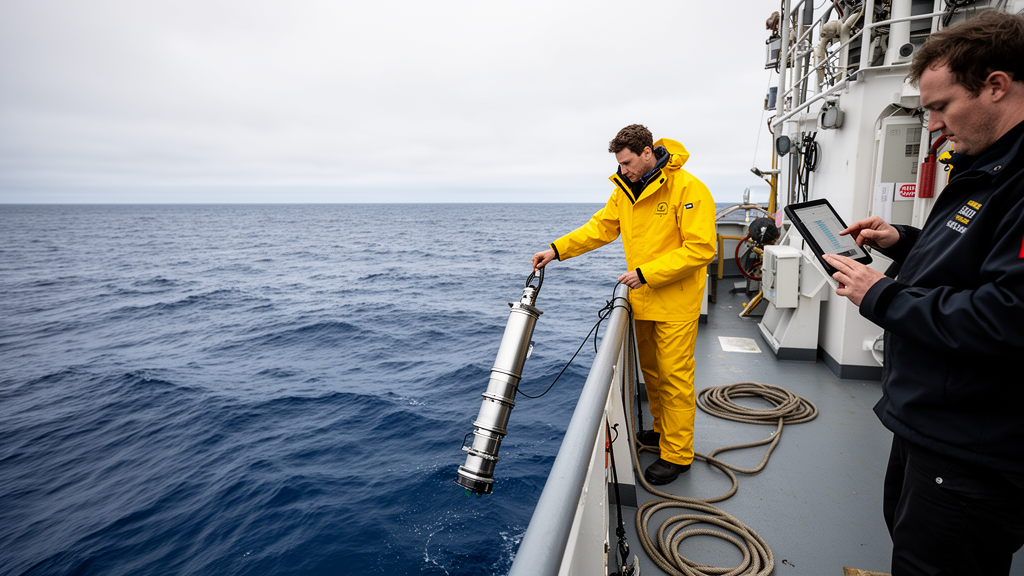
The ocean already quietly does much of humanity’s climate heavy lifting. As Earth’s largest actively cycling carbon reservoir, it holds roughly 44 times more carbon than the atmosphere and draws down about 2.9 petagrams of carbon every year, exchanging it on timescales relevant to human societies. A growing field of marine carbon dioxide removal, or mCDR, aims to amplify that natural service deliberately, and a new collection of eleven studies published in Frontiers in Environmental Engineering offers one of the most detailed engineering assessments yet of what works, what remains uncertain, and what could go wrong before these technologies scale.
The research topic, assembled by editors Michael B. Fong of the National Institute of Standards and Technology, Maribel I. García-Ibáñez of the Spanish Institute of Oceanography, and Xinyu Li of the University of Washington, spans the full portfolio of ocean-based approaches. Biotic strategies enhance biological carbon fixation and export through nutrient fertilization, artificial upwelling, macroalgae aquaculture, and ecosystem restoration. Geochemical methods manipulate seawater chemistry directly, most prominently through ocean alkalinity enhancement, which raises the ocean’s capacity to absorb atmospheric CO2, and direct ocean carbon capture and storage, which strips dissolved inorganic carbon from seawater. Physical approaches such as artificial downwelling accelerate the sinking of carbon-rich water into the deep ocean.
What makes mCDR attractive beyond carbon accounting is its potential for co-benefits: enhanced fisheries and aquaculture, valuable biomass products, reuse of desalination byproducts, and even feedstocks for fuels and industrial chemicals. Yet the editors and contributing authors are blunt about the state of the field. Most methods remain at an early stage of development, with substantial gaps in carbon removal durability, additionality—the question of whether a project removes carbon beyond what nature would have absorbed anyway—monitoring, reporting, and verification, scalability, environmental impacts, and governance.
Four perspective articles frame the road ahead. Buesseler and colleagues, writing for the Exploring Ocean Iron Solutions group, lay out a coordinated five-year research roadmap to determine whether ocean iron fertilization can be safe, effective, and durable. Their framework centers on the concept of the centennial tonne: carbon that must remain isolated from the atmosphere for at least 100 years before it can count. They call for larger and longer field experiments, improved biogeochemical modeling, robust environmental monitoring and verification, and early engagement with coastal communities and regulators.
Hooper and colleagues examine the ecosystem risks of direct ocean carbon capture, synthesizing evidence from ocean acidification research, alkalinity enhancement studies, and natural analogues. Their conclusion is sobering: empirical knowledge about how marine organisms respond to the low-dissolved-inorganic-carbon, high-pH effluents that such facilities would discharge remains thin, and large-scale deployment is premature without a dedicated environmental impact evidence base. Martocello and colleagues assess macroalgae-based removal and find that high monitoring costs and the absence of validated regional circulation models are the key barriers to scalability and certification. They propose leveraging remote sensing and artificial intelligence for cost-effective monitoring while urging greater public investment in long-term field studies.
Ward and colleagues, in a separate perspective, tackle a foundational weakness: the ocean biogeochemical models that would underpin verification are inadequate for the task. Existing models struggle to resolve fine-scale processes and to represent the mechanisms that determine how long removed carbon stays out of the atmosphere. Their roadmap calls for refined parameterizations, modular technology-specific model components, and systematic testing across diverse ocean settings.
The original research contributions show how laboratory and field experiments are filling those gaps. Shaw and colleagues compared industrial magnesium hydroxide with material precipitated from seawater-derived brines for alkalinity enhancement, demonstrating that lower-crystallinity materials derived from seawater dissolve more rapidly and completely. The finding suggests that alkalinity enhancement performance can be tuned through material synthesis pathways, an engineering lever with real consequences for how much CO2 a given dose of alkalinity ultimately absorbs. Fucich and colleagues probed the role of microbial biology in hydroxide-based alkalinity enhancement using sterilized and unsterilized mesocosms. Biological activity accelerated the equilibration of CO2 in seawater but did not significantly change total carbon uptake, supporting the use of mesocosm experiments to set field-scale expectations and design verification strategies.
Monitoring emerged as perhaps the thorniest engineering challenge. Stewart and colleagues evaluated commercially available pH and carbon dioxide sensors for alkalinity enhancement verification and found that uncertainty in pH measurements dominates the uncertainty in estimated total alkalinity. Even dense sensor networks may underestimate surface pH changes because alkalinity plumes dilute rapidly after discharge. Savoie and colleagues confirmed the problem in the field: in a proof-of-concept trial of electrochemically generated alkalinity released through a coastal outfall, strong tidal mixing diluted the signal so quickly that near-field plume modeling was needed to guide sensor placement and interpret the observations. Ho and colleagues added a hydrodynamic twist, using a high-resolution regional ocean model of the San Francisco Bay Estuary to show that estuarine circulation can enhance atmospheric CO2 uptake by exporting alkalinity to the open ocean and enlarging the effective air-sea exchange area, making local currents a decisive factor in site selection.
Environmental risk and economics rounded out the collection. Ringham and colleagues, working with indigenous stakeholders from the Lower Elwha Klallam Tribe, exposed juvenile coho salmon to pulse conditions of electrochemically generated alkalinity representative of near-field mixing zones and observed no detectable adverse effects, a demonstration of how stakeholder-engaged laboratory science can inform risk assessment. Ward and colleagues performed a techno-economic analysis of a hypothetical large-scale ocean iron fertilization deployment, estimating levelized costs of carbon removal while finding large uncertainty driven primarily by poorly characterized oceanographic variables and the infrastructure demands of verification, such as research vessels. Their conclusion reframes uncertainty reduction itself as an engineering optimization: better science is a prerequisite for cost-effective monitoring.
Taken together, the eleven contributions chart both the promise and the distance remaining before marine carbon dioxide removal can be deployed responsibly. The editors emphasize that future progress will require improved modeling capabilities, tightly integrated observational and modeling frameworks for verification, rigorous ecological impact assessment, demonstrated economic feasibility, and transparent governance with genuine stakeholder engagement. The ocean’s carbon pump is powerful, but teaching humanity to steer it safely, measurably, and durably remains one of the defining engineering challenges of the coming decades.
Subject of Research: Marine carbon dioxide removal technologies including ocean alkalinity enhancement, direct ocean capture, iron fertilization, and macroalgae cultivation
Article Title: Editorial: Environmental engineering perspectives on ocean-based carbon dioxide removal
Article References: Fong, M. B., García-Ibáñez, M. I., & Li, X. (2026). Editorial: Environmental engineering perspectives on ocean-based carbon dioxide removal. Frontiers in Environmental Engineering, 5, Article 1908453. https://doi.org/10.3389/fenve.2026.1908453
Image Credits: AI Generated
DOI: 10.3389/fenve.2026.1908453
Keywords: marine carbon dioxide removal, ocean alkalinity enhancement, direct ocean carbon capture, ocean iron fertilization, macroalgae cultivation, monitoring reporting and verification, carbon storage durability, ocean biogeochemical modeling, environmental impact assessment, techno-economic analysis, coho salmon, San Francisco Bay Estuary
Cite Scienmag News
Denise Maddox. (October 17, 2026). Engineering the Ocean’s Carbon Pump: New Research Maps the Path to Marine CO2 Removal. Scienmag. https://scienmag.com/engineering-the-oceans-carbon-pump-new-research-maps-the-path-to-marine-co2-removal/
Denise Maddox. "Engineering the Ocean’s Carbon Pump: New Research Maps the Path to Marine CO2 Removal." Scienmag, 17 October 2026, https://scienmag.com/engineering-the-oceans-carbon-pump-new-research-maps-the-path-to-marine-co2-removal/. Accessed 17 October 2026.
Denise Maddox. "Engineering the Ocean’s Carbon Pump: New Research Maps the Path to Marine CO2 Removal." Scienmag. October 17, 2026. https://scienmag.com/engineering-the-oceans-carbon-pump-new-research-maps-the-path-to-marine-co2-removal/


